The War in the Air: Summer 1940
"It is certainly an awful sight to behold those ugly black bombers in rank after rank. Your mouth dries up like cotton wool. You lose all sense of space and time. We fought far above the clouds in a world of our own – a world of freezing cold, of limitless space traced with white plumed trails of wheeling aircraft as they fought. It was like skywriting gone mad. "
Ernest McNab, Squadron Leader, No. 1 Fighter Squadron, RCAF
Quoted from Canada: a people’s history
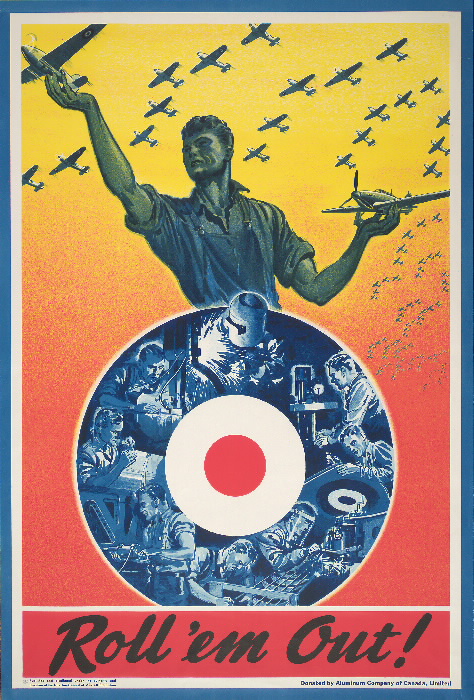
Toronto Reference Library
One of the great battles of the Second World War commenced seventy five years ago this summer. The evacuation of British, French and Belgium forces from Dunkirk in late May and early June, and the surrender of France on June 22, left most of Europe in the control of German forces. Hitler set his sights on bombing Britain into submission, as a prelude to full invasion, or complete surrender.
Thus on July 10, 1940, commenced the Battle of Britain, the first major military battle in history to be fought entirely in the air.
For ten weeks, the Luftwaffe and the Royal Air Force fought in the skies over Britain. While both air forces had roughly equivalent technical equipment, the number of German planes outnumbered Britain almost two to one. Britain was fighting over home territory, with ground support, while Germany’s operations were long range, unlike their previous air campaigns on the continent. And though both nations had Radar, it was Britain that used it to the greatest effect. Eventually, the advantage turned towards Britain.


By mid-September, Hitler called off the offensive, and postponed the invasion of Britain indefinitely. This did not end the bombing, but the strategy changed, and so began the Blitz—the indiscriminate bombing of British cities at night. Still, the German objective of destroying British air power to allow an invasion from the sea was foiled. It was the first serious check on German power since the war began.
Many Canadian pilots flew with the RAF, and it was during the Battle of Britain that No. 1 Fighter Squadron, RCAF, became the first Royal Canadian Air Force group to engage German planes. At battle’s end, the two Canadian squadrons (out of more than 70 British and allied squads) had destroyed an estimated sixty German planes, with another fifty listed as probably destroyed.


Toronto Public Library carries many accounts of the Battle of Britain. Here's a short recommended list:
Books
The Battle of Britain: five months that changed history, May-October 1940
by James Holland Also in eBook
Battle of Britain Pilot: self-portrait of an RAF fighter pilot and escaper by George Barclay
Dowding of Fighter Command by Vincent Orange
Last of the Few: the Battle of Britain in the words of the pilots that won it by Max Arthur
The Many Not the Few: the stolen history of the Battle of Britain by Richard North Also in eBook
The Most Dangerous Enemy: a history of the Battle of Britain by Stephen Bungay
A Question of Honor: the Kosciuscko Squadron: forgotten heroes of World War II by Lynn Olson
RCAF, the war years, WW II: Airt Forces reunion commemorating 40th anniversary, Battle of Britain by Don Henderson
Splendid hundred: the true story of Canadians who flew in the greatest air battle of World War II by Arthur Bishop
A Summer Bright and Terrible: Winston Churchill, Lord Dowding, Radar and the impossible triumph of the Battle of Britain by David E. Fisher
With Wings like Eagles: a history of the Battle of Britain by Michael Korda Also in Large Print
DVDs
Defending the Realm: the Battle of Britain
The Battle of Britain: the true story behind the aircraft that won it
This post has been modified from the original text.
8 thoughts on “The War in the Air: Summer 1940”
“With incredible speed, Hitler had conquered most of Europe by June of 1940. The evacuation of British, French and Belgium forces from Dunkirk in late May and early June, and the surrender of France on June 22, left most of Europe in the control of German forces. With both the United States and the Soviet Union still debating entry into the conflict, Hitler set his sights on bombing Britain into submission, as a prelude to full invasion, or complete surrender.”…
If the library’s intent is to disseminate well-balanced knowledge to the public, then it should try not to distort historical facts. The excerpt above, taken from the library blog, suggests that in 1940 the Soviet Union was still “debating” whether to enter “the conflict”. It mentions the hardship and evacuation faced by the population in western part of Europe and makes reference to surrender of Belgium and France, as if these countries were the only ones to experience Nazi aggression. The wording used in the library blog may suggest to a not-so-well-informed-reader that all was quiet and uneventful on the eastern front and that in the summer of 1940 the Soviet Union was, somehow, still neutral and not involved in “the conflict”. To some, this twisting of historical facts may seem as if the author, for some reason, shies away from tackling this historical “hot potato” and purposely avoids to mention the Stalinist’s Soviet Union aggression, at the same time, unfortunately, distorting the historical truth.
I wonder, why the library seems to post incomplete and, in my opinion, incorrect information. While the quoted wording may be a result of a naive over-simplification of the events by the library blog’s author, it certainly may create misconceptions and lead to misrepresentation of historical facts of WWII. Could it be, that whoever wrote the blog did not research the topic of this tragic period extensively? Was the author totally oblivious to the fact, that the war actually started on September 1, 1939 when Hitler’s army invaded its eastern neighbour, Poland? Although Polish military power could not compare with that of Germany, it stood up to the invading Nazis much longer than the French, who capitulated very quickly.
Also, by failing to make any reference to “evacuations” happening in war-torn regions of Eastern Europe, one may argue, that the blog shows bias towards Britain and western countries of the continental Europe.
Following the Nazi blitzkrieg, and in accordance with the secret pact between Nazi Germany and the Soviet Union (Ribbentrop-Molotov Pact), on September 17, 1939 Stalin’s Soviet army invaded eastern Poland. The Soviet Union acted together with Nazi Germany as aggressors and were Hitler’s allies until June 1941, when Germany invaded Soviet Union. Almost to the very last moments before Germany’s attack on the Soviet Union, Stalin’s government actively supported Hitler’s war efforts by sending to Germany train-loads of provisions and natural resources necessary for the production of military equipment. Between September 1, 1939 and June 1941 the Soviet Union was not “debating entry into the conflict”. Instead, together with Hitler’s forces, it started and actively participated in the the war by invading an independent European country, Poland.
As a result of Hitler-Stalin war cooperation during 1939-1941, Poland’s population was subject to unspeakable persecutions and war crimes (Katyn massacre, etc.) and forced deportations by both aggressors. Actually, the “evacuations” of Polish population by the Soviets in the Soviet occupied Polish territories led to mass deportations of, as some historians estimate, between 500.000 to 1.5 million people, thrown at gun-point at a moment’s notice into cattle-cars, transported in inhuman conditions to perish in Siberia as slave labour. These two simultaneous invasions resulted in mass refugee movement from Poland. The “lucky ones”, were able to trek their way to, among others, France and Belgium and later Britain, where efforts were being made to organize the defense troops. Many of them were trained soldiers and officers who later bravely fought in what has become to be known as “the Battle of Britain”. Is there any mention of this fact in the library’s blog? As you can see, things were not so peaceful on the eastern front under the Soviet occupation.
One could argue that, if the Toronto Public Library truly hopes to promote information about historical events, the blogs, such as the one in question, should be better researched and not distort the historical truth.
“With both the United States and the Soviet Union still debating entry into the conflict” – I would suggest a serious study week to crack that dark period of European history called WWII – instead of repeating some stereotypes about it. It is sad to see that the library’s blog can be so embarrassingly off mark on the subject.
This book, explains in excellent way how the Battle of Britain was won. Please include it into your recommended reading.
http://www.amazon.com/Question-Honor-Kosciuszko-Squadron-Forgotten/dp/037572625X
I had to wince when I read some of the erroneous information contained in this blog “The War in the Air: Summer 1940,” specifically the line “With both the United States and the Soviet Union still debating entry into the conflict…”
In fact, and this is well known, at the beginning of World War Two, the Soviet Union was Allied with Germany (Molotov-Ribbentrop Pact). It had already entered the conflict on September 17, 1939 when it invaded Poland and soon thereafter annexed the eastern half of the country (which it never gave back). The Soviets then invaded Finland that November and had also, for all intents and purposes, occupied the Baltic countries of Lithuania, Latvia and Estonia.
One would hope that a library of the stature of the Toronto Reference Library could make an effort to check facts before publishing articles for public consumption. Much of the public has not been taught this history and therefore believes little tidbits such as this. This is especially problematic in light of continued Russian denials as to to the extent of their involvement in the first two years of the war. For them, WW2 begins only with the invasion of the Soviet Union by Germany in June, 1941. This is only propaganda.
Henryk Sokolowski
Polish Combatants’ Association in Canada
Toronto
I apologize, and am duly embarrassed for that sentence.
This post was meant to commemorate the time, and lead people to the huge amount of material written that deals with the complexities of the Battle of Britain. As such, it was meant to be a short intro to the air battle. There was no disrespect meant to the suffering of the millions of others affected by the war.
But the sentence was ill considered and, yes, a stereotype.
Thank you all for your careful and extensive additions to the record.
Thank you for this excellent recommendation Andrew. I have added this title to the short list.
The TPL also has an excellent book by a British military historian, Adam Zamoyski (TPL owns 21 of his titles): “The forgotten few : the Polish Air Force in the second world war”.
According to the Royal Canadian Air Force website “History of the Battle of Britain” — “the airmen whom Prime Minister Churchill dubbed “the few” comprised 2,353 pilots and air crew from Great Britain and 574 from overseas”. Out of the total 574 non-British airmen, the largest group were Poles (145), followed by New Zealanders (127 or 135?) and Canadians (112).
See also the UK learning site “Polish Pilots in the Battle of Britain” which reads “…by the time the Battle of Britain had ended, the Poles had shot down around 20% of all Luftwaffe aircraft”. The same site also lists names of Polish pilots who fought in the Battle of Britain. Many of these pilots after the war came to live in Canada. One of them, J. Zurakowski, due to his superior skills was chosen as the chief development test pilot of the famous CF-15 Avro Arrow program; and of the Brigadier General Tadeusz Sawicz, who died at the age of 97 in Toronto, Canada, and was believed to have been the last surviving Polish pilot from the Battle of Britain. Read more about it in UK’s “Daily Mail” (27 Oct. 2011)
Interesting read on the Battle of Britain Historical Society’s “The Pilots That Took Part”: “…With the fall of various countries in Europe, many experienced pilots from the air forces of Czechoslovakia, Belgium and Poland made their own ways, many under very difficult circumstances in an effort to get to Britain and join the Royal Air Force. Because of the number of pilots that had made their way from their invaded countries to Britain, the RAF was able to establish individual squadrons such as the 303 Polish and 310 Czech squadrons. Canada was also given their own squadron which was 401 Squadron that originally was 1RCAF Squadron but was renumbered so as to avoid confusion with 1 Squadron RAF. Australia, New Zealand, United States and Belgium did not have their own units during the Battle of Britain but later in the war all these countries were to have their own squadrons”.
Thanks Night Owl. Here are two links to the Forgotten Few, which covers not only the Battle of Britain, but many more of the contributions of the Polish air force in WW2.
TRL: http://www.torontopubliclibrary.ca/detail.jsp?Entt=RDM655326&R=655326
Runnymede:http://www.torontopubliclibrary.ca/detail.jsp?Entt=RDM1631040&R=1631040