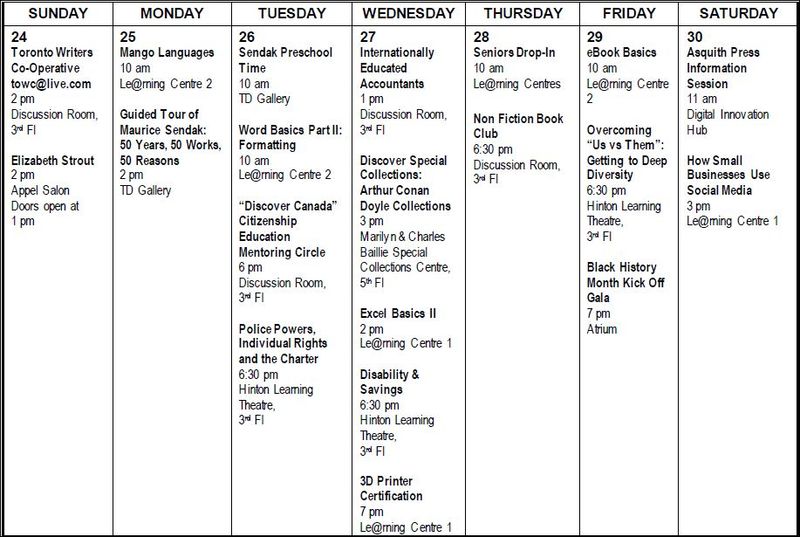
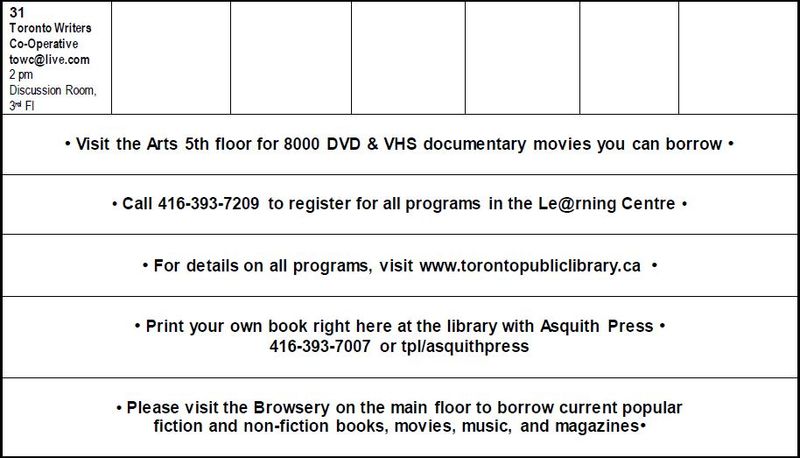
TRL Program Calendar January 2016

December 31, 2015 | Claire B. | Comments (2)

 See the stunning new gallery show "Maurice Sendak: 50 years, 50 works, 50 reasons" with special tours and programs for adults and children. Discover the new Green Screen Studio in the Digital Innovation Hub. Don't miss authors André Alexis, winner of this year's Giller Prize and the Rogers Writers' Trust Award, plus Gabrielle Hamilton and Elizabeth Strout.

Click on each image to enlarge or Download The January 2016 @ TRL as a pdf file.

For a full list of programs to browse or search, visit our Programs, Classes and Exhibits page.
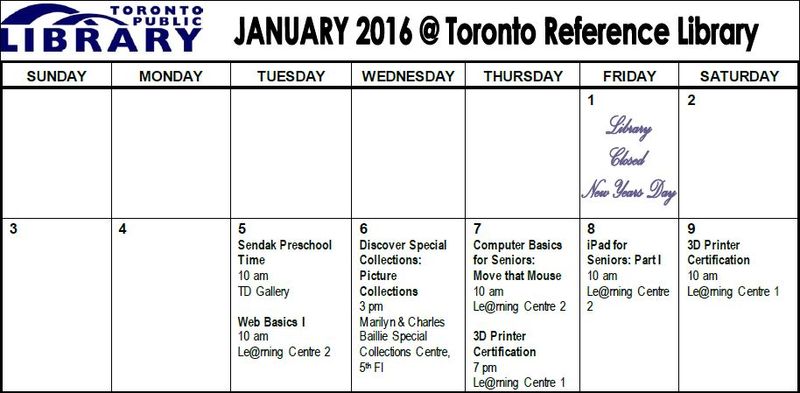
January 1 January 2 January 3 January 4 January 5

Comments

2 thoughts on “TRL Program Calendar January 2016

  1. With regards to a book to be found in the Reference Library, “Toronto Theatres and the Golden Age of the Silver Screen”, I would to make some comments.
    ( I didn’t know where else to post this to you, so please excuse this for being in the incorrect place).
    This book is filled with many errors, and this is going to be a long note because I am going rebut some of the most egregious ones individually.
    My reason for doing so is that this book is In Print, and the mistakes herein could very easily be perpetuated by unsuspecting researchers in the future and I cannot stand by and let them go unchallenged. This is a highly specific topic, likely to be of most interest to Torontonians in particular, and movie theatre and history buffs in general, therefore the specificity of the details are bound to be of considerable importance to them.
    The first example of an error that could have been very easily researched occurs in the Introduction. In describing a typical Saturday matinee schedule for kids he says:
    “….Next they showed a serial, which was a short film that required five or six episodes, one shown each week, before the entire tale was completed. Serials were also referred to as “movie-chapter plays” or “cliff hangers,”…. (page 12)
    Serials of the 1930’s, 40’s and 50’s were never that short. They were always between twelve and fifteen episodes
    “Each company turned out four to five serials per year, of 12 to 15 episodes each, a pace they all kept up until the end of World War II when, in 1946, Universal dropped its serial unit… Republic and Columbia continued, Republic fixing theirs at 12 chapters each while Columbia fixed at fifteen”.
    https://en.wikipedia.org/wiki/Serial_film#Sound_era
    The Great Movie Serials; authors; Glut, Harmon. Publisher; Routledge (2013)
    On page 33, in talking about the Loews Downtown theatre located at Queen and Yonge he states:
    “In 1960, the theatre was converted to “Cinerama,” which required three projectors. To accommodate the expansive curved screen, the opera boxes and the proscenium arch were removed. This greatly diminished the appearance of the theatre ‘s auditorium”.
    This is incorrect. There were only two theatres in Toronto that ever converted to three projector Cinerama; The University and The Eglinton.
    The University began with “This Is Cinerama” on Oct 24,1957 (not in 1958 as the author states on page 110) and permanently ceased with the Cinerama format on November 25, 1959 with “South Seas Adventure”(to make way for Ben Hur, projected in 70mm).
    The Eglinton began three projector screenings on Dec 23,1960 with a rival process called Cinamiracle. The film was called “Windjammer”, but this was the only film ever made in Cinamiracle. The company went bankrupt, and was bought out by Cinerama. The Eglinton then converted to Cinerama, and continued with it until December 15, 1963 with the screening of “How The West Was Won”. This was the last three projector Cinerama film shown in Toronto.
    http://www.in70mm.com/library/70mm_in/canada/index.htm
    Also in Mr. Taylor’s description of the University Theatre
    he says the following:
    “In 1962, the film Ben Hur played at the University. Because of the movies I saw in the theatre, in my mind, Charlton Heston was forever the towering hero-Moses or Judah Ben Hur. In 1962, I also saw Lawrence of Arabia, a lengthy film that almost gave me camel sores. Fortunately, the plush maroon theatre seats compensated, as they were soft and comfortable. However, the desert scenes dehydrated me, and at intermission, I gulped two containers of Vernor’s Ginger Ale” (p 110-111)
    Well, I know this to be categorically incorrect because in high school I worked every weekend at the University (and fulltime in the summer) from 1962-1964.
    Before I started working there, “Ben Hur” played at the University from Dec 23, 1959 to May 5, 1961. It won 11 Academy awards on April 4 1960. It did not play at the University in 1962. Nor did Lawrence of Arabia ever play at the University. That played exclusively at the Carlton Cinema from Jan 31,1963 to July3,1963. The only 70mm roadshow film to play at the University in 1962 was “Mutiny on the Bounty”, followed by “Cleopatra” in 1963.
    There are other errors that could have been resolved by more careful proofreading. The author states on page 35 that:
    “On the evening the Hippodrome opened, the feature film was “Run for Cover”, starring James Cagney”.
    As the Hippodrome, which originated as a Vaudeville house, but was certainly showing films by 1924, this is incorrect, as “Run For Cover” was released in 1955. So (presumably) what the author was indicting is that this was the closing film at the Hippodrome.
    On page 77 he quotes Mae West as follows:
    “When I’m good I’m good, but when I’m bad I’m really good.”(sic)
    The actual quote is:
    “When I’m good, I’m very good, but when I’m bad, I’m better. ”
    There are more factual errors and debatable premises but I will leave those for now and turn my attention to the author’s style.
    The author is prone to superfluous digressions. For example on page 21:
    “In the 1940’s,The Ace on Queen Street was owned by Sam Ulster, who also owned The Broadway on Queen St and The Rio on Yonge St. He was also the owner of the Town and Country restaurant on Mutual Street. I remember this eatery very well. It was famous for it’s buffet, which featured roast beef and lobster. Its main rival on the 1940’s was the Savarin Tavern on Bay Street… In the 1940’s, to the west of the theatre was a restaurant named Bowles lunch, the space later occupied by Scott’s Chicken Villa.”
    These digressions, and there are others like them, I think are irrelevant in a book about the history of Toronto theatres.
    Which brings up the central question about this book. What kind of book is this exactly? Is it a history of Toronto’s Theatres?, or is it a personal memoir? The problem is that it can’t make up its mind and is trying to be both at the same time, and it simply doesn’t work.
    That is not to say that there isn’t much interesting and useful information to be found here. On page 15, he talks about the first projected screening in Toronto having taken place August 31, 1896 at the Robinson Musee located at Yonge and Adelaide.
    That was new information to me, and how I wish he had listed a reference for that. It took quite a while, but I eventually tracked it down as coming from the Toronto Historical Board.
    And that’s the biggest problem with this book. There is no bibliography whatsoever, no index, no source notes, nor any footnotes.
    Am I being too hard here? I don’t think so. To date, there is only one other book on the history of Toronto Film Theatres, called “The Nabes” by John Sebert, published in 2001. So “Toronto Theatres in the Golden Age of the Silver Screen” will undoubtedly be consulted as an additional historical reference. There are 19 print copies in the Toronto Public Library (including the one at The Reference Library).
    I am going to inform the publisher of these errors and hopefully changes can be made in upcoming editions, but this article is a forewarning to anyone who might read this imprint in the meantime.
    It is my sincerest wish that these and any other errors in this book can be rectified, and source notes for factual information supplied.
    Then it would be a truly useful volume.
    A note on pagination: I read this book in an on-line copy borrowed from the Toronto Public Library and it is 154 pages long. The hard copy print version is listed as being 160 pages. So there may be a slight discrepancy with the print version pagination.

    Reply
  2. Hello Gil,
    Thank you for sharing your very close reading of the book “Toronto theatres and the golden age of the silver screen”. Anyone reading your post will be impressed by your knowledge of Toronto history, and your attention to detail. As you’ve mentioned, the best place to lodge your specific comments is with the author and/or the publisher. Thanks again for your interest in Toronto, and your use of the Toronto Public Library.

    Reply

Leave a Comment

Your email address will not be published. Required fields are marked *

TRL Program Calendar January 2016

December 31, 2015 | Myrna | Comments (2)

 See the stunning new gallery show "Maurice Sendak: 50 years, 50 works, 50 reasons" with special tours and programs for adults and children. Discover the new Green Screen Studio in the Digital Innovation Hub. Don't miss authors André Alexis, winner of this year's Giller Prize and the Rogers Writers' Trust Award, plus Gabrielle Hamilton and Elizabeth Strout.

Click on each image to enlarge or Download The January 2016 @ TRL as a pdf file.

For a full list of programs to browse or search, visit our Programs, Classes and Exhibits page.
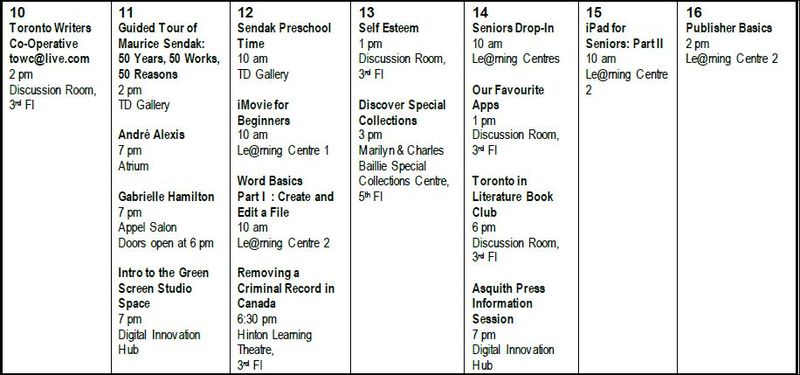
January 1 January 2 January 3 January 4 January 5

Comments

2 thoughts on “TRL Program Calendar January 2016

  1. With regards to a book to be found in the Reference Library, “Toronto Theatres and the Golden Age of the Silver Screen”, I would to make some comments.
    ( I didn’t know where else to post this to you, so please excuse this for being in the incorrect place).
    This book is filled with many errors, and this is going to be a long note because I am going rebut some of the most egregious ones individually.
    My reason for doing so is that this book is In Print, and the mistakes herein could very easily be perpetuated by unsuspecting researchers in the future and I cannot stand by and let them go unchallenged. This is a highly specific topic, likely to be of most interest to Torontonians in particular, and movie theatre and history buffs in general, therefore the specificity of the details are bound to be of considerable importance to them.
    The first example of an error that could have been very easily researched occurs in the Introduction. In describing a typical Saturday matinee schedule for kids he says:
    “….Next they showed a serial, which was a short film that required five or six episodes, one shown each week, before the entire tale was completed. Serials were also referred to as “movie-chapter plays” or “cliff hangers,”…. (page 12)
    Serials of the 1930’s, 40’s and 50’s were never that short. They were always between twelve and fifteen episodes
    “Each company turned out four to five serials per year, of 12 to 15 episodes each, a pace they all kept up until the end of World War II when, in 1946, Universal dropped its serial unit… Republic and Columbia continued, Republic fixing theirs at 12 chapters each while Columbia fixed at fifteen”.
    https://en.wikipedia.org/wiki/Serial_film#Sound_era
    The Great Movie Serials; authors; Glut, Harmon. Publisher; Routledge (2013)
    On page 33, in talking about the Loews Downtown theatre located at Queen and Yonge he states:
    “In 1960, the theatre was converted to “Cinerama,” which required three projectors. To accommodate the expansive curved screen, the opera boxes and the proscenium arch were removed. This greatly diminished the appearance of the theatre ‘s auditorium”.
    This is incorrect. There were only two theatres in Toronto that ever converted to three projector Cinerama; The University and The Eglinton.
    The University began with “This Is Cinerama” on Oct 24,1957 (not in 1958 as the author states on page 110) and permanently ceased with the Cinerama format on November 25, 1959 with “South Seas Adventure”(to make way for Ben Hur, projected in 70mm).
    The Eglinton began three projector screenings on Dec 23,1960 with a rival process called Cinamiracle. The film was called “Windjammer”, but this was the only film ever made in Cinamiracle. The company went bankrupt, and was bought out by Cinerama. The Eglinton then converted to Cinerama, and continued with it until December 15, 1963 with the screening of “How The West Was Won”. This was the last three projector Cinerama film shown in Toronto.
    http://www.in70mm.com/library/70mm_in/canada/index.htm
    Also in Mr. Taylor’s description of the University Theatre
    he says the following:
    “In 1962, the film Ben Hur played at the University. Because of the movies I saw in the theatre, in my mind, Charlton Heston was forever the towering hero-Moses or Judah Ben Hur. In 1962, I also saw Lawrence of Arabia, a lengthy film that almost gave me camel sores. Fortunately, the plush maroon theatre seats compensated, as they were soft and comfortable. However, the desert scenes dehydrated me, and at intermission, I gulped two containers of Vernor’s Ginger Ale” (p 110-111)
    Well, I know this to be categorically incorrect because in high school I worked every weekend at the University (and fulltime in the summer) from 1962-1964.
    Before I started working there, “Ben Hur” played at the University from Dec 23, 1959 to May 5, 1961. It won 11 Academy awards on April 4 1960. It did not play at the University in 1962. Nor did Lawrence of Arabia ever play at the University. That played exclusively at the Carlton Cinema from Jan 31,1963 to July3,1963. The only 70mm roadshow film to play at the University in 1962 was “Mutiny on the Bounty”, followed by “Cleopatra” in 1963.
    There are other errors that could have been resolved by more careful proofreading. The author states on page 35 that:
    “On the evening the Hippodrome opened, the feature film was “Run for Cover”, starring James Cagney”.
    As the Hippodrome, which originated as a Vaudeville house, but was certainly showing films by 1924, this is incorrect, as “Run For Cover” was released in 1955. So (presumably) what the author was indicting is that this was the closing film at the Hippodrome.
    On page 77 he quotes Mae West as follows:
    “When I’m good I’m good, but when I’m bad I’m really good.”(sic)
    The actual quote is:
    “When I’m good, I’m very good, but when I’m bad, I’m better. ”
    There are more factual errors and debatable premises but I will leave those for now and turn my attention to the author’s style.
    The author is prone to superfluous digressions. For example on page 21:
    “In the 1940’s,The Ace on Queen Street was owned by Sam Ulster, who also owned The Broadway on Queen St and The Rio on Yonge St. He was also the owner of the Town and Country restaurant on Mutual Street. I remember this eatery very well. It was famous for it’s buffet, which featured roast beef and lobster. Its main rival on the 1940’s was the Savarin Tavern on Bay Street… In the 1940’s, to the west of the theatre was a restaurant named Bowles lunch, the space later occupied by Scott’s Chicken Villa.”
    These digressions, and there are others like them, I think are irrelevant in a book about the history of Toronto theatres.
    Which brings up the central question about this book. What kind of book is this exactly? Is it a history of Toronto’s Theatres?, or is it a personal memoir? The problem is that it can’t make up its mind and is trying to be both at the same time, and it simply doesn’t work.
    That is not to say that there isn’t much interesting and useful information to be found here. On page 15, he talks about the first projected screening in Toronto having taken place August 31, 1896 at the Robinson Musee located at Yonge and Adelaide.
    That was new information to me, and how I wish he had listed a reference for that. It took quite a while, but I eventually tracked it down as coming from the Toronto Historical Board.
    And that’s the biggest problem with this book. There is no bibliography whatsoever, no index, no source notes, nor any footnotes.
    Am I being too hard here? I don’t think so. To date, there is only one other book on the history of Toronto Film Theatres, called “The Nabes” by John Sebert, published in 2001. So “Toronto Theatres in the Golden Age of the Silver Screen” will undoubtedly be consulted as an additional historical reference. There are 19 print copies in the Toronto Public Library (including the one at The Reference Library).
    I am going to inform the publisher of these errors and hopefully changes can be made in upcoming editions, but this article is a forewarning to anyone who might read this imprint in the meantime.
    It is my sincerest wish that these and any other errors in this book can be rectified, and source notes for factual information supplied.
    Then it would be a truly useful volume.
    A note on pagination: I read this book in an on-line copy borrowed from the Toronto Public Library and it is 154 pages long. The hard copy print version is listed as being 160 pages. So there may be a slight discrepancy with the print version pagination.

    Reply
  2. Hello Gil,
    Thank you for sharing your very close reading of the book “Toronto theatres and the golden age of the silver screen”. Anyone reading your post will be impressed by your knowledge of Toronto history, and your attention to detail. As you’ve mentioned, the best place to lodge your specific comments is with the author and/or the publisher. Thanks again for your interest in Toronto, and your use of the Toronto Public Library.

    Reply

Leave a Comment

Your email address will not be published. Required fields are marked *