Curator’s Choice: Going Down Under in the Osborne Collection
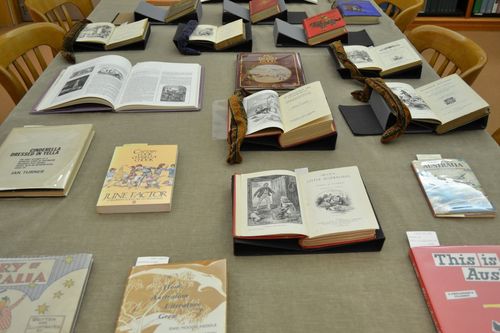
Welcome to Curator’s Choice! This Toronto Public Library initiative gives Special Collections and the people who love them a chance to shine every Saturday morning. This past Saturday, Elizabeth Derbecker was the curator, the location was the Osborne Collection of Early Children’s Books, located at the Lillian H. Smith branch, and the subject of choice was Australian children’s literature.
Unlike other nations that began as British colonies, Australia from its earliest days worked to create a literature that was entirely its own. Drawing on the landscapes before them, and on the folklore of the island nation’s Aboriginal people, Australian books were written for Australian readers, incorporating the flora and fauna unique to Australia as well as the different worlds to be found in the six official colonies: sheep and cattle stations in the northeast, gold mining in the west, opal fields in the south and apple orchards on the island of Tasmania.
The first Australian book for children’s book was published in 1841, more than 50 years after the arrival of the First Fleet in 1788. Written by Charlotte Barton, the title was A Mother’s Offering to Her Children and it was a simple text about the history and natural wonders of Australia. But the book that really captured the hearts of Australian children was Seven Little Australians (1894), written by Ethel S. Turner, who knew her audience well. The book begins “Before you fairly start this story, I should like to give you just a word of warning. If you imagine you are going to read of model children, with perhaps a naughtily-inclined one to point a moral, you had better lay down the book immediately … Not one of the seven is really good, for the very excellent reason that Australian children never are.”
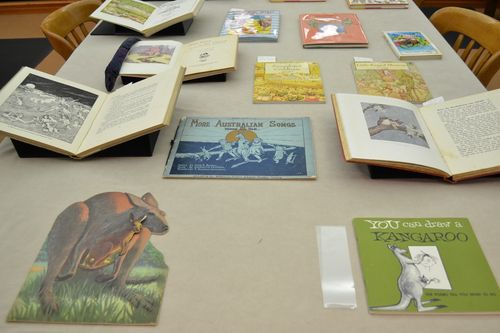
Picture books have the astonishing variety of Australian flora and fauna to draw upon for inspiration.
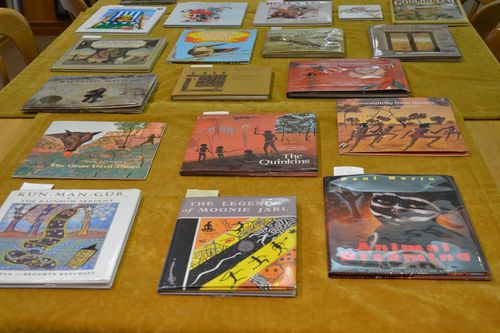
Aboriginal legends are illustrated using traditional styles and painting methods.
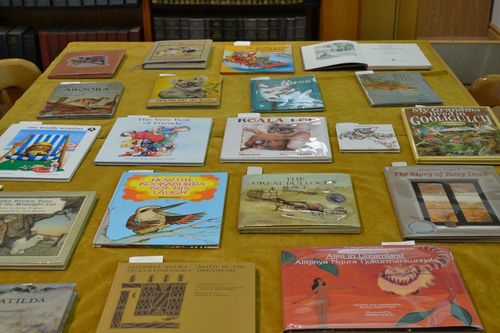
The Osborne Collection holds two different editions of Alice’s Adventures in Wonderland translated into Pitjantjatjara, an Aboriginal language spoken in South Australia and the Northern Territory –- one edition was illustrated by Carrollian scholar Byron Sewell (1975) and the other by Aboriginal artist Donna Leslie (1992).
Interested in learning more?
Here are some links to other sites featuring Australian children’s books and the long history of indigenous art in Australia:
http://www.slv.vic.gov.au/about-dromkeen
http://www.australia.gov.au/about-australia/australian-story/austn-indigenous-art
http://www.australia.gov.au/about-australia/australian-story/austn-childrens-books
Comments