Precarious Work: Why It Is Bad For Our Health
Defining Precarious Work and The Precariat
I began to see and hear the words "precarious work" and "the precariat" in the media, in our journals, and then in our book collection. Unsure of the meanings of these words, I did what every good librarian might do — (no, not Wikipedia!) – I went to the dictionary. Imagine my surprise when I found this in the Merriam-Webster Dictionary:
precarious adjective pre·car·i·ous \pri-ˈker-ē-əs\
Simple definition of precarious: not safe, strong, or steady.
precariat: The word you've entered was not found. Please try your search again.
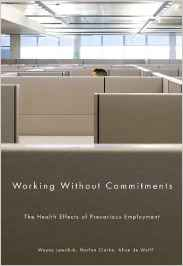 Toronto Reference Library is hosting a Thought Exchange program on this very topic: Precarious Work: Why It's Bad for Our Health, part of a series on poverty and health issues. As I am involved with the program, I needed to know what these words mean. So I tried again.
This time I used the Oxford English Dictionary. Success! Precarious employment: 1) dependent on chance or circumstance; uncertain, liable to fail; exposed to risk, hazardous; insecure, unstable and 2) subject to or fraught with physical danger or insecurity; at risk of falling, collapse, or similar accident; unsound, unsafe, rickety.
Yes, I was getting the picture. Not a pretty one but a picture, nevertheless. So I tried "precariat". This is what came up:
"No dictionary entries found for 'precariat'. Did you mean precarial, precardiac, precarium? Check your search and try again." Clearly the word precariat is so current, it hasn't yet been accepted by the OED (Oxford English Dictionary) people.
The Macmillan Dictionary Buzzword displayed this: "the precariat, noun (singular) informal — "A social group consisting of people whose lives are difficult because they have little or no job security and few employment rights".
Macmillan followed the definition with a lengthy backgrounder which I will excerpt:
… "The term precariat dates back to the 1980s, when French sociologists used it to define unprotected, temporary workers as a new social class. It also exists as a term in French (precariat), Italian (precariato) and German (Prekariat), with shifts in meaning determined by the time, place and social context in which it is used.
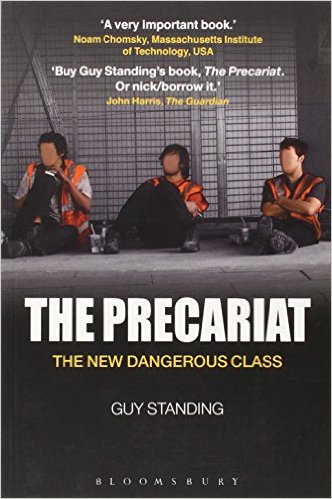 In Britain, the term was brought into the public eye by Guy Standing, an economics professor, who uses it in the title of his book: Precariat: The New Dangerous Class."
But most importantly, Macmillan provided me with this definition:
"Precariat is a blend of adjective precarious and noun proletariat, a word used to describe working-class people as a social group. Proletariat has its origins in Latin proletarius, which denoted a person who had no wealth in property and whose only way of serving the state was by producing offspring."… and "Precarity" is most commonly associated with workers who leave their home country to compete for low-paid retail and service jobs. (Kerry Maxwell, Brave New Words).
Books on Precarious Work and The Precariat
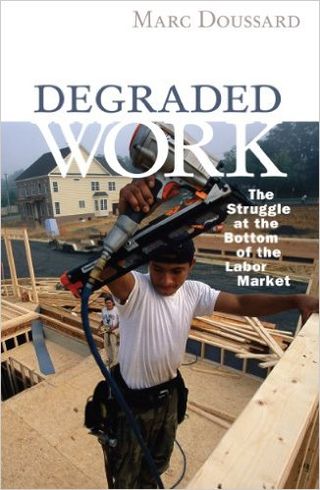
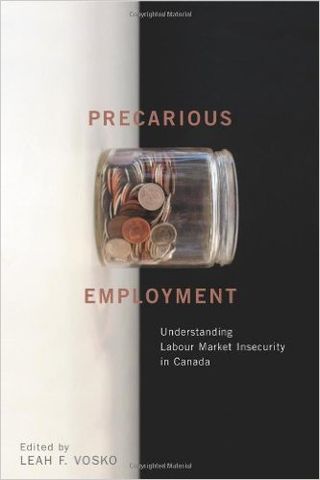
Let's take a look at a sampling of what's in the Humanities and Social Sciences collection:
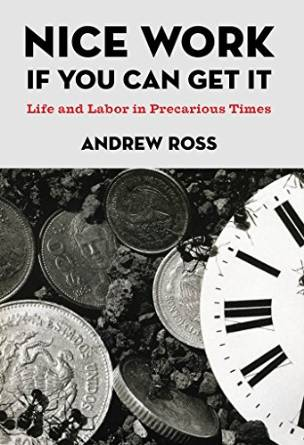
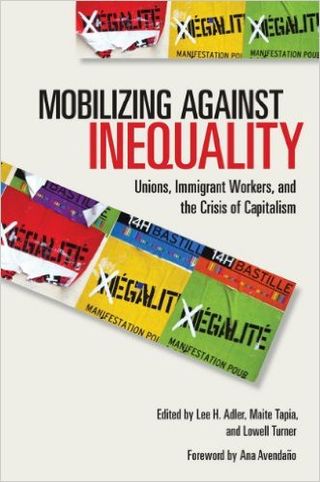
Precarious Work: Why It Is Bad for Our Health
with Dr. Andrew Pinto, MD, St. Michael's Hospital
Wednesday April 20, 2016
6:30 pm-8:30 pm
Toronto Reference Library Atrium
4 thoughts on “Precarious Work: Why It Is Bad For Our Health”
An educative and informative website refered by students and staff at the university of Nairobi in kenya
http://healthservices.uonbi.ac.ke/
An educative and informative website refered by students and staff at the university of Nairobi in kenya
http://healthservices.uonbi.ac.ke/
Thank you, Meshack. It is wonderful to know that our blog is being read as far away as Nairobi. Thank you!
Thank you, Meshack. It is wonderful to know that our blog is being read as far away as Nairobi. Thank you!