The Art of Cartography: Mapping New Worlds and Phantom Islands
Note: This article includes historical materials from the collections of Toronto Public Library. Who tells the story, and how the story is told creates tensions when trying to present content written by settlers about Indigenous people. These materials can reflect offensive historic attitudes, and in some cases, were created by individuals directly involved in acts of cultural genocide committed against Indigenous peoples. These materials are included as part of TPL’s commitment to the 69th Call to Action from the Truth and Reconciliation Commission of Canada, which recognizes the inalienable right of Indigenous peoples to know the truth of what happened and why.
Our new exhibit, The Art of Cartography, offers a look at some of the beautiful (and weird) ways that European mapmakers represented the New World. The exhibit includes maps of the Americas spanning over 300 years, from about 1545 to 1851.
You’ll discover that maps from this period are often elaborately decorated with pastoral landscapes, mythological figures, Indigenous peoples, flora and fauna. Here are a few highlights.
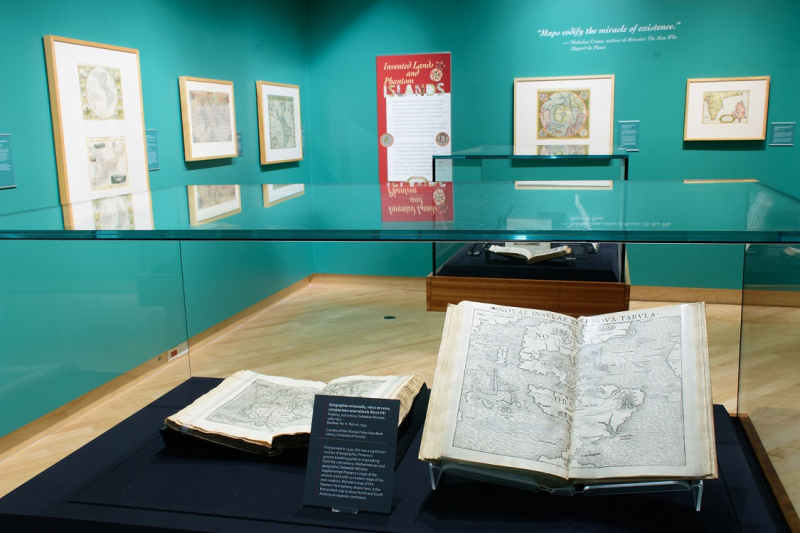
Shown above right is Geographia vniversalis, vetvs et nova, complectens enarrationis libros VIII, by Sebastian Münster (1489-1552), 1545, courtesy of the Thomas Fisher Rare Book Library, University of Toronto.
First printed in 1540, Münster's Geographia vniversalis was a significant revision of Geographia, Ptolemy’s ground-breaking guide to map-making from the 2nd century. Münster’s map of the Western Hemisphere is the first printed map to show North and South America as separate continents and the first to name the Pacific Ocean.
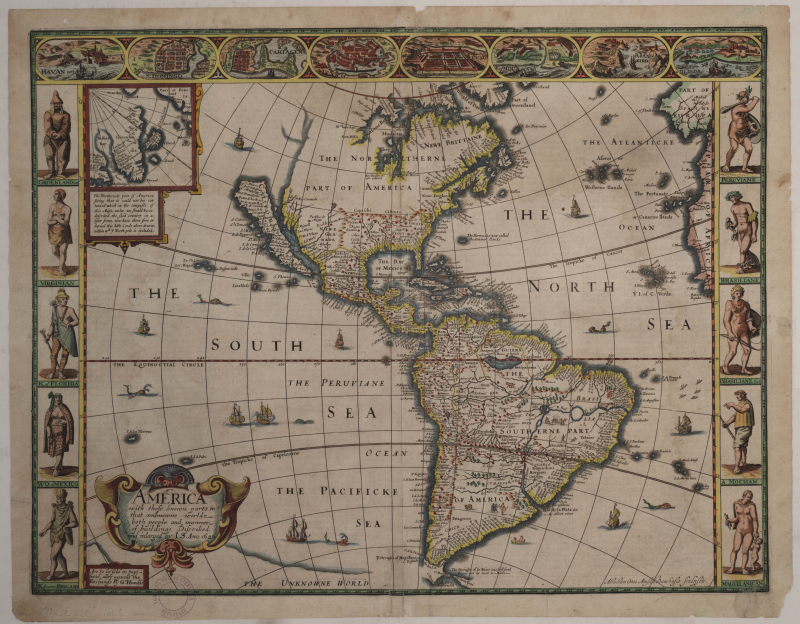 America with those known parts in that unknowne worlde both people and manner of buildings discribed and inlarged, by John Speed (1552-1629), 1626.
The borders of English cartographer John Speed’s map of America are decorated with bird’s eye views of South American cities and costumed figures of Indigenous peoples. Much of North America is unknown territory, and the oceans appear ominous with depictions of sea monsters. This is one of the earliest maps to depict California as an island. In 1747 King Ferdinand VI of Spain issued a royal decree stating that California was not an island, however this cartographic error continued to appear on some maps even as late as the mid-1800s.
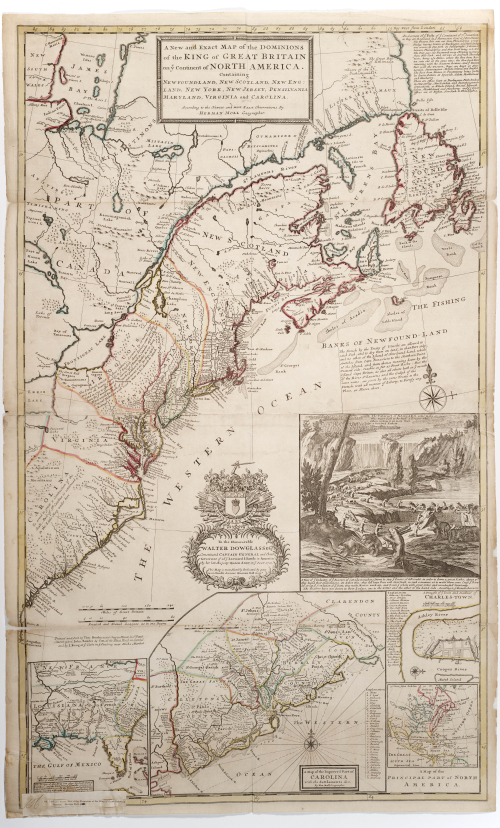 A new and exact map of the Dominions of the King of Great Britain on ye Continent of North America, by Herman Moll (ca. 1654-1732) London: Tho. Bowles, John Bowles and J. King, 1715.
Commonly known as the “beaver map,” Moll’s 1715 map of North America documents the ongoing land border disputes between France and Great Britain following the Treaty of Utrecht in 1713. The map’s most striking feature is the vignette of beavers busily building a dam in front of Niagara Falls. The beavers appear to be highly intelligent, industrious creatures – symbols for the opportunity for trade and commerce in the colonies.
A New & Accurate Map of all the Known World Drawn from the Latest & Most Accurate Surveys, by Emmanuel Bowen (1693-1767), 1740
Maps are fascinating records of what was known and unknown about the world at time. In Bowen's double-hemisphere world map of 1740, a large swath of the North-West of North America is described as "Parts Undiscovered."
Early cartographers rarely had first-hand knowledge of the territories they mapped. They worked from travelogues and relied on the accuracy of the mapmakers who came before them. They also relied on creative imagery to embellish the empty spaces

Frislanda, Scoperta da Nicolo Zeno Patritio Veneto Creduta Favolosa, o nel Mare Somersa by Vincenzo Coronelli (1650-1718), 1695
Either honest mistakes or conscious fabrications, historical maps sometimes feature places that never actually existed. On maps of the North Atlantic, the phantom island of Frisland was rendered in a surprising amount of detail. These “mistakes” were copied again and again by subsequent mapmakers.
West Canada, drawn and engraved by John Rapkin (1815-1876), illustrations drawn by Henry Warren, engraved by Robert Wallis, 1851.
As explorers and cartographers filled in the world with more detail and accuracy, decorative elements were pushed out to the margins. John Tallis was one the most popular map publishers of the 19th century and one of the last great decorative map makers. Tallis’ atlas, which was published to coincide with the Great Exhibition of 1851 in London, was celebrated for its accurate and visually striking maps embellished with illustrated borders and vignettes.
The library’s Special Collections include over 3,000 maps and atlases dated before 1920, including both printed and manuscript maps. These historical documents offer a view of Canada and North America as seen through the eyes of European explorers and cartographers. Decorative elements and choices about what is included or excluded don’t simply reflect the creative whims of the mapmaker: maps are always shaped by politics and power. The colonial powers that claimed control over these territories had a vested interest in how they were represented.
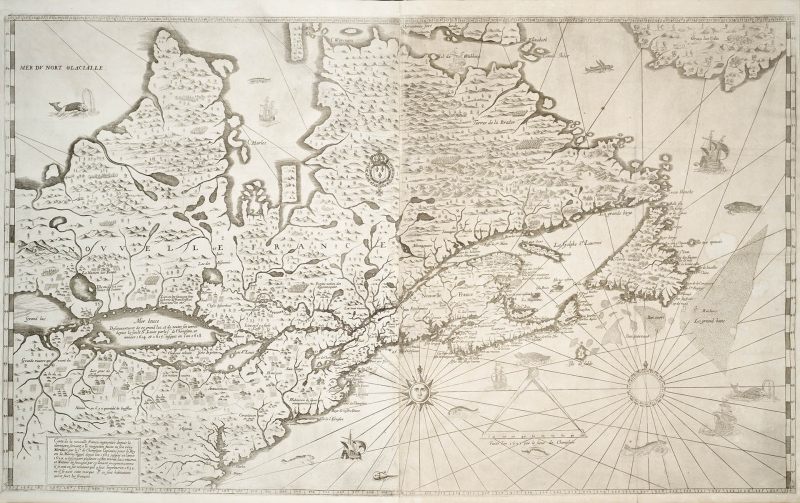
Carte de la Nouvelle France, Samuel de Champlain (1574-1635), 1640
Champlain’s 1640 map of New France is a good example of how maps were devised as tools for selling the idea of colonial settlement, trade, future investment and expeditions. The Terra incognita of the New World was most often portrayed as an empty territory waiting to be divided up and filled by the nations of Europe. Champlain’s maps of New France helped transform what was seen as a barren wilderness into an abundant land, ripe for colonization.
Interestingly, Champlain is also described as the first European mapmaker who relied on accounts of Aboriginal peoples to map areas he had not explored. Map historians now recognize that there were rich pre-Colonial indigenous map-making traditions.

Drawing Map on Birch-Bark (Rivière Moisie, Labrador Peninsula Expedition, Québec, 1861), by William G. R. Hind (1833-1889), 1861
While our exhibit focuses on the “art” of cartography – it is important to remember the power of maps and map-making. Maps are authoritative: they name places, define borders, and assert claims over the rightful ownership of land. Maps and atlases played a key role in shaping ideas of the “New World,” setting it up as land ripe for European colonization and settlement.
As John Owen Edward Clark writes, “Like written accounts of the past all maps are 'prisoners of their time' but they allow us to see how the world or a particular part of it was viewed and understood by the mapmaker and his audience at that time.”
The Art of Cartography is a free exhibit on display in the Toronto Reference Library's TD Gallery until October 16, 2016.
Edit: Note added at start of post. January 12, 2022.
2 thoughts on “The Art of Cartography: Mapping New Worlds and Phantom Islands”
The art of cartography has grown exceedingly in the current century with the use of the software.We appreciate that above skills,that is the power of creativity.
The art of cartography has grown exceedingly in the current century with the use of the software.We appreciate that above skills,that is the power of creativity.