The Art of Cartography: Mapping the City with Shawn Micallef, Daniel Rotsztain, Flavio Trevisan & Marlena Zuber
Our current exhibit, The Art of Cartography, focuses on the artistry of mapmakers from the 16th to the 19th century. Crafting beautiful and insightful maps, however, is certainly not an art form resigned to the past. Maps continue to inspire artists, illustrators, geographers and story tellers. As a medium, maps can help communicate complex ideas, challenge assumptions about place, and connect new meanings about the spaces where we live.
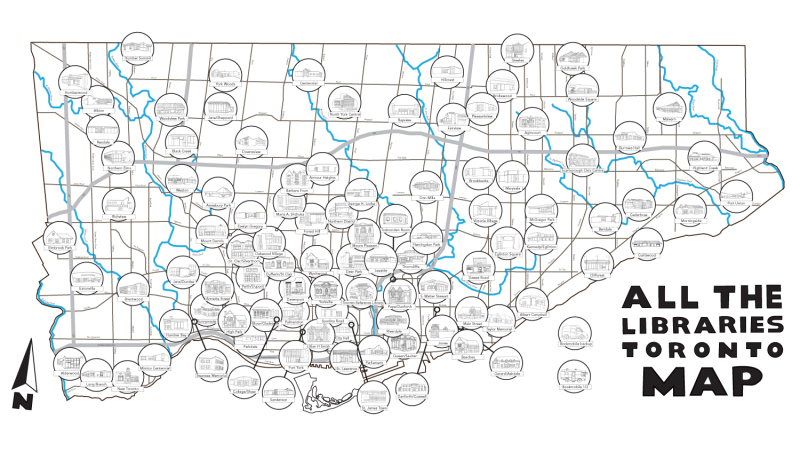
All the Libraries map by Daniel Rotsztain
Interested in learning more about how the city of Toronto is being mapped by artists, illustrators and geographers today?
Join us this Thursday, September 22 at 6:30 p.m. in the Toronto Reference Library's Hinton Learning Theatre for a panel discussion on Mapping the City featuring Daniel Rotsztain, Flavio Trevisan and Marlena Zuber.
Daniel Rotsztain is the Urban Geographer: an artist, writer and cartographer whose work explores the relationships to the places we inhabit, especially the fascinating and elusive geography of Toronto. The author and illustrator of All the Libraries Toronto, a colouring book featuring drawings and captions of all 100 branches and 2 bookmobiles of Toronto Public Library, Daniel's work has also appeared in Spacing Magazine, Globe and Mail and Now Magazine.
 Grey Area, 2009 by Flavio Trevisan
Flavio Trevisan is a visual artist and designer. He has been publishing books as Hex Editions since 2013. His previous projects include “Museum of the Represented City,” at the Koffler Gallery Off-Site; “Pink Republic,” at TYPE Books and “The Game of Urban Renewal (Special Regent Park Edition),” a project for Queen Specific. His work has been featured in Art With Heart 2011, Titles and A Guidebook to Contemporary Architecture in Toronto.
Map of Kensington Market by Marlena Zuber
Marlena Zuber is an illustrator and map maker with a career in Community Arts. Her first large scale map of the city was published in uTOpia: Towards a New Toronto. Her maps and drawings were also featured in Stroll: Psychogeographic Walking Tours of Toronto. In 2013, Marlena collaborated with Matt Galloway of CBC's Metro Morning and his listeners to create a people’s map of Secret Toronto. Her maps have also been featured at Toronto Harbourfront Centre and at City Hall for Doors Open and they have been published in collections such as All About Maps and a Map of the World: The World According to Illustrators and Storytellers.
The talk will be moderated by Shawn Micallef. Micallef is the author of The Trouble with Brunch: Work Class & the Pursuit of Leisure, Stroll: Psychogeographic Walking Tours of Toronto and Full Frontal TO. He is also a weekly columnist at the Toronto Star, and a senior editor and co-owner of the independent, Jane Jacobs Prize–winning magazine Spacing.
The Art of Cartography: Mapping the City
Before or after the talk, be sure to visit the exhibit in the TD Gallery to take a look at early maps and views of Toronto and other cities from around the world.
As you can see from the highlights below, maps, plans and views help to define a city’s character. Cartographers offer new perspectives and selective highlights: important landmarks, architectural styles, boundaries, and places of civic importance. Maps can also be tools for visualizing and planning for future development.
Topographical plan of the city of Toronto, Sir Sandford Fleming (1827-1915), Toronto: Hugh Scobie, 1851
Sir Sandford Fleming was a Scottish-born Canadian engineer, inventor, surveyor and engraver. His many accomplishments include the proposal of worldwide standard time zones and designing Canada's first postage stamp. While Fleming worked as a land surveyor in 1851, he drew this plan of Toronto with engravings of the significant buildings of the city around the edges.
The map was published by Hugh Scobie, a Scotsman who published a newspaper entitled The British Colonist out of a book and stationery store at 16 King E. in Toronto. His services were listed as such: “Bookseller, and stationer, printer, bookbinder, lithographer, copperplate and woodengraver.”
Plano Pintoresco De La Habana con los numeros de las casas, José María de la Torre (1815-73), Engraved by William S. Barnard, 1809-?, Havana, Cuba: B. May y Ca, 1853
An example of one of our maps of international cities, this “picturesque” plan of Havana was created by Cuban geographer José María de la in 1849. The scale is in Castilian varas (yards), an old Spanish unit of measurement. The border features decorative vignettes and views of the city: prominent buildings, fortifications, military facilities, existing and proposed roadways, railroads and boundaries. These engravings originally appeared in Federico Mialhe’s Album Pintoresco de La Isla de Cuba.
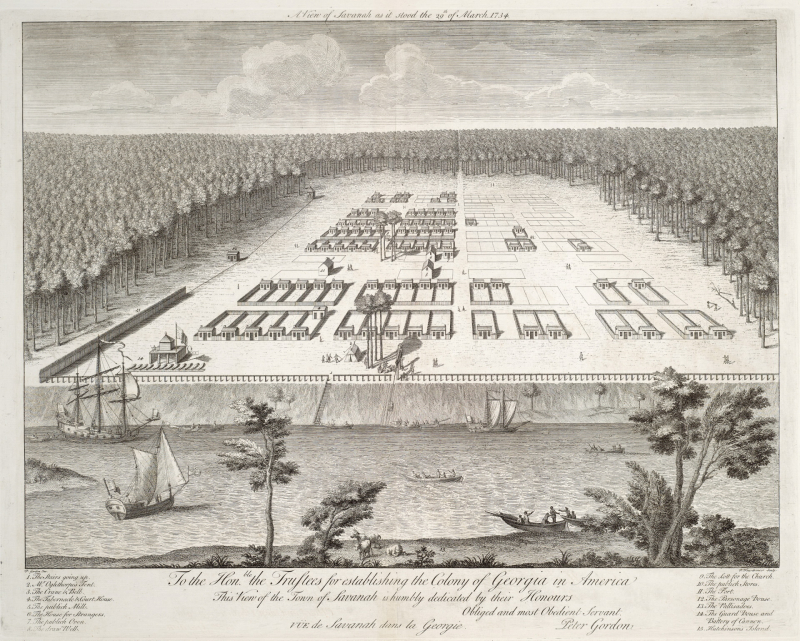
A view of Savanah as it stood the 29th of March, 1734, Peter Gordon (1697-1740), Engraved by Pierre Fourdrinier (1720-1760), 1734. Gift of James Bain Family
Peter Gordon was one of the first settlers of the British Colony of Georgia and served as its chief bailiff. He sketched this bird's-eye view of the new planned settlement of Savannah. This plan captures how James Edward Oglethorpe (1696-1785), British philanthropist and founder of Georgia, meticulously laid out the streets, housing lots, public buildings and town squares.
Toletum [Toledo, Spain], Book V, Plate 15 from the German edition of Braun and Hogenberg's Civitates Orbis Terrarum, Georg Braun (1541-1622), Frans Hogenberg (1535-1590), 1566.
The exhibit also features several hand-coloured views from Georg Braun and Franz Hogenberg’s Civitates Orbis Terrarum (“Cities of the World”), considered one of the greatest achievements European cartography. Published in Cologne, Germany in a series of six volumes between 1572 and 1618, the Civitates eventually contained 546 scenes, birds-eye views, and map views of cities from all over the world. The editions appeared in Latin, German and French.
This hand-coloured panoramic view of Toledo has an elaborate border and features dramatic elevations of the city’s cathedral and royal palace. In his commentary, Braun notes that the Italian city was rumoured to have been founded by Hercules.
Gyor [Hungary], Book V Plate 54 from the German edition of Braun and Hogenberg's Civitates Orbis Terrarum, 1594
Braun who was a cleric of Cologne Cathedral was the principal editor of the work. He consulted and sought input from various artists, printers and surveyors of the time. The engravings are mostly attributed to Frans Hogenberg, a Flemish engraver and painter.
The maps in Civitas Orbis Terrarum often include foreground figures wearing local garb. It is interesting to note the similarities between the contours of the clothing and the topography and architecture in the scene.
The Art of Cartography is a free exhibit on display in the Toronto Reference Library's TD Gallery until October 16, 2016. It is open to the public during regular library hours.
6 thoughts on “The Art of Cartography: Mapping the City with Shawn Micallef, Daniel Rotsztain, Flavio Trevisan & Marlena Zuber”
Mapping of cities should be encouraged, made continuous, such that new features and attributes are seamlessly integrated as upddates
Mapping of cities should be encouraged, made continuous, such that new features and attributes are seamlessly integrated as upddates
This has been quite helpful
This has been quite helpful
This is so helpful.
This is so helpful.