Infamous: Sex Work in Nineteenth-Century Toronto
“Houses of ill-fame in Toronto? Certainly not. The whole city is an immense house of ill-fame….” ̶ C.S. Clark, Of Toronto the Good: A Social Study: The Queen City of Canada as it is, 1898
Join us at the Toronto Reference Library on Monday, March 6 for a free lecture on the history of one Toronto's most secretive economies: sex work. The lecture will be presented by Professor Laurie K Bertram, faculty member in the Department of History at the University of Toronto. Her current research examines the historical relationships between brothels, colonialism, race and nation building in Canada from 1870-1914 with a focus on johns (male clients).
The talk begins at 7pm in the Hinton Learning Theatre on the third floor. No registration is required.
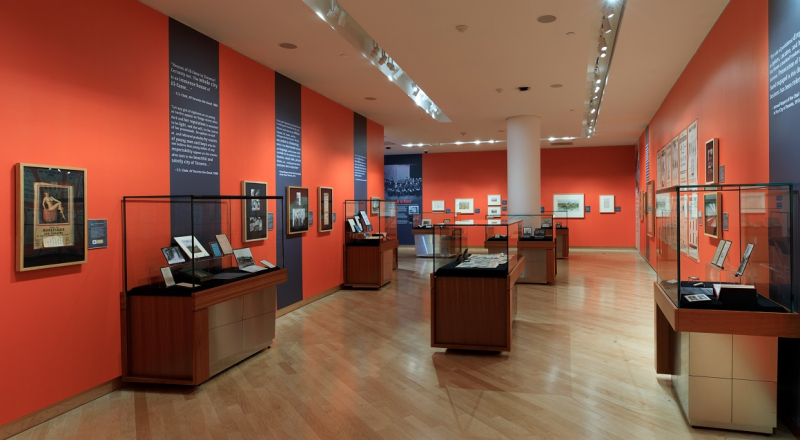
This program is presented in conjunction with our current exhibit, Vice & Virtue, which is on display in the Toronto Reference Library's TD Gallery. From booze to opium, bawdy house legislation to burlesque, the exhibit looks at moral reform in Toronto in the late nineteenth and early-twentieth century.
Here is a sneak peek at a few items in the exhibit that shed light on the history of sex work in Toronto.
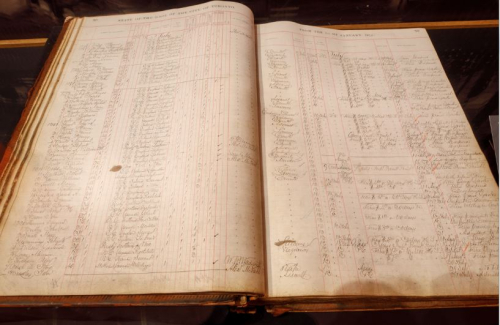
Toronto Gaol (Don Jail) Registries, 1874-1877
This registry was used to record the individuals who were incarcerated in the Don Jail from 1874-1877: their names, ages, trade, “rank in life,” offences, sentence and how they were discharged. More than half were charged with drunkenness. Vagrancy and larceny (theft) are also common offences. Prior to the establishment of the Criminal Code in 1892, vagrancy laws were used to prosecute sex workers as well as those who ran or frequented bawdy houses. In the gallery, the registry is open to show the records of those incarcerated in July of 1874, including men, women and children as young as 11. All are noted as being of the “lower class.” A number of women have “prostitute” recorded as their trade.
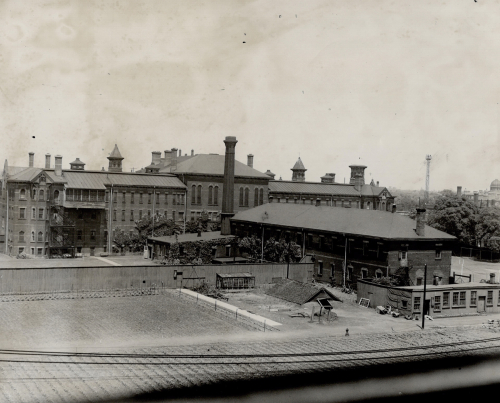
Andrew Mercer Reformatory for Women, 1948. From the Toronto Star Photograph Archive.
By the mid-19th century, new correctional institutions, reformatories and houses of refuge were established in Toronto to “rescue” women from the sex trade. The Toronto Magdalene Asylum and Industrial House of Refuge was incorporated in 1858. The exhibit features the Rules and Regulations for the Asylum from 1876, which reveals that inmates had to agree to remain for at least a year and abide by strict schedule of domestic work and evangelical worship. You can explore the Magdalene Asylum's Annual Reports from 1859 to 1880 through the library's Digital Archive.
When it opened in 1880, the Mercer Reformatory became the first prison in Canada exclusively for female offenders. Its inmates included many women charged with prostitution-related crimes. Like other institutions of its time, it aimed to reform women through instilling Victorian ideals of feminine virtue. Closed in the 1970s, it is now the site of Lamport Stadium in Liberty Village.
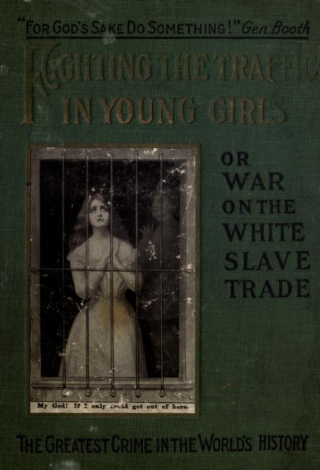
Fighting the traffic in young girls: or, war on the white slave trade, Ernest Albert Bell, 1865-1928, Chicago: L.H. Walter, 1911
By the end of the 19th century, a moral panic erupted over what was called “White Slave Trade.” The panic originated in England and quickly spread to the US and Canada. Newspapers were filled with lurid and racist tales of innocent white women being lured into the sex trade by “foreigners.” In 1911, Ernest Albert Bell published a collection of accounts of the trade internationally, including a chapter on the traffic in Toronto. In it, Reverend St. Clair recounts the story of a young woman working at the glove counter of a downtown department store. After turning down the advancements of a male customer, the girl almost falls prey to a “widow,” a trafficker in disguise, offering her chocolates laced with “knock-out” drops. The book in its entirety is available through the library's Digital Archive.
Historians have found little evidence to support thee sensationalist claims about the "white slave trade." Nonetheless the panic led to widespread support for anti-prostitution and anti-immigration legislation across the country.
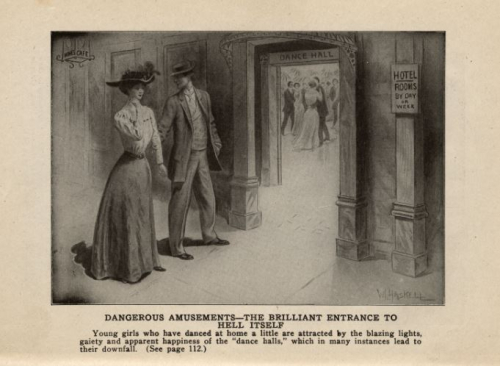
"Dangerous Amusements" from Fighting the traffic in young girls: or, war on the white slave trade, Ernest Albert Bell, 1865-1928, Chicago: L.H. Walter, 1911
Moral reformers also blamed the trade on ineffectual paren'ts, employers paying low wages and young women themselves for falling prey to “vanity and laziness.” In 1913, the morality department of the Toronto police added the city’s first two female officers to patrol parks, theatres and dancehalls – places where young, single women were deemed at risk of succumbing to the temptations of immorality. According to Toronto moral reformer, B. G. Jefferies, the dance hall was the milestone that marks “the working girl’s downward path from virtue to vice, from modesty to shame.”
Interested in learning more about the stories and real-life women and men behind one of Toronto's most secretive economies? Don't miss Professor Bertram's talk: Infamous: Sex Work in Nineteenth-Century Toronto on Monday, March 6.
The Vice & Virtue exhibit runs until April 30, 2017. Admission as always is free and the gallery is open to the public during regular library hours.
12 thoughts on “Infamous: Sex Work in Nineteenth-Century Toronto”
Typo: “employees paying low wages” assuming you mean employERS.
Typo: “employees paying low wages” assuming you mean employERS.
“lurid and racist tales” >>>>> “racist” is a meaningless word actually, until I go over that material myself I’m gonna say its safe to assume that there was actually no racial hatred spoken of. Claims of racism are not only often exaggerated, they are downright hallucinated.
“lurid and racist tales” >>>>> “racist” is a meaningless word actually, until I go over that material myself I’m gonna say its safe to assume that there was actually no racial hatred spoken of. Claims of racism are not only often exaggerated, they are downright hallucinated.
Racist does NOT mean racial hatred – it means racial stereotypes.
Racist does NOT mean racial hatred – it means racial stereotypes.
Then you have no idea what the word racist actually means, and are further diluting it. Am I supposed to assume that gender stereotypes are somehow sexist? Think about it carefully, you got the wrong definition of the word.
Then you have no idea what the word racist actually means, and are further diluting it. Am I supposed to assume that gender stereotypes are somehow sexist? Think about it carefully, you got the wrong definition of the word.
Thanks Dave. Typo has been fixed.
Thanks Dave. Typo has been fixed.
Hi Meph,
A number of historians have written about the racial dimensions of early 20th century white slavery narratives [ie. how accounts villainized recent immigrants, particularly Black and Chinese men, and how campaigns were linked with building support for discriminatory immigration policies and racial “purity” ideologies].
Based on reading a number of primary and secondary accounts, I found that the term “racist” was appropriate, given that an established definition is “racial prejudice or discrimination.” https://www.merriam-webster.com/dictionary/racism
If you are interested in reading more about the topic on your own, here are some relevant resources from our collection:
The age of light, soap, and water : moral reform in English Canada, 1885-1925
http://www.torontopubliclibrary.ca/detail.jsp?Entt=RDM818927&R=818927
Making good : law and moral regulation in Canada, 1867-1939
http://www.torontopubliclibrary.ca/detail.jsp?Entt=RDM858926&R=858926
Selling Sex: Experience, Advocacy, and Research on Sex Work in Canada
http://www.torontopubliclibrary.ca/detail.jsp?Entt=RDM3103872&R=3103872
Canada the Good: A Short History of Vice since 1500
http://www.torontopubliclibrary.ca/detail.jsp?Entt=RDM3117491&R=3117491
Trafficking and prostitution reconsidered : new perspectives on migration, sex work, and human rights
http://www.torontopubliclibrary.ca/detail.jsp?Entt=RDM2863400&R=2863400
Hi Meph,
A number of historians have written about the racial dimensions of early 20th century white slavery narratives [ie. how accounts villainized recent immigrants, particularly Black and Chinese men, and how campaigns were linked with building support for discriminatory immigration policies and racial “purity” ideologies].
Based on reading a number of primary and secondary accounts, I found that the term “racist” was appropriate, given that an established definition is “racial prejudice or discrimination.” https://www.merriam-webster.com/dictionary/racism
If you are interested in reading more about the topic on your own, here are some relevant resources from our collection:
The age of light, soap, and water : moral reform in English Canada, 1885-1925
http://www.torontopubliclibrary.ca/detail.jsp?Entt=RDM818927&R=818927
Making good : law and moral regulation in Canada, 1867-1939
http://www.torontopubliclibrary.ca/detail.jsp?Entt=RDM858926&R=858926
Selling Sex: Experience, Advocacy, and Research on Sex Work in Canada
http://www.torontopubliclibrary.ca/detail.jsp?Entt=RDM3103872&R=3103872
Canada the Good: A Short History of Vice since 1500
http://www.torontopubliclibrary.ca/detail.jsp?Entt=RDM3117491&R=3117491
Trafficking and prostitution reconsidered : new perspectives on migration, sex work, and human rights
http://www.torontopubliclibrary.ca/detail.jsp?Entt=RDM2863400&R=2863400