Toronto Reference Library at 40: The Evolution of its Site. Part 2. Yonge Street Frontage
The Toronto Reference Library is located on the east side of Yonge Street between Asquith Avenue and Collier Street. Shown here are some of the buildings on Yonge Street that stood on or opposite this block during the 100 years or so before the library opened on November 2, 1977.
1. Yorkville Town Hall. Stood on Yonge Street, west side, opposite today's Collier Street, 1860-1941
This early picture is a remarkable record of the area in the 1860s. In the centre is the Yorkville Town Hall, which opened, minus its tower, on west side of Yonge Street just north of William Street (Yorkville Avenue) in 1860. In front of the Town Hall is a horse-drawn car of the Toronto Street Railway. Service commenced from the Town Hall to the St. Lawrence Market in September 1861. Wooden sidewalks are on both sides of the street and a gas lamp provides illumination.
This section of Yonge Street in the 1860s was described in great detail by Harry Smallpeice in a reminiscence of “When Yorkville was a baby town,” published in the Toronto Star on November 20, 1909. Going south from the Town Hall were the post office and store operated by James Dobson. Across the road at the southwest corner of William Street (Yorkville Avenue), Smallpiece recollected, "stood the residence of Mr. Geo. Bostwick, the autocrat of the village. Bostwick was a man of independent means and a magistrate….Next door was William Hewitt’s dry good store….Then came George Scott’s grocery store and the house and large grounds [behind the fence] of Mr. Geo. Botswick’s sister, the Widow Parker.”
The east side of Yonge between Jarvis (Asquith) and James (Collier) appears much more ramshackle. Going north were shops of a grocer, a tinsmith, a butcher and blacksmith James Wallis. "It was on the green in front of Wallis’ shop the Queen’s Birthday celebrations always took place," Smallpeice recalled. "Promptly at sunrise…the village notables would assemble around one of Wallis’ big anvils that had been brought out of the shop for the occasion and solemnly fire off twenty-one rounds….In the rear, Richard Peacock, a drover, lived in a small cottage, surrounded by a beautiful garden, the pride of the neighbourhood. Next came a small white brick cottage, occupied then by Matthew Hutchinson; then William Hand’s saddlery establishment and Matthew Hutchinson’s carriage and wagon works in the rear.”
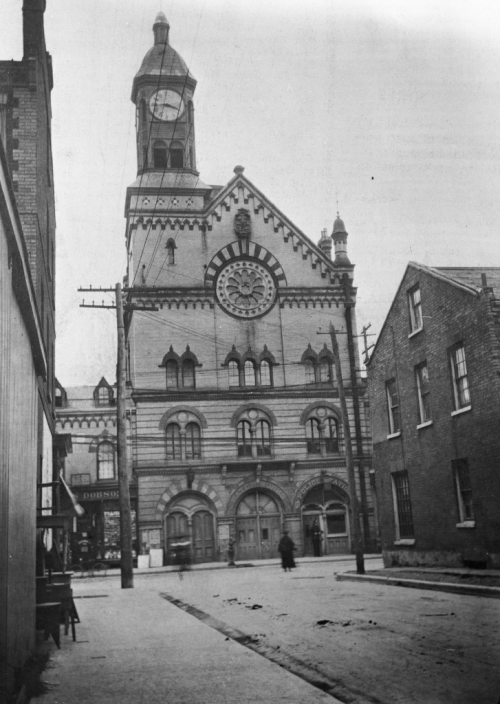
Designed in 1859 by William Hay, one of Toronto’s most important early architects, the Yorkville Town Hall was built of white “Yorkville” brick with red-brick and blackened-brick detailing. Nineteenth-century historian Henry Scadding commented in his monumental Toronto of Old (1873) that the town hall had "a Flemish look. It might have strayed hither from Ghent.”
After Yorkville became St. Paul's Ward on annexation in 1883, the building was renamed St. Paul's Hall. It was used by a variety of organizations, including the Toronto Public Library, which operated its first branch, Northern, there from 1884 until the Carnegie-financed Yorkville Branch opened in 1907.
Fire destroyed the old town hall on November 12, 1941 and it was demolished the following May. The clock (which had been installed in the tower in 1889) and the Village of Yorkville coat of arms (seen here above the huge rose window) eventually were removed to the fire hall beside the public library on Yorkville Avenue.
Also visible in this picture are two buildings on the opposite side of Yonge Street at the corner of Collier Street. The one at the southeast corner, then a furniture store, was demolished when the Toronto Reference Library was built.
More images of Yorkville Town Hall
2. Parker's Dye Works. Stood on Yonge Street, east side, between today's Asquith Avenue and Collier Street, 1885-1960?
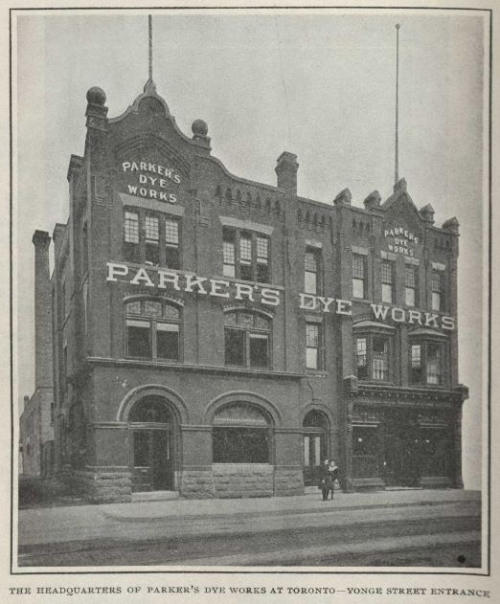
In 1876, Thomas Parker established a large “steam dyeing and scouring works” in Yorkville on the west side of Yonge Street just north of Davenport Road. The business soon was taken over by Thomas’s young son, Robert, who in 1885, relocated Parker’s Dye Works a few block south to James Wallis’s old smithy. In the same year, Yorkville architect Mancel Willmott, designed a three-storey, 30- by 150-foot building with three entrances on the east side of Yonge Street for the enterprise. As the business expanded with branches in Montreal, Hamilton, London and other Ontario places, along with hundreds of agencies across Canada, additions were made to the works, which boasted in 1901 that it was “the largest of the kind” in Canada.
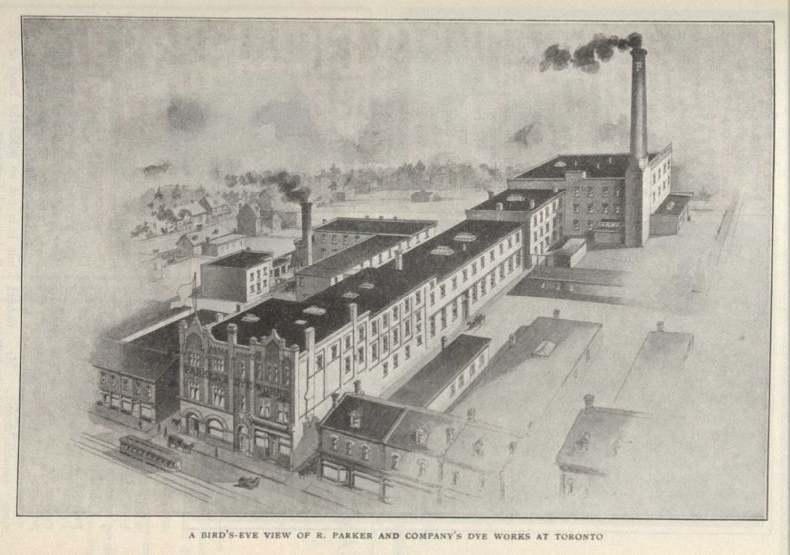
By 1908, Parker’s main offices and headquarters extended back several hundred feet east from Yonge Street with a T-shaped extension to Collier Street on the north and Bismarck (Asquith) Avenue on the south. The company remained at this location until the late 1950s. In 1961, Parker’s Dye Works and Cleaners advertised it had newly opened “Toronto’s first drive-through cleaning service” at 21-27 Yorkville Avenue. Its old Yonge Street headquarters were cleared of buildings by 1965, and much of the vacant land was used for a parking lot. In 1973, Tranby Holdings Limited owned the vacant land, where the Metropolitan Toronto Reference Library was constructed.
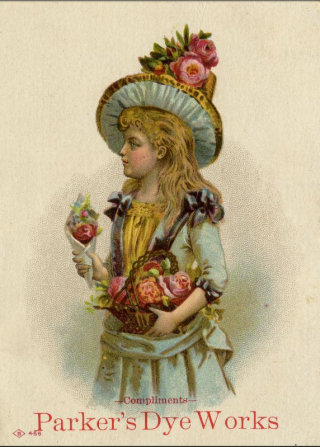
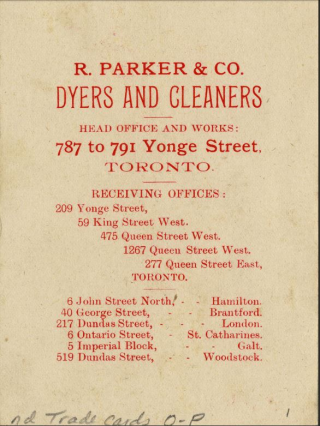
Parker’s Dye Works heavily promoted its services. In 1890, it circulated sheet music for an advertising jingle entitled We Dye to Live, which invited people to “Come! Come! Come! to Parker’s Dye Works” – set to the tune of Tramp! Tramp! Tramp! The Boys are Marching. Mary Lou Fallis included the piece in her 1997 recording of historic Canadian songs, Primadonna on a Moose.
The song’s title is rather ironic, since working at Parker’s could be unhealthy if not downright dangerous for its 125 workers. Many were regularly exposed to gasoline, benzene and other toxic chemicals used in the dyeing and cleaning processes, and these highly flammable materials occasionally exploded. An explosion in one of the outbuildings in October 1909 destroyed the structure and injured nine workers. A firefighter at the Yorkville Avenue station reported, "I was sitting in the hall when I heard it go off. As soon as the roar came I knew what was up. ‘There goes Parker’s Dye Works again, boys’, said I."
3. Buildings on Yonge Street at the southeast corner of Collier Street. Stood 1880s?-c.1973.
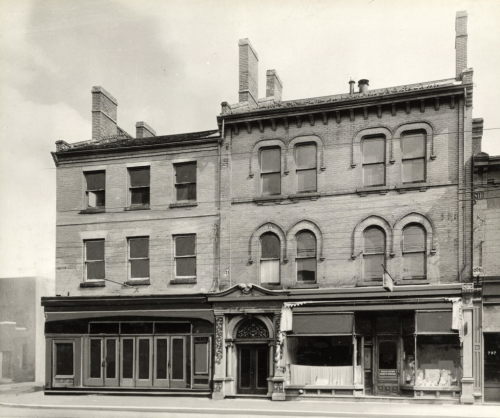
These buildings may have built between the 1880s and the early 1900s. In 1910, the year that this picture was taken, the Toronto city directory recorded that the the only occupant was a Masonic Lodge at 801 Yonge (centre); the rest of the buildings were vacant,
In the 1950s, Birdsall Dance Academy, operated by Fanny Birdsall (1898-1991) and her younger sister Helen Birdsall (1906-1988), was at 801 Yonge. Their dance school opened in Toronto in 1923, and over the next 60 years, thousands of children were taught there. The sisters also were involved in producing various dance shows across Toronto, including performances at Massey Hall, the Eaton Auditorium and the Canadian National Exhibition. Fanny retired in 1969 but both sisters were involved in teaching until 1983. In 1987, they were special guests to honour 50 years of choreographing CNE dance shows.
All of the buildings pictured here were demolished in 1973-4 to make way for the Toronto Reference Library. Previously Tranby Holdings Limited had owned 803 Yonge and 11 Collier Street, which had been leased to a music store, Long & McQuade.
4. Buildings on Yonge Street between today's Asquith Avenue and Collier Street. Stood 1880s – c. 1973.
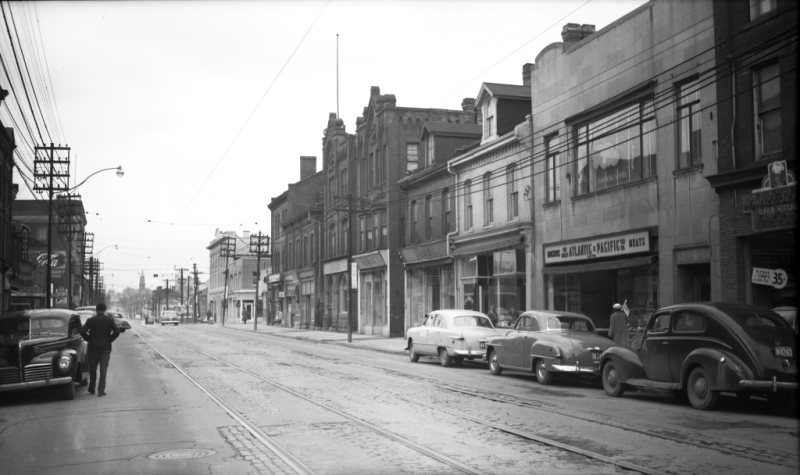
Several businesses are visible in this 1953 streetscape. Going north on the east (right) side of Yonge beyond Asquith Avenue, one can discern Three Sevens Open Kitchen restaurant (where fish and chips were 35 cents) at 777; an A & P grocery store with Patricia Stevens Finishing School upstairs at 779-781; and a shoe repair and a bakery at 783. Parker’s Dye Works and Cleaners occupied three store fronts in the middle of the block at 785-791 Yonge. It was gone from here by 1965, but the buildings on Yonge near the Asquith and Collier intersections were standing until they were acquired and demolished for construction of the Toronto Reference Library in the 1970s.
Note the streetcar tracks on Yonge Street. These were removed after the Toronto Transit Commission opened Canada's first subway in 1954 under Yonge Street between Union Station and Eglinton Avenue.
Find out more
To see originals of many of the items featured in the blog, join me for a Discover Special Collections talk on Wednesday November 1.
Everyone is welcome to the public celebration of the 40th anniversary on Thursday November 2 at 2 p.m. in the Atrium of the Toronto Reference Library.
More Toronto Public Library resources about Yorkville are available through our Toronto neighbourhoods map.
Much of the information on the blog is derived from Stephanie Hutcheson's book, Yorkville in Pictures, or my unpublished revision and expansion of it.
Related posts
Toronto Reference Library at 40: The Evolution of its Site. Part 1. Site and Street Name Changes
Toronto Reference Library at 40: The Evolution of its Site. Part 3. Asquith Avenue Frontage
30 thoughts on “Toronto Reference Library at 40: The Evolution of its Site. Part 2. Yonge Street Frontage”
It is interesting to imagine Yonge Street north of Bloor with wooden sidewalks and gas lamps, and Parker’s Dye Works and its somewhat sad history where Toronto Reference Library is now. You have really brought this area’s past alive!
It is interesting to imagine Yonge Street north of Bloor with wooden sidewalks and gas lamps, and Parker’s Dye Works and its somewhat sad history where Toronto Reference Library is now. You have really brought this area’s past alive!
It is interesting to imagine Yonge Street north of Bloor with wooden sidewalks and gas lamps, and Parker’s Dye Works and its somewhat sad history where Toronto Reference Library is now. You have really brought this area’s past alive!
Looking forward to the talk, Babsy! I plan on attending.
Looking forward to the talk, Babsy! I plan on attending.
Looking forward to the talk, Babsy! I plan on attending.
Hi Muriel
Thanks for you comments. It was a revelation to me about how much of the Toronto Reference Library site had been occupied by Parker’s Dye Works, and that they were on the property for 75 years!
Barb
Hi Muriel
Thanks for you comments. It was a revelation to me about how much of the Toronto Reference Library site had been occupied by Parker’s Dye Works, and that they were on the property for 75 years!
Barb
Hi Muriel
Thanks for you comments. It was a revelation to me about how much of the Toronto Reference Library site had been occupied by Parker’s Dye Works, and that they were on the property for 75 years!
Barb
Hi Edward
Looking forward to seeing you at the Discover Special Collections talk on Wednesday!
Barb
Hi Edward
Looking forward to seeing you at the Discover Special Collections talk on Wednesday!
Barb
Hi Edward
Looking forward to seeing you at the Discover Special Collections talk on Wednesday!
Barb
My grandmother played piano for the Birdsall Dance Academy. She retired at age 80 in 1968. Fanny and Helen were a highly respected team in the industry.
My grandmother played piano for the Birdsall Dance Academy. She retired at age 80 in 1968. Fanny and Helen were a highly respected team in the industry.
My grandmother played piano for the Birdsall Dance Academy. She retired at age 80 in 1968. Fanny and Helen were a highly respected team in the industry.
Hi Jennifer
Thanks for sharing the story about your grandmother. Clearly age was no barrier either for the Birdsall sisters or their pianist to continue working well past normal retirement. Good for them! Interestingly, a library staff member also has a relation that was a pianist for the Birdsalls.
Barbara Myrvold
Hi Jennifer
Thanks for sharing the story about your grandmother. Clearly age was no barrier either for the Birdsall sisters or their pianist to continue working well past normal retirement. Good for them! Interestingly, a library staff member also has a relation that was a pianist for the Birdsalls.
Barbara Myrvold
Hi Jennifer
Thanks for sharing the story about your grandmother. Clearly age was no barrier either for the Birdsall sisters or their pianist to continue working well past normal retirement. Good for them! Interestingly, a library staff member also has a relation that was a pianist for the Birdsalls.
Barbara Myrvold
Ottawa history fans seem only to know about the Parker’s business founded in Ottawa in 1876 by Thomas’ brother Robert, and few know there were two. (It appears the brothers sold off their Montreal business to launch these two new enterprises.) R. Parker and Co. of Toronto established an Ottawa Branch at 211 Sparks St. in 1911, in competition with the Ottawa Parker’s at 260 Sparks. That continued through 1923, after which there was only one which appears to have been an continuation of Ottawa-based business, and modern-day Parker’s history pages link it to Ottawa origins.
I’m looking for the history of Parker’s in Toronto say 1922-1930. Did this huge business really get absorbed by its Ottawa cousin? Or was it the other way around? Or…?
You might enjoy this photo from Library and Archives Canada of a (Toronto-based) Parker’s Dye Works Truck in Ottawa, June 1922 (MIKAN 3382063)
http://data2.archives.ca/ap/a/a033992.jpg
Ottawa history fans seem only to know about the Parker’s business founded in Ottawa in 1876 by Thomas’ brother Robert, and few know there were two. (It appears the brothers sold off their Montreal business to launch these two new enterprises.) R. Parker and Co. of Toronto established an Ottawa Branch at 211 Sparks St. in 1911, in competition with the Ottawa Parker’s at 260 Sparks. That continued through 1923, after which there was only one which appears to have been an continuation of Ottawa-based business, and modern-day Parker’s history pages link it to Ottawa origins.
I’m looking for the history of Parker’s in Toronto say 1922-1930. Did this huge business really get absorbed by its Ottawa cousin? Or was it the other way around? Or…?
You might enjoy this photo from Library and Archives Canada of a (Toronto-based) Parker’s Dye Works Truck in Ottawa, June 1922 (MIKAN 3382063)
http://data2.archives.ca/ap/a/a033992.jpg
Ottawa history fans seem only to know about the Parker’s business founded in Ottawa in 1876 by Thomas’ brother Robert, and few know there were two. (It appears the brothers sold off their Montreal business to launch these two new enterprises.) R. Parker and Co. of Toronto established an Ottawa Branch at 211 Sparks St. in 1911, in competition with the Ottawa Parker’s at 260 Sparks. That continued through 1923, after which there was only one which appears to have been an continuation of Ottawa-based business, and modern-day Parker’s history pages link it to Ottawa origins.
I’m looking for the history of Parker’s in Toronto say 1922-1930. Did this huge business really get absorbed by its Ottawa cousin? Or was it the other way around? Or…?
You might enjoy this photo from Library and Archives Canada of a (Toronto-based) Parker’s Dye Works Truck in Ottawa, June 1922 (MIKAN 3382063)
http://data2.archives.ca/ap/a/a033992.jpg
Hi Jaan
Thanks for supplying this interesting information about the Ottawa Parker’s.
I suggest that you start your search for the Toronto Parker’s 1922-1930 by consulting Toronto city directories which are available online: https://www.torontopubliclibrary.ca/history-genealogy/lh-digital-city-directories.jsp
Toronto newspapers of that time may also provide some documentation – Toronto Public Library provides online access to the historic Toronto Star and Globe and Mail databases to TPL cardholders. You could also check Canadiana online, which is now freely available. http://online.canadiana.ca/ It includes The Canadian Magazine, December 1908, which features the excellent article about the company.
Hi Jaan
Thanks for supplying this interesting information about the Ottawa Parker’s.
I suggest that you start your search for the Toronto Parker’s 1922-1930 by consulting Toronto city directories which are available online: https://www.torontopubliclibrary.ca/history-genealogy/lh-digital-city-directories.jsp
Toronto newspapers of that time may also provide some documentation – Toronto Public Library provides online access to the historic Toronto Star and Globe and Mail databases to TPL cardholders. You could also check Canadiana online, which is now freely available. http://online.canadiana.ca/ It includes The Canadian Magazine, December 1908, which features the excellent article about the company.
Hi Jaan
Thanks for supplying this interesting information about the Ottawa Parker’s.
I suggest that you start your search for the Toronto Parker’s 1922-1930 by consulting Toronto city directories which are available online: https://www.torontopubliclibrary.ca/history-genealogy/lh-digital-city-directories.jsp
Toronto newspapers of that time may also provide some documentation – Toronto Public Library provides online access to the historic Toronto Star and Globe and Mail databases to TPL cardholders. You could also check Canadiana online, which is now freely available. http://online.canadiana.ca/ It includes The Canadian Magazine, December 1908, which features the excellent article about the company.
Thanks for those suggestions, Barbara. It’s great that TPL has links for all those city directories!
And thanks for including the reference to the Canadian Magazine article in your blog – I had read it with great interest. Could I prevail on you for help with one more thing?
Articles on the Ottawa firm say Robert Parker had been in the business in Montreal with his (unnamed) brother to whom he had sold his interest before coming to Ottawa in 1876. I had determined the brother was Thomas who had a son Robert (age 12 in the 1870 census) and the business was British American Steam Dyeing and Scouring Works, prop. T. Parker, according to an ad in Lovell’s 1868 Montreal Directory. I had come to believe that Robert Parker’s business in Toronto was continuation of Thomas’ when I came across your blog saying the same. Indeed, if Thomas founded the Toronto business in 1876 as you write, then rather than brother Robert selling out to him it was more a case of the two brothers selling off the Montreal business to each start a new business for their sons to continue.
Now, what would really help me tie a bow on that early history is if you could provide a source for the information that Thomas founded the Toronto business (and that the year was 1876.) I did not see a mention of Thomas in the Canadian Magazine article. Do you recall where you learned about Thomas?
Here is a link to the 1868 Lovell Directory ad for the business in Montreal:
https://archive.org/details/cihm_36995/page/n565
Thanks for those suggestions, Barbara. It’s great that TPL has links for all those city directories!
And thanks for including the reference to the Canadian Magazine article in your blog – I had read it with great interest. Could I prevail on you for help with one more thing?
Articles on the Ottawa firm say Robert Parker had been in the business in Montreal with his (unnamed) brother to whom he had sold his interest before coming to Ottawa in 1876. I had determined the brother was Thomas who had a son Robert (age 12 in the 1870 census) and the business was British American Steam Dyeing and Scouring Works, prop. T. Parker, according to an ad in Lovell’s 1868 Montreal Directory. I had come to believe that Robert Parker’s business in Toronto was continuation of Thomas’ when I came across your blog saying the same. Indeed, if Thomas founded the Toronto business in 1876 as you write, then rather than brother Robert selling out to him it was more a case of the two brothers selling off the Montreal business to each start a new business for their sons to continue.
Now, what would really help me tie a bow on that early history is if you could provide a source for the information that Thomas founded the Toronto business (and that the year was 1876.) I did not see a mention of Thomas in the Canadian Magazine article. Do you recall where you learned about Thomas?
Here is a link to the 1868 Lovell Directory ad for the business in Montreal:
https://archive.org/details/cihm_36995/page/n565
Thanks for those suggestions, Barbara. It’s great that TPL has links for all those city directories!
And thanks for including the reference to the Canadian Magazine article in your blog – I had read it with great interest. Could I prevail on you for help with one more thing?
Articles on the Ottawa firm say Robert Parker had been in the business in Montreal with his (unnamed) brother to whom he had sold his interest before coming to Ottawa in 1876. I had determined the brother was Thomas who had a son Robert (age 12 in the 1870 census) and the business was British American Steam Dyeing and Scouring Works, prop. T. Parker, according to an ad in Lovell’s 1868 Montreal Directory. I had come to believe that Robert Parker’s business in Toronto was continuation of Thomas’ when I came across your blog saying the same. Indeed, if Thomas founded the Toronto business in 1876 as you write, then rather than brother Robert selling out to him it was more a case of the two brothers selling off the Montreal business to each start a new business for their sons to continue.
Now, what would really help me tie a bow on that early history is if you could provide a source for the information that Thomas founded the Toronto business (and that the year was 1876.) I did not see a mention of Thomas in the Canadian Magazine article. Do you recall where you learned about Thomas?
Here is a link to the 1868 Lovell Directory ad for the business in Montreal:
https://archive.org/details/cihm_36995/page/n565
Hello Jaan
My source for Thomas Parker is the Toronto directory for 1877. Here is the link: https://www.torontopubliclibrary.ca/detail.jsp?Entt=RDMDC-758720&R=DC-758720. Thomas Parker had at least two listings in this directory. The first was on p. 337 of the alphabetical section: PARKER THOMAS, PROPRIETOR ONTARIO DYEING AND SCOURING ESTABLISHMENT, WORKS AND OFFICE: 109 YONGE STREET, YORKVILLE.” The second entry was in the Yorkville section: “PARKER THOMAS, dyer and scourer, 109 Yonge, h 40 Hazleton av.” Here is its link: http://static.torontopubliclibrary.ca/da/pdfs/758720.pdf#page=407:
The 1877 directory appears to be the first one that had a listing for Thomas Parker. He was not included in the local directories for Toronto, York County or Yorkville published in 1876.
The Library’s introduction to Toronto city directories cautions researchers to be aware, “Information in each directory was usually compiled the previous year. This means that data contained in a directory predates the directory’s publication date by one year. For example, the directory for 1900 reflects the status of the site in 1899.” See https://www.torontopubliclibrary.ca/history-genealogy/lh-city-directories.jsp
Following this precaution, I may have erroneously assumed that Thomas Parker was in Toronto (Yorkville) in 1876, but he certainly was there in 1877.
If you want to do further checking on the Parker family’s early days in Yorkville, then I suggest that you consult Toronto Public Library’s new online finding aid, Places within Toronto in Digital Toronto City Directories, 1837-1969. It provides direct links to separate listings for Yorkville in Toronto city directories from 1866 to 1883, the latter being the year that Yorkville was annexed to the city; thereafter its listings were included with the main listings for Toronto. Here is the link: https://www.torontopubliclibrary.ca/history-genealogy/places-in-digital-toronto-city-directories.jsp
Barbara Myrvold
Hello Jaan
My source for Thomas Parker is the Toronto directory for 1877. Here is the link: https://www.torontopubliclibrary.ca/detail.jsp?Entt=RDMDC-758720&R=DC-758720. Thomas Parker had at least two listings in this directory. The first was on p. 337 of the alphabetical section: PARKER THOMAS, PROPRIETOR ONTARIO DYEING AND SCOURING ESTABLISHMENT, WORKS AND OFFICE: 109 YONGE STREET, YORKVILLE.” The second entry was in the Yorkville section: “PARKER THOMAS, dyer and scourer, 109 Yonge, h 40 Hazleton av.” Here is its link: http://static.torontopubliclibrary.ca/da/pdfs/758720.pdf#page=407:
The 1877 directory appears to be the first one that had a listing for Thomas Parker. He was not included in the local directories for Toronto, York County or Yorkville published in 1876.
The Library’s introduction to Toronto city directories cautions researchers to be aware, “Information in each directory was usually compiled the previous year. This means that data contained in a directory predates the directory’s publication date by one year. For example, the directory for 1900 reflects the status of the site in 1899.” See https://www.torontopubliclibrary.ca/history-genealogy/lh-city-directories.jsp
Following this precaution, I may have erroneously assumed that Thomas Parker was in Toronto (Yorkville) in 1876, but he certainly was there in 1877.
If you want to do further checking on the Parker family’s early days in Yorkville, then I suggest that you consult Toronto Public Library’s new online finding aid, Places within Toronto in Digital Toronto City Directories, 1837-1969. It provides direct links to separate listings for Yorkville in Toronto city directories from 1866 to 1883, the latter being the year that Yorkville was annexed to the city; thereafter its listings were included with the main listings for Toronto. Here is the link: https://www.torontopubliclibrary.ca/history-genealogy/places-in-digital-toronto-city-directories.jsp
Barbara Myrvold
Hello Jaan
My source for Thomas Parker is the Toronto directory for 1877. Here is the link: https://www.torontopubliclibrary.ca/detail.jsp?Entt=RDMDC-758720&R=DC-758720. Thomas Parker had at least two listings in this directory. The first was on p. 337 of the alphabetical section: PARKER THOMAS, PROPRIETOR ONTARIO DYEING AND SCOURING ESTABLISHMENT, WORKS AND OFFICE: 109 YONGE STREET, YORKVILLE.” The second entry was in the Yorkville section: “PARKER THOMAS, dyer and scourer, 109 Yonge, h 40 Hazleton av.” Here is its link: http://static.torontopubliclibrary.ca/da/pdfs/758720.pdf#page=407:
The 1877 directory appears to be the first one that had a listing for Thomas Parker. He was not included in the local directories for Toronto, York County or Yorkville published in 1876.
The Library’s introduction to Toronto city directories cautions researchers to be aware, “Information in each directory was usually compiled the previous year. This means that data contained in a directory predates the directory’s publication date by one year. For example, the directory for 1900 reflects the status of the site in 1899.” See https://www.torontopubliclibrary.ca/history-genealogy/lh-city-directories.jsp
Following this precaution, I may have erroneously assumed that Thomas Parker was in Toronto (Yorkville) in 1876, but he certainly was there in 1877.
If you want to do further checking on the Parker family’s early days in Yorkville, then I suggest that you consult Toronto Public Library’s new online finding aid, Places within Toronto in Digital Toronto City Directories, 1837-1969. It provides direct links to separate listings for Yorkville in Toronto city directories from 1866 to 1883, the latter being the year that Yorkville was annexed to the city; thereafter its listings were included with the main listings for Toronto. Here is the link: https://www.torontopubliclibrary.ca/history-genealogy/places-in-digital-toronto-city-directories.jsp
Barbara Myrvold