Toronto Reference Library at 40: The Library Catalogue, From Paper to Online
This month we are celebrating the 40th anniversary of Toronto Public Library’s largest branch, Toronto Reference Library (TRL). Over the past 40 years, TRL has undergone some drastic changes; from its relocation to Yonge and Bloor in 1977, to a megacity amalgamation 20 years later, to a major revitalization project in 2014.
But throughout these 40 years, there has been one piece of technology that has been vital to the functioning of this (or really any) library, and that my friends is the catalogue.
The catalogue has changed over the years. On Wednesday, November 2, 1977, TRL (which was named Metro Toronto Reference Library back then) first opened its doors. The library had relocated from College St. and St. George St. and with the move, came the wonderful wooden card catalogue technology. The catalogue back then was a wooden case with drawers, filled with 3X5 cards (in some systematic order of course) and it stood as the gateway to all of the library's wonders.
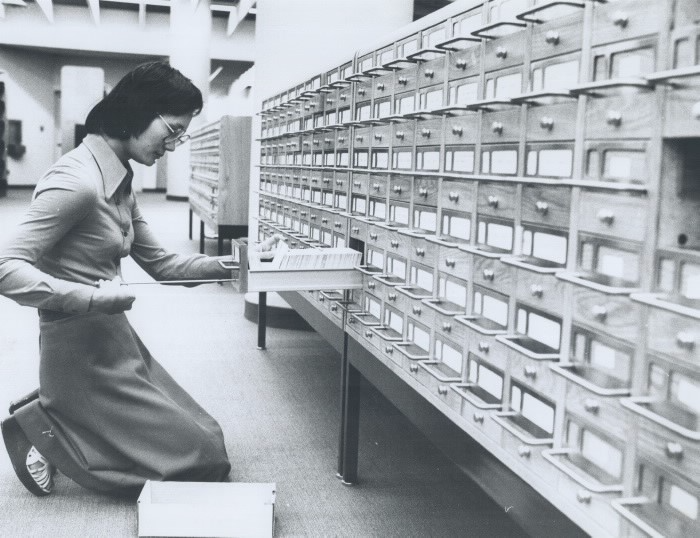
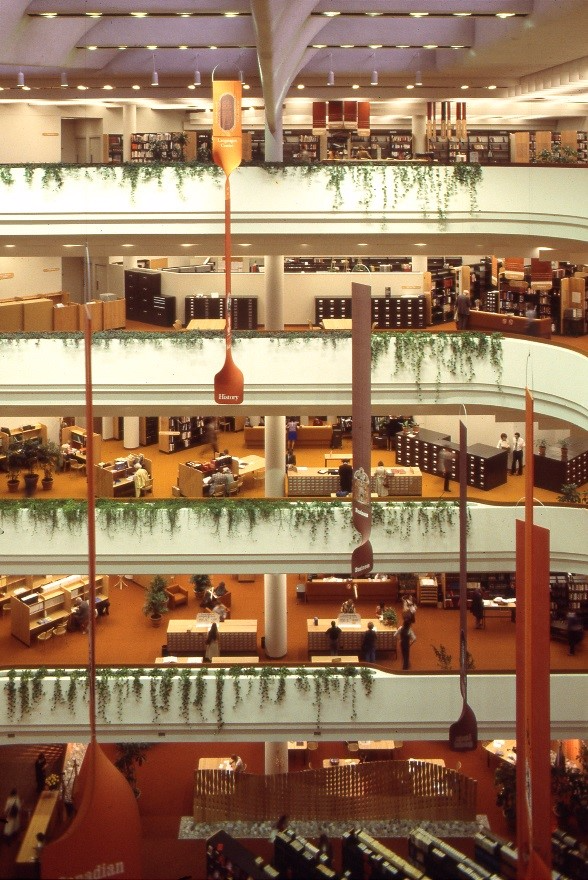
Metro Toronto Reference Library (MTRL), as it still stands today, had six floors and each department had their own card catalogue that provided access to information on print resources found on just those floors. Every day, clerical staff were given the tedious task of shelving stacks of index cards back into the catalog. What made it more difficult was that each book usually had at least three cards, one for the author’s name, one for the title of the book and one for the subject heading. For the user, this was great because it allowed for multiple access points when searching for materials.
Apart from directly operating its own library, Metropolitan Toronto Library Board was a regional library system that provided back-up services to the six city and borough public library systems making up the Metropolitan Toronto region (East York, Etobicoke, North York, Scarborough, Toronto and York). Hence why, separate to the catalogues found in each department, there was the Union Card Catalogue found downstairs in the Bibliographic Centre (where Book Ends is now). The Union Card Catalogue was a combined catalogue and listed the resources of all libraries found in the Metro Toronto Region.
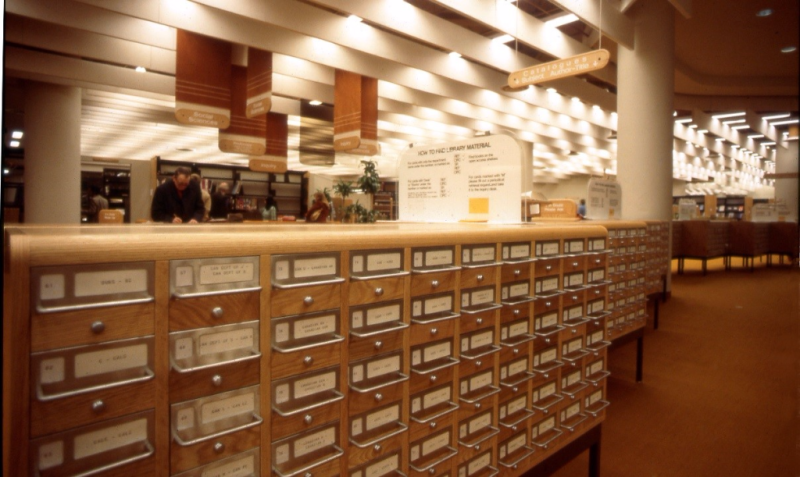
Until 1981, MTLB maintained 42 card catalogues and 15 shelf lists containing around six million cards. In 1981, the library closed its card catalogue and began its venture into the Computer Output Microfilm Catalogues (known as 'COM cats'). COM cats were great as they allowed for the storage of multiple records on a single flat sheet of microfiche. Within just two years, it soon contained 168,000 records.
The task of managing, sorting and filling millions of cards was complex but the mere size of these catalogues was the most obvious problem. As the size of our collection grew, so did the need for more space. The search for alternative methods began!
Soon after relocation, MTRL became a contractual user of the University of Toronto Library Automation System (UTLAS). This cataloguing support system was used for searching bibliographic information, online data entry, file storage and maintenance and more. To this day, staff still recall the difficulty they had in learning this software since they were trained remotely over the phone. Prior to amalgamation we had a few other cataloguing systems. Following UTLAS was WLN (Washington Library Network) and in 1995, we had VTLS (Virginia Tech Library System).
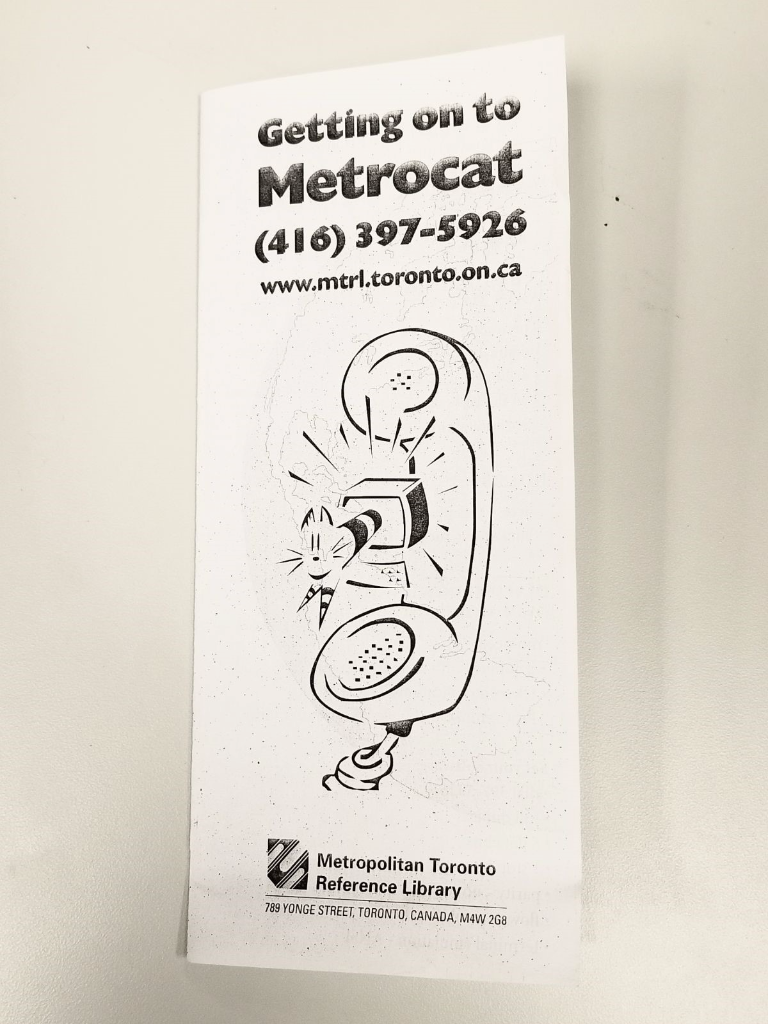
For customers, Metrocat was MTRL's first online catalogue. It was the online public access catalogue version of VTLS. TRL staff member, Karen from Access, was able to find this flyer in her locker, for a first time user:
In the late 80s, the Union Card Catalogue housed at MTRL was replaced with a Broadart Automation CD-ROM catalogue called MultiCat. MultiCat was installed on 15 workstations at the Reference Library and single workstations at each of the six city and borough public library systems that made up the Metropolitan Toronto Region. This catalogue contained 1.5 million records and the holdings of the reference and the city and borough libraries. MultiCat was a great alternative as it had lower operational costs and made better use of space.
Finally, in 1996 we had WorldVue. Heather Kessler (TPL's Manager of Acquisition & Cataloguing) describes it as “an in-house built menu system of resources including links to Metrocat, Internet sites, licensed databases and a few other resources”. It was known as a great technology for library users.
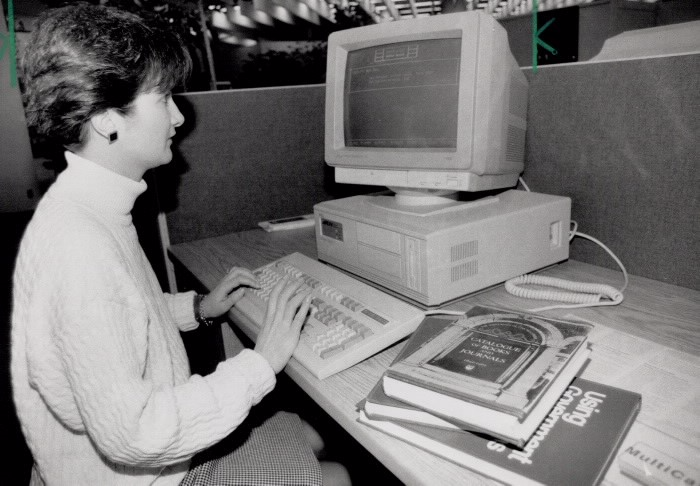
In 1998, the seven library boards (North York, York, Toronto, East York, Scarborough and Etobicoke) in Metropolitan Toronto decided to unite to become the Toronto Public Library. Having used different systems, amalgamation presented an opportunity to look into ways of combining their resources and to use a single automated library information system. As we became TPL, our long-term venture partnership with the SirsiDynix Corporation began.
Today, SirsiDynix’s Symphony is our integrated library system (ILS), the software we use to manage acquisition, cataloguing, and circulation of the library’s collections. We have built our own website using a content delivery platform and web services to present catalogue data in ways that make sense to library users.
Whether in print form or online, the catalogue has been a powerful instrument and provides us with the necessary tools and information to provide the best service to all our patrons.
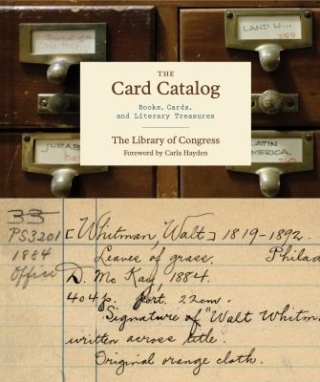
Looking to learn more? Here are some books in our online catalogue to marvel upon, on card catalogues and library classification.


Special thanks to those who shared their memories with me from over these past 40 years!
18 thoughts on “Toronto Reference Library at 40: The Library Catalogue, From Paper to Online”
Above you write that, “Every day, clerical staff were given the tedious task of shelving stacks of index cards back into the catalog.”
They were not shelving cards “back into” the catalog. Rather, they were filing new cards into the existing catalog. Also, it makes no sense to say they “shelved stacks of… cards” because “shelving” implies the use of shelves. Putting the 3″ x 5″ cards on shelves would be impractical, awkward and silly because the cards would fall off shelves. Cards were filed into the catalog drawers, which had sturdy metal rods which ran the length of drawers at the bottom of the cards and held the cards from falling out of the drawers because library cards came with holes already made at the centre bottom of all the cards; books were “shelved,” but not cards. Cards were filed.
Nor were these cards “index cards.” They were cards manufactured for use by libraries in card catalogs. Nearly all libraries in North America had card catalogs, which required a lot of cards.
Above you write that, “Every day, clerical staff were given the tedious task of shelving stacks of index cards back into the catalog.”
They were not shelving cards “back into” the catalog. Rather, they were filing new cards into the existing catalog. Also, it makes no sense to say they “shelved stacks of… cards” because “shelving” implies the use of shelves. Putting the 3″ x 5″ cards on shelves would be impractical, awkward and silly because the cards would fall off shelves. Cards were filed into the catalog drawers, which had sturdy metal rods which ran the length of drawers at the bottom of the cards and held the cards from falling out of the drawers because library cards came with holes already made at the centre bottom of all the cards; books were “shelved,” but not cards. Cards were filed.
Nor were these cards “index cards.” They were cards manufactured for use by libraries in card catalogs. Nearly all libraries in North America had card catalogs, which required a lot of cards.
Above you write that, “Every day, clerical staff were given the tedious task of shelving stacks of index cards back into the catalog.”
They were not shelving cards “back into” the catalog. Rather, they were filing new cards into the existing catalog. Also, it makes no sense to say they “shelved stacks of… cards” because “shelving” implies the use of shelves. Putting the 3″ x 5″ cards on shelves would be impractical, awkward and silly because the cards would fall off shelves. Cards were filed into the catalog drawers, which had sturdy metal rods which ran the length of drawers at the bottom of the cards and held the cards from falling out of the drawers because library cards came with holes already made at the centre bottom of all the cards; books were “shelved,” but not cards. Cards were filed.
Nor were these cards “index cards.” They were cards manufactured for use by libraries in card catalogs. Nearly all libraries in North America had card catalogs, which required a lot of cards.
While I agree with the points you raise, may I just say, there is a certain tut-tutting tone to them which is unfortunate.
I found it a very informative, even interesting blog post, notwithstanding the poor cards being shelved.
While I agree with the points you raise, may I just say, there is a certain tut-tutting tone to them which is unfortunate.
I found it a very informative, even interesting blog post, notwithstanding the poor cards being shelved.
While I agree with the points you raise, may I just say, there is a certain tut-tutting tone to them which is unfortunate.
I found it a very informative, even interesting blog post, notwithstanding the poor cards being shelved.
Everything you say is correct, Lousie, but what really irked me was the remark about the “tedious task”. I was one of the people entrusted with this job. Tremendous effort was made to train us, and we took great pride in filing these cards. Since much of the rest of our day involved searching the card card catalogue we knew first hand the consequences of any mistakes.
Everything you say is correct, Lousie, but what really irked me was the remark about the “tedious task”. I was one of the people entrusted with this job. Tremendous effort was made to train us, and we took great pride in filing these cards. Since much of the rest of our day involved searching the card card catalogue we knew first hand the consequences of any mistakes.
Everything you say is correct, Lousie, but what really irked me was the remark about the “tedious task”. I was one of the people entrusted with this job. Tremendous effort was made to train us, and we took great pride in filing these cards. Since much of the rest of our day involved searching the card card catalogue we knew first hand the consequences of any mistakes.
It is not just misleading, but factually incorrect to say that the libraries “decided” to unite. I won’t go into all the details here, but the Mike Harris government forced the former cities of Metropolitan Toronto to amalgamate, (despite about 80%+ of the citizens voting against this action), and hence the libraries had to amalgamate as well.
It is not just misleading, but factually incorrect to say that the libraries “decided” to unite. I won’t go into all the details here, but the Mike Harris government forced the former cities of Metropolitan Toronto to amalgamate, (despite about 80%+ of the citizens voting against this action), and hence the libraries had to amalgamate as well.
It is not just misleading, but factually incorrect to say that the libraries “decided” to unite. I won’t go into all the details here, but the Mike Harris government forced the former cities of Metropolitan Toronto to amalgamate, (despite about 80%+ of the citizens voting against this action), and hence the libraries had to amalgamate as well.
Oh my… In fact I found the rest of the blogpost very informative and only “tut-tutted” about the things I know best, if “tut-tutting” it was. I really appreciate Patricia Wright’s choice of the verb “entrusted” with regard to the card catalogue records and their ordering. Because filing, checking the filing, pulling those rods and dropping the cards into the old card catalogues–all those things really were matters of trust and still are today in the digital version of what remain the same processes. Except now the responsibility for such aspects of what is basically the same process, ordering and integrating records into compilations of records, have been entrusted to the database management systems and the computers, which are oblivious and will not bring any observed errors or difficulties to anyone’s attention at all in integrating new records into existing record databases, but will just unquestioningly file the records literally. It is not surprising that no mention was made of the then practiced, now unknown, intricate rules for filing cards into the different sections of the card catalogue, author-title or subjects, as for instance, as, for instance, when the same word was used as a person, place, or thing; or the separation and ordering of “Mc” and “Mac” name prefixes, when they were prefixes and not just letters at the beginning of names starting with Mc or Mac that were not prefixed, but instead all-one-word; etc., and more. This all sounds legalistic and tedious. But such rules arose to resolve intelligently perceived problems and were in fact elegant solutions. There was beauty in it.
Oh my… In fact I found the rest of the blogpost very informative and only “tut-tutted” about the things I know best, if “tut-tutting” it was. I really appreciate Patricia Wright’s choice of the verb “entrusted” with regard to the card catalogue records and their ordering. Because filing, checking the filing, pulling those rods and dropping the cards into the old card catalogues–all those things really were matters of trust and still are today in the digital version of what remain the same processes. Except now the responsibility for such aspects of what is basically the same process, ordering and integrating records into compilations of records, have been entrusted to the database management systems and the computers, which are oblivious and will not bring any observed errors or difficulties to anyone’s attention at all in integrating new records into existing record databases, but will just unquestioningly file the records literally. It is not surprising that no mention was made of the then practiced, now unknown, intricate rules for filing cards into the different sections of the card catalogue, author-title or subjects, as for instance, as, for instance, when the same word was used as a person, place, or thing; or the separation and ordering of “Mc” and “Mac” name prefixes, when they were prefixes and not just letters at the beginning of names starting with Mc or Mac that were not prefixed, but instead all-one-word; etc., and more. This all sounds legalistic and tedious. But such rules arose to resolve intelligently perceived problems and were in fact elegant solutions. There was beauty in it.
Oh my… In fact I found the rest of the blogpost very informative and only “tut-tutted” about the things I know best, if “tut-tutting” it was. I really appreciate Patricia Wright’s choice of the verb “entrusted” with regard to the card catalogue records and their ordering. Because filing, checking the filing, pulling those rods and dropping the cards into the old card catalogues–all those things really were matters of trust and still are today in the digital version of what remain the same processes. Except now the responsibility for such aspects of what is basically the same process, ordering and integrating records into compilations of records, have been entrusted to the database management systems and the computers, which are oblivious and will not bring any observed errors or difficulties to anyone’s attention at all in integrating new records into existing record databases, but will just unquestioningly file the records literally. It is not surprising that no mention was made of the then practiced, now unknown, intricate rules for filing cards into the different sections of the card catalogue, author-title or subjects, as for instance, as, for instance, when the same word was used as a person, place, or thing; or the separation and ordering of “Mc” and “Mac” name prefixes, when they were prefixes and not just letters at the beginning of names starting with Mc or Mac that were not prefixed, but instead all-one-word; etc., and more. This all sounds legalistic and tedious. But such rules arose to resolve intelligently perceived problems and were in fact elegant solutions. There was beauty in it.
When I began work at the University of Calgary Cataloguing Dept. in 1967 I had no knowledge of what I was going to do there. I was hired as a “Graduate Assistant.” That meant that I was hired by the library as a form of intermediate librarian in training, and after sufficient learning I would be able to apply my knowledge, (a B.Sc.) moving through the various departments of the Library. I began in Cataloguing and was thoroughly schooled in the filing rules and then began to spend one hour a day filing catalogue cards. In effect, what I was training for was to be a filing supervisor. The library clerks and technician would do the filing and I would check their work. A card was merely placed in position above the rod in the drawer and then finally dropped in position and pinned by the rod for searching by the library patron.
It was legalistic and tedious but the beauty of it is only hazily imitated by modern digital search and output techniques. I have missed many an important work as the sorting app screwed up, seemingly more frequently than filing done by homo sapiens!
When I began work at the University of Calgary Cataloguing Dept. in 1967 I had no knowledge of what I was going to do there. I was hired as a “Graduate Assistant.” That meant that I was hired by the library as a form of intermediate librarian in training, and after sufficient learning I would be able to apply my knowledge, (a B.Sc.) moving through the various departments of the Library. I began in Cataloguing and was thoroughly schooled in the filing rules and then began to spend one hour a day filing catalogue cards. In effect, what I was training for was to be a filing supervisor. The library clerks and technician would do the filing and I would check their work. A card was merely placed in position above the rod in the drawer and then finally dropped in position and pinned by the rod for searching by the library patron.
It was legalistic and tedious but the beauty of it is only hazily imitated by modern digital search and output techniques. I have missed many an important work as the sorting app screwed up, seemingly more frequently than filing done by homo sapiens!
When I began work at the University of Calgary Cataloguing Dept. in 1967 I had no knowledge of what I was going to do there. I was hired as a “Graduate Assistant.” That meant that I was hired by the library as a form of intermediate librarian in training, and after sufficient learning I would be able to apply my knowledge, (a B.Sc.) moving through the various departments of the Library. I began in Cataloguing and was thoroughly schooled in the filing rules and then began to spend one hour a day filing catalogue cards. In effect, what I was training for was to be a filing supervisor. The library clerks and technician would do the filing and I would check their work. A card was merely placed in position above the rod in the drawer and then finally dropped in position and pinned by the rod for searching by the library patron.
It was legalistic and tedious but the beauty of it is only hazily imitated by modern digital search and output techniques. I have missed many an important work as the sorting app screwed up, seemingly more frequently than filing done by homo sapiens!