“The Luminous Appearances of the Sea” and Other Old Library Programs

What programs did Toronto Public Library offer 150 years ago? It's a bit of a trick question. From 1830-1883, it was the Toronto Mechanics' Institute — the library's forerunner — that offered comparable educational programming. The institute was for working class Torontonians. So what programs did it offer? Several printed broadsides (posters) from our Digital Archive reveal specific lectures and classes — you might even think of these as early library programs.
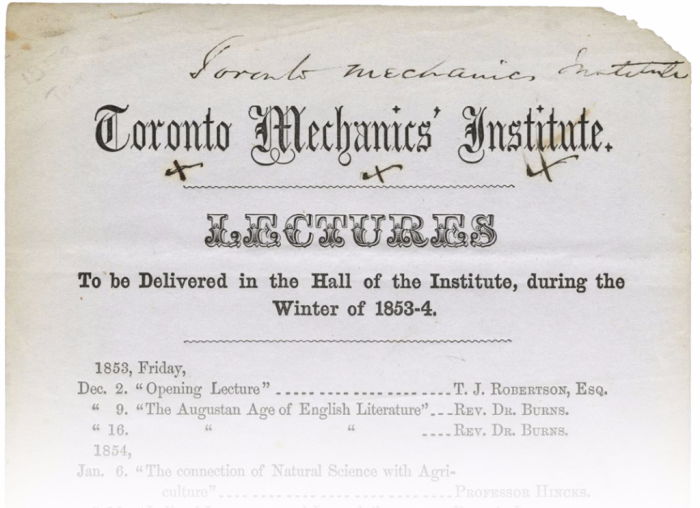
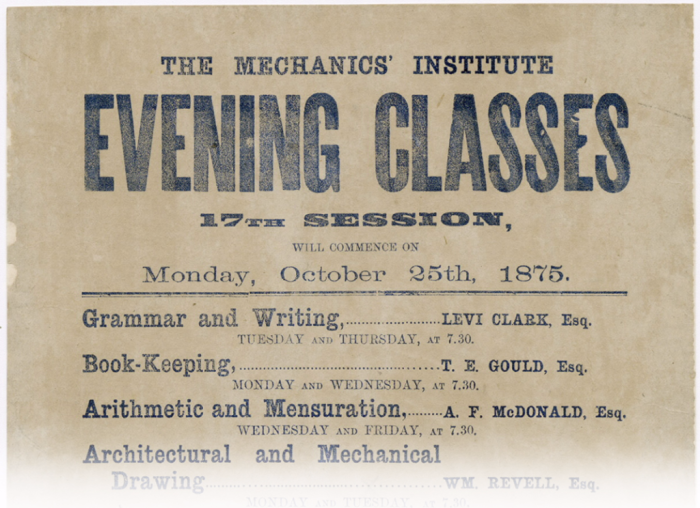
While there are some commonalities, these lectures were quite different than programs nowadays. Consider the term “lecture.” It suggests a formal structure with an academic focus. Indeed, many of the speakers had the title “Professor” or “Rev.” (Reverend), both associated with higher education at the time. Participatory storytimes, these were not. That said, more recent posters — like the one below from 1875 — list practical “classes” like “Book-Keeping” and “Telegraphic Operating.”
Here’s a sample of program names:
- The Luminous Appearances of the Sea
- Anomalies in the the Structure of Leaves
- Wax Flower Making
- The Mechanism of the Human Hand
- The Emotions
- The Advertisements of Ancient Romans
- Ancient Bibliography
- Water, Hydrogen, &c.
- Disinfectants and Deodorizers
- The Respiratory Function of Animals
- The Poetry of Insanity
- Philosophy—falsely so called
Unlike the library's current programs, these programs were not free. In some cases tickets were free or discounted for members, but membership was paid. Pricing was also tiered for single lectures versus full courses. While most current programs are single sessions, these older programs lasted weeks — the listed dates were just start dates. Some posters mention prizes “awarded amongst the most successful pupils” worth “one hundred dollars.”

In the item above, you might notice the line: “Ladies are especially invited.” There was debate about limiting women to courses “pertaining to their position in the world” but women were nonetheless encouraged to attend courses with incentives. Women attended for free or at a discounted rate. In part, the lower rates reflected the reality that working class women were paid less than men. By the late 1870s, 11% of students in evening classes were young women.
Young adults in general were a popular demographic for the institute. In the late 1870s, 65% of the students of evening classes were 18 years old or younger. In this sense, the library’s services to youth has very deep roots.
See Toronto Public Library's brief timeline of the Toronto Mechanics' Institute and beyond. For deeper dives into the classes of the institute, check out these academic articles:
- Open to All Classes on Terms of Perfect Equality": The Association of Mechanics’ Institutes and the Establishment of "Adult" Education in Ontario, 1868-1895 by Darren Neil Ferry
- Art and Industrial Society: The Role of the Toronto Mechanic’s Institute in the Promotion of Art, 1831-1883 by Ellen L. Ramsay
Digital Archive lets you access over 150,000 photos, postcards, maps, rare books and more from the library’s collections.
Explore more digitized library-related items here or explore the programs and classes we're currently offering.
27 thoughts on ““The Luminous Appearances of the Sea” and Other Old Library Programs”
Thank you for this blog and the link to the timeline of the Toronto Mechanics Institute and beyond. The history and photographs are very informative. The 1895 photo of Reference Library Staff is wonderful as it reflects the addition of women to new avenues of labour in this time period.
Thank you for this blog and the link to the timeline of the Toronto Mechanics Institute and beyond. The history and photographs are very informative. The 1895 photo of Reference Library Staff is wonderful as it reflects the addition of women to new avenues of labour in this time period.
Thank you for this blog and the link to the timeline of the Toronto Mechanics Institute and beyond. The history and photographs are very informative. The 1895 photo of Reference Library Staff is wonderful as it reflects the addition of women to new avenues of labour in this time period.
Thanks so much for this quaint, fun and informative post David! The titles of the various lectures are sometimes stiff and dry (or were they?), sometimes hilarious, sometimes poetic, so revealing of their time.
Thanks so much for this quaint, fun and informative post David! The titles of the various lectures are sometimes stiff and dry (or were they?), sometimes hilarious, sometimes poetic, so revealing of their time.
Thanks so much for this quaint, fun and informative post David! The titles of the various lectures are sometimes stiff and dry (or were they?), sometimes hilarious, sometimes poetic, so revealing of their time.
Thanks Susan. You bring up an interesting aspect of library history. It was indeed very positive that libraries expanded the limited opportunities for women at the time. There was a disturbing side effect, though. Some argue that library work — like social work, nursing and teaching — suffered from “feminization” of the profession. In short, “feminized professions” are professions dominated by women, which might be deemed less important simply because women are involved. These professions unfairly struggled — and continue to struggle — for pay and social prestige.
Thanks Susan. You bring up an interesting aspect of library history. It was indeed very positive that libraries expanded the limited opportunities for women at the time. There was a disturbing side effect, though. Some argue that library work — like social work, nursing and teaching — suffered from “feminization” of the profession. In short, “feminized professions” are professions dominated by women, which might be deemed less important simply because women are involved. These professions unfairly struggled — and continue to struggle — for pay and social prestige.
Thanks Susan. You bring up an interesting aspect of library history. It was indeed very positive that libraries expanded the limited opportunities for women at the time. There was a disturbing side effect, though. Some argue that library work — like social work, nursing and teaching — suffered from “feminization” of the profession. In short, “feminized professions” are professions dominated by women, which might be deemed less important simply because women are involved. These professions unfairly struggled — and continue to struggle — for pay and social prestige.
I must admit, I’d still be interested in attending many of these — I’d probably pick “The Advertisements of Ancient Romans.”
I must admit, I’d still be interested in attending many of these — I’d probably pick “The Advertisements of Ancient Romans.”
I must admit, I’d still be interested in attending many of these — I’d probably pick “The Advertisements of Ancient Romans.”
Love learning about TPL’s history. This is fascinating, thanks for sharing!
Love learning about TPL’s history. This is fascinating, thanks for sharing!
Love learning about TPL’s history. This is fascinating, thanks for sharing!
I read one of the classes as Arithmetic and Menstruation! (it was Mensuration) haha
I read one of the classes as Arithmetic and Menstruation! (it was Mensuration) haha
I read one of the classes as Arithmetic and Menstruation! (it was Mensuration) haha
In your defense, “mensuration” is not a common term! (I had to look it up, only to find that it indeed basically means “measuring”.)
In your defense, “mensuration” is not a common term! (I had to look it up, only to find that it indeed basically means “measuring”.)
In your defense, “mensuration” is not a common term! (I had to look it up, only to find that it indeed basically means “measuring”.)
Thanks for reading!
Thanks for reading!
Thanks for reading!
What a cool blast-from-the-past blog post on programming, David! It’s so interesting to see what was offered so long ago, especially with how popular programs are today! For instance, in 2015:
– 220,000 people attended preschool programs
– 83,000 people attended ESL programs
– 43,000 people attended technology training programs
– 207,000 people attended cultural programs
*Numbers were taken out of the 2016-2019 Strategic Plan.
What a cool blast-from-the-past blog post on programming, David! It’s so interesting to see what was offered so long ago, especially with how popular programs are today! For instance, in 2015:
– 220,000 people attended preschool programs
– 83,000 people attended ESL programs
– 43,000 people attended technology training programs
– 207,000 people attended cultural programs
*Numbers were taken out of the 2016-2019 Strategic Plan.
What a cool blast-from-the-past blog post on programming, David! It’s so interesting to see what was offered so long ago, especially with how popular programs are today! For instance, in 2015:
– 220,000 people attended preschool programs
– 83,000 people attended ESL programs
– 43,000 people attended technology training programs
– 207,000 people attended cultural programs
*Numbers were taken out of the 2016-2019 Strategic Plan.