I Tried Making a Recipe from Canada’s First Cookbook
Now that we're staying home due to COVID-19, I've seen many people baking bread and experimenting with their pantries. This modern pandemic seems to have brought us back to earlier times. In this spirit, I thought it'd be interesting to test a recipe from an early cookbook.
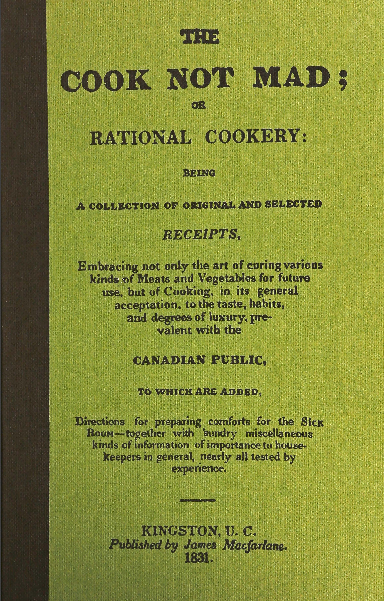
I chose the first cookbook published in Canada: The Cook Not Mad. (I won't repeat its full, fantastically-long 19th-century title here.) It's one of thousands of early Canadian books available on our Digital Archive.
Published in Kingston in 1831, this charming, palm-sized book includes recipes and household tips. Written for early settlers from Britain, the recipes reflect that heritage with adaptations for local ingredients.
Picking a recipe
Like the rest of Toronto, I’m following recommendations to limit trips to grocery stores during the pandemic. So my pantry lacked ingredients for some intriguing recipes in the book, like "Rice Snowballs" or "Federal Cake". However, I had everything for recipe number ninety-two, "Lemon Pudding".
The full recipe:
Four eggs, four ounces of sugar, one lemon grated with the juice, mix with four ounces of butter, one cup of cream, baked in a paste.
That’s it. Step by step it’s not, but let’s see. (Very brief recipes were common in the 1800s. They assumed the reader had experience with cooking and baking, so this shorthand was good enough.)
In old recipes, as in modern ones, it’s necessary to read to the end. Here, for example, the recipe ends with “Bake in a paste.” “Paste” sounds a little…icky, but translated into modern usage, this just means pastry. So our lemon pudding appears to be a tart.
Baking the recipe
The pastry base is not part of the recipe, so I prepared a standard one-crust pie dough and baked before adding the filling. This is often done for custard pies. Fortunately, I had the beans needed for blind baking (pre-baking) the crust.

Now for the filling. No details are given for how to put the ingredients together, so I guessed: I creamed the butter with the sugar; then added the juice and grated rind; then the eggs one by one, using a whisk to keep the mixture smooth. I mixed the cream in last, and poured the result into the cooled crust.
There’s no indication of baking temperature, which is not surprising since they didn’t have electric ovens in 1831. Custard pies are normally baked at a lower setting than fruit pies, so I set my oven to 350 Fahrenheit and left the pie in until it looked done, which took forty minutes.
The result
The end result tasted like a lemon square. My perception may be influenced by the fact that I ran out of chocolate or dessert in any form about a week ago, but it tasted pretty good to me. If you like lemon squares, and can’t run out to your nearest café to get one, why not try this recipe from the past?
A modern update of the recipe is available on page 75 of an annotated 1972 edition of the book if you'd prefer less guesswork. If you have your own suggestions for a different approach to the recipe, please share in the comments!

More from TPL
While you’re enjoying your lemon pudding, you can have a look at our online resources related to cooking:
- Vintage cookbooks in our Digital Archive (I hope to try The Dominion Cook Book next)
- Current and popular cookbooks available as ebooks from the library
- Our digital magazines include cooking magazines
48 thoughts on “I Tried Making a Recipe from Canada’s First Cookbook”
Ever clever, Peggy. Have you tried The Female Emigrant’s Guide by Catherine Parr Traill?
Ever clever, Peggy. Have you tried The Female Emigrant’s Guide by Catherine Parr Traill?
Ever clever, Peggy. Have you tried The Female Emigrant’s Guide by Catherine Parr Traill?
What a great idea! Looking forward to seeing what else you make and bake, Peggy!
What a great idea! Looking forward to seeing what else you make and bake, Peggy!
What a great idea! Looking forward to seeing what else you make and bake, Peggy!
No, I haven’t—but I’ll have a look!
https://www.torontopubliclibrary.ca/detail.jsp?Entt=RDMDC-37131055386056D&R=DC-37131055386056D
No, I haven’t—but I’ll have a look!
https://www.torontopubliclibrary.ca/detail.jsp?Entt=RDMDC-37131055386056D&R=DC-37131055386056D
No, I haven’t—but I’ll have a look!
https://www.torontopubliclibrary.ca/detail.jsp?Entt=RDMDC-37131055386056D&R=DC-37131055386056D
I can also recommend the “Economical Fruit Cake” in the Dominion Cook Book!
https://www.torontopubliclibrary.ca/detail.jsp?Entt=RDMDC-37131055351217D&R=DC-37131055351217D
I can also recommend the “Economical Fruit Cake” in the Dominion Cook Book!
https://www.torontopubliclibrary.ca/detail.jsp?Entt=RDMDC-37131055351217D&R=DC-37131055351217D
I can also recommend the “Economical Fruit Cake” in the Dominion Cook Book!
https://www.torontopubliclibrary.ca/detail.jsp?Entt=RDMDC-37131055351217D&R=DC-37131055351217D
Wow, well done! Hearkens back to a time when people just did stuff, every day, remembering it from having done it every day since childhood. So the explanations would be sort of like telling a grown-up how to boil water, today. Shows what a very different world we live in today, doesn’t it?
Lacking most of these basic “boil-water” skills myself, I am agog, and also wishing I could taste it myself! ‘Course, if I did have the skills then I would bake…and eat more baking… a wonderfully vicious circle. I’d need a larger family, though, to spare myself the need for all that willpower!
Thanks, Peggy, for your fascinating blog, with your great links. I am very impressed you followed the original recipe for lemon pudding, and it turned out so beautifully! I actually own the annotated 1972 edition of The Cook Not Mad, and I would certainly follow the instructions on page 75. You might be interested in A Century of Canadian Home Cooking, a wonderful compilation of Canadian recipes and food history from 1900 to the 1990s:
https://www.torontopubliclibrary.ca/detail.jsp?Entt=RDM786517&R=786517
I agree that a larger family would have been good to have around to share the pie. That’s another thing they did well in the 1800s!
I agree that a larger family would have been good to have around to share the pie. That’s another thing they did well in the 1800s!
I agree that a larger family would have been good to have around to share the pie. That’s another thing they did well in the 1800s!
I had already puzzled out the recipe and baked the pie when a coworker pointed out the more detailed 1972 recipe. Nothing like doing things the hard way. 😂 Thanks for the link!
I had already puzzled out the recipe and baked the pie when a coworker pointed out the more detailed 1972 recipe. Nothing like doing things the hard way. 😂 Thanks for the link!
I had already puzzled out the recipe and baked the pie when a coworker pointed out the more detailed 1972 recipe. Nothing like doing things the hard way. 😂 Thanks for the link!
Great post, Peggy! I was intrigued by “Federal Cake,” which sounds like something you’re forced to eat as punishment (“I hearby sentence you to twelve slices, to be served at home…”), but alas we do not have a pint of yeast on hand.
Great post, Peggy! I was intrigued by “Federal Cake,” which sounds like something you’re forced to eat as punishment (“I hearby sentence you to twelve slices, to be served at home…”), but alas we do not have a pint of yeast on hand.
Great post, Peggy! I was intrigued by “Federal Cake,” which sounds like something you’re forced to eat as punishment (“I hearby sentence you to twelve slices, to be served at home…”), but alas we do not have a pint of yeast on hand.
With good behavior you might get let off after just 10 slices…
A pint of yeast sounds like a lot, but those old yeast proportions don’t map neatly onto what we have commercially available now. Another recipe I tried required a “gill” of yeast, but a packet of instant dry yeast did the trick.
You could give it a try. Maybe you’ll find yourself saying, “Please sir, I want some more!”
Well that was a fun adventure with a good outcome! I enjoyed reading this, Peggy.
Also curious – were you formerly a school librarian at 20th St? If so, our paths have crossed!
Well that was a fun adventure with a good outcome! I enjoyed reading this, Peggy.
Also curious – were you formerly a school librarian at 20th St? If so, our paths have crossed!
Well that was a fun adventure with a good outcome! I enjoyed reading this, Peggy.
Also curious – were you formerly a school librarian at 20th St? If so, our paths have crossed!
Thank you, Jessica.
I have never been a school librarian, but I have been both a children’s librarian and a high school outreach librarian for Toronto Public Library. Our paths may not have crossed, but they have likely run parallel at times!
Thank you, Jessica.
I have never been a school librarian, but I have been both a children’s librarian and a high school outreach librarian for Toronto Public Library. Our paths may not have crossed, but they have likely run parallel at times!
Thank you, Jessica.
I have never been a school librarian, but I have been both a children’s librarian and a high school outreach librarian for Toronto Public Library. Our paths may not have crossed, but they have likely run parallel at times!
What a cool experiment! Is this something you’d bake again?
What a cool experiment! Is this something you’d bake again?
What a cool experiment! Is this something you’d bake again?
Yes, I would, but I think I prefer lemon squares with a shortbread-style butter crust rather than the lard-based one I used here.
That being said, I find it so interesting to experiment with the options. One of the things I like about the approach taken in these old cookbooks is that they encourage working with what you have. There are a lot of similar recipes that can be selected from based on whether you’re short on butter, have a surfeit of eggs, etc.
Thank you for your comment!
That’s awesome Peggy! What a fun idea. Your lemon pudding looks delightful! I’m glad you chose that one to make; from what I remember when I went through that cookbook, there are some pretty gruesome sounding recipes in there!
That’s awesome Peggy! What a fun idea. Your lemon pudding looks delightful! I’m glad you chose that one to make; from what I remember when I went through that cookbook, there are some pretty gruesome sounding recipes in there!
That’s awesome Peggy! What a fun idea. Your lemon pudding looks delightful! I’m glad you chose that one to make; from what I remember when I went through that cookbook, there are some pretty gruesome sounding recipes in there!
This is awesome! I love old cookbooks and the way the recipes reflect the times. I’m lucky to own a 1900 copy of Mrs Beaton’s All About Cookery and a c1909 Glasgow Cookery Book. They often give directions such as “make a sauce in the usual way”, and the Scottish one has several recipes that use 1/2 an egg, assuming you would split the egg to make 2 different dishes.
As to your recipe, it looks divine!