Sweet Tears was a Robot.
When I was a child I had a doll whose factory name was Sweet Tears. My grandfather, apprised of the doll's special talents (Sweet Tears could "drink," and pee, and as her name suggests, cry) was flummoxed. Why, even if you liked dolls, would you want it to do those things? Is it the verisimilitude? The ramping up to later-life caregiving? Or a more obscure attempt to observe ourselves in simplified form, and by imitation parse the differences between real and made?
Which brings me to The Invention of Hugo Cabaret, the bestselling book by Brian Selznick and Academy Award-winning movie. If you've read or seen the story, you know that at its centre is a mysterious automaton what the character namesake Hugo is trying to rebuild. The automaton is a lynchpin in the plot, but is also emblematic of the fascination we have with the "place" where human and technological intersect – very much a theme of the book and movie. The automaton is mysterious, and familiar.
Every age has its version:
Hephaestus, ancient Greek god of fire and manufacture, engineered the kourai khyseai . . . golden robot handmaidens . . .
Homer, Iliad 18.416 ff (translation, Lattimore)
"[Hephaistos left his bellows] took up a heavy stink in his hand, and went to the doorway limping. And in support of their master he moved his attendants. These are golden, and in appearance like living young women. There is intelligence in their hearts, and there is speech in them and strength, and from the immortal gods they have learned how to do things. These stirred nimbly in support of their master."
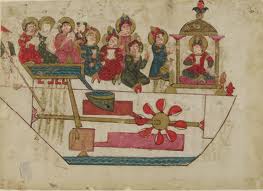
Al-Jazari (1136-1206) wrote The Book of Knowledge of Ingenious Mechanical Devices, which describes how to make different automata, including a robot band!
Mary Shelly explored the nexus between human and manufactured human in her 1818 novel Frankenstein.

Our modern versions of automata are whimsical: "Don't Tase Me Bro'!" . . .
Wrouggghh! . . .
. . . and look forward to an age that sees the distinctions between organism and machine blur yet more.

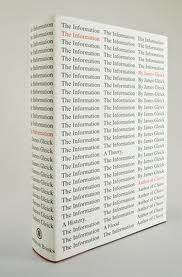
The new James Gleick book called The Information: a History, a Theory, a Flood also addresses – with extraordinary scope that includes chapters on language, bio-chemistry, cybernetics, physics, math – the ways in which humans and other organisms are more like machines than we once imagined.
2 thoughts on “Sweet Tears was a Robot.”
I believe Peter Carey’s new novel, The chemistry of tears, also deals with automata. They are very much front and “click, click” center.
Thanks LC. In some sense, it appears they always were. Just that science is catching up with intuition?