Snapshots in History: July 3: Remembering Franz Kafka
On July 3 and beyond, take a moment to remember Franz Kafka
(Born: July 3, 1883 in Prague, Bohemia, Austria-Hungary; Died: June 3, 1924 in
Kierling, Austria), an influential Czech-German-Jewish writer whose writing in
the original German (also translated into English and other languages) was
filled with examples of alienation, psychological or physical cruelty, endless
bureaucracy, and inexplicable transformations. Following his training as a
lawyer, he worked for an insurance company but began to write short stories in
his spare time. Most of Kafka’s work was published posthumously, mainly of
account of the refusal of Kafka’s friend Max Brod
to burn Kafka’s manuscripts (as per Kafka’s request) upon his death. Despite
being the literary executor of Kafka’s estate, Brod had previously told Kafka
that he would not accede to his request to destroy his manuscripts. Brod held
Kafka’s writing in high regard and sought to have them published. Most of
Kafka’s work was published following his demise.
Consider the
following selected titles by Franz Kafka for loan from Toronto Public Library
collections:
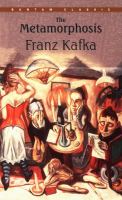
Metamorphosis
[Bantam classic ed.] / Franz Kafka, 1981. Book. Adult Fiction.
After disturbing dreams, Gregor Samsa wakes up and
finds himself transformed into an insect. His family feels horrified and
disgraced; Gregor in turn feels alienated from his family and society but
gradually comes to accept the transformation. Feelings of inadequacy, guilt,
and isolation come to the fore in this story.
See also: eBook
(2000), eBook
(2004), eBook
(2005), eBook
(2009), eAudiobook
(2011), eAudiobook
(2011).
See also: Audiobook
CD (2003).
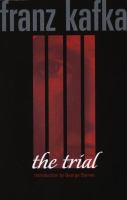
The
trial [Definitive ed.] / Franz Kafka, 1968, c1946. Book.
Adult Fiction.
Joseph K., a respected bank employee, is arrested
suddenly and surprisingly and is confounded by the situation of defending
himself against a charge about which he cannot find out anything. He also does
not know who his judges are and his trial drags out for a year until he is executed.
Was he guilty? If so, of what? Beware of blind and bureaucratic
totalitarianism.
See also: eAudiobook
(2011).
See also: Audiobook
CD (2007).
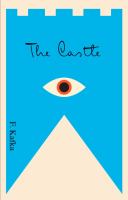
The
castle / Franz Kafka, 1998. Book. Adult Fiction.
In one of Kafka’s incomplete novels, K., an underappreciated
land surveyor, undertakes a futile and incessant attempt to gain access to the
castle. K. is not accepted in the village and he is not able to go home.
See also: Audiobook
CD (1998).
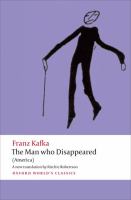
The
man who disappeared (America) / Franz Kafka, 2012.
Book. Adult Fiction.
Kafka’s first (and incomplete) novel focuses on
16-year old Karl Rossmann who was compelled by his family to leave for the
United States, following his seduction by a female servant. Karl befriends a
ship’s stoker but meets up with his uncle, Senator Jacob, who abandons him
after Karl seeks out a friend of his uncle without first seeking his uncle’s
permission. Karl becomes mixed up with two drifters named Robinson and
Delamarche who take advantage of him but Karl finds it hard to get away.
Finally, he escapes the drifters after having landed a job with the Nature
Theatre of Oklahoma.
See also: eBook
(1996)
Want to learn more about Frank Kafka himself? Then
consider borrowing the following title from Toronto Public Library collections:
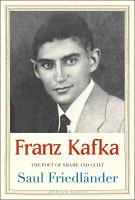
Franz
Kafka: the poet of shame and guilt / Saul Friedländer,
2013. Book. Adult Non-Fiction.
Historian Friedländer focused on Kafka’s ambivalent
relationships with family, friends, lovers, Judaism, and his own physical
being. The author alleged that Kafka was homosexual despite acknowledging that
Kafka was only involved with women in a romantic sense. On the one hand, the
book touched upon Kafka’s melancholy but also accounted for his socializing
with friends, frequenting nightclubs, and flirting with women. Undoubtedly,
Kafka was a complicated individual.
Comments