Snapshots in History: May 15: Remembering the Winnipeg General Strike
(Credit: CBC Digital Archives – Remembering the Winnipeg General Strike – Medium: Radio; Program: Between Ourselves; Broadcast Date: May 15, 1969; Guest(s): Jim Walker; Duration: 3:11 – URL: http://www.cbc.ca/archives/categories/economy-business/labour-unions/labour-unions-general/remembering-the-winnipeg-general-strike.html – See also: http://www.cbc.ca/player/Digital%2BArchives/Economy%2Band%2BBusiness/Labour%2Band%2BUnions/ID/1721210423/ )
(Credit: YouTube – Winnipeg General Strike (montage of past and more recent images from Winnipeg) – Uploaded on November 24, 2008)
On May 15, take a moment to remember the Winnipeg General Strike and its impact upon the history of Canada and its working people. Canada’s best known and largest general strike began on May 15, 1919 and concluded on June 25, 1919. The strike occurred amidst high inflation and unemployment (including unemployed soldiers) following the end of the First World War. Throw into the mix the success of the Russian Revolution, the rise of revolutionary industrial unionism as demonstrated by the presence of the Industrial Workers of the World (IWW) (also known as “the Wobblies”) and the One Big Union (OBU) movement, and a context was created that was ripe for some degree of worker unrest.
Negotiations faltered between management and labour negotiators in the building and metal trades so the Winnipeg Trades and Labor Council (WTLC) called a general strike over the issues of collective bargaining, better pay rates and working conditions. Workers in other trades and jobs soon joined the strike in sympathy for a total of some 30,000 workers engaged in work stoppage action. Winnipeg was brought to a standstill with closed factories, suspended street cars, and various public sector employees (including: police, fire, postal workers, telephone operators, and other public utility employees).
The Central Strike Committee oversaw the strike’s operations with membership from each of the unions belonging to the Winnipeg Trade and Labor Council (WTLC), negotiated with employer representatives and coordinated the delivery of essential services to Winnipeg residents. As a counterpoint, business interests were represented by the Citizens’ Committee of 1,000 who were strongly opposed to the strike as a manifestation of revolutionary conspiracy controlled by foreigners. Evidence was lacking as to the charge of foreign control and revolutionary intent but the Citizens’ Committee continued to make these charges to thwart any attempts at compromise with workers.
Fearful of the spread of labour unrest, the federal government intervened by ordering federal employees to return to work or be dismissed from their jobs, by amending the Immigration Act to deport British-born immigrants as needed, and by amending the Criminal Code to broaden the definition of sedition. The government arrested 10 strike leaders and two representatives on June 17, 1919. On June 21, 1919, “Bloody Saturday” resulted in 29 injuries and one death when a contingent of Royal North-West Mounted Police charged into a crowd of striking workers. Six labour leaders were released by the Canadian government but Fred Dixon and James S. Woodsworth were arrested. Federal troops were brought in to occupy the city. The strikers discontinued their work stoppage and returned to work on June 25, 1919.
Sympathetic strikes occurred in places far removed from Winnipeg, Manitoba such as Amherst, Nova Scotia and Victoria, British Columbia. Seven strike leaders were convicted of conspiracy to overthrow the government. Fred Dixon was acquitted by a jury and the sedition charge against J.S. Woodsworth was dropped. Decades would pass before more robust union recognition was in place and collective bargaining became more commonplace in labour-management relations.
Consider the following titles for borrowing from Toronto Public Library collections:

Winnipeg's General Strike: Reports from the Front Lines / Michael Dupuis, 2014. Book. Adult Non-Fiction. 331.8925 DUP
This book dealt with the issue of media coverage of the Winnipeg General Strike as the public turned to magazines and newspapers of the day for information to make up their own minds about Canada’s largest general strike. The Toronto Daily Star newspaper was generally sympathetic towards the strikers as people fighting for fair treatment rather than seeking to overthrow the Canadian political system. Listen to the radio clip below in which the author discussed this book:
(Credit: CBC Radio – Information Radio (Manitoba) – May 13, 2014; Duration: 7:31 – URL: http://www.cbc.ca/player/AudioMobile/Information%2BRadio%2B-%2BMB/ID/2456316675/ )
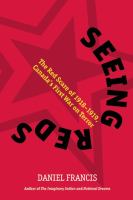
Seeing reds: the red scare of 1918-1919, Canada's first war on terror / Daniel Francis, 2010. Book. Adult Non-Fiction. 971.061 FRA
Historian Daniel Francis put the 1918-1919 period in Canada’s history into perspective with the Canadian business and political establishment fearful of a recurrence of the Russian Revolution in Canada. Francis compared the Canadian situation with similar activities in European countries and the United States. Legitimate labour leaders were labelled as “Bolsheviks” or “Reds”. Move forward in time with a comparison to the more recent “war on terror” in which free speech and political differences have also been subjected to pressures in the name of national security.
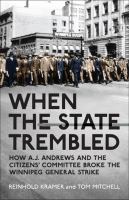
When the state trembled: how A.J. Andrews and the Citizens' Committee broke the Winnipeg General Strike / Reinhold Kramer and Tom Mitchell, 2010. Book. Adult Non-Fiction. 331.8925 KRA
Read the captivating story of the Citizens’ Committee of 1,000 formed by leading business figures to combat the Winnipeg General Strike. Learn about the close strategic, co-operation between Citizen’s Committee lawyer A.J. Andrews and Justice Minister Arthur Meighen to undermine the strike and brand it as criminal activity, divide the working class, and lobby for the support of the middle class. Ultimately, the labour movement was defeated at this event and the trials of strike leaders on sedition charges demonstrated a fear of radicalism, although the charges against James S. Woodsworth were dropped after a jury acquitted fellow labour leader Fred Dixon. One strike leader was deported to the United States.
On strike: the Winnipeg General Strike, 1919 [1 videodisc] / National Film Board of Canada; Directors: Joe MacDonald, Clare Johnstone Gilsig; Producers: Joe MacDonald, Keith Packwood; narrator: Vlasta Vrana, 2008. DVD. Documentary. Adult Non-Fiction. 331.89297 ONS PPR. Public Performance Rights.
This short NFB documentary told the story of the Winnipeg General Strike through personal remembrances from people who experienced the events as they unfolded. Follow the timeline of events leading up to the strike, the issues and the personalities related to the strike as well as cleavages amongst the population of Winnipeg, culminating in the riot of June 21, 1919 (“Bloody Saturday”) when death and injury occurred.
This documentary is available for direct viewing from the National Film Board of Canada website through the following URL:
http://www3.nfb.ca/objectifdocumentaire/index.php?mode=view&language=english&filmId=33
(Credit: National Film Board of Canada – On Strike: The Winnipeg General Strike, 1919; 1991, Joe MacDonald, Clare Johnstone Gilsig; 19 min 46 s)
(Those interested in National Film Board of Canada documentaries might find the following short one to be of interest, available for direct viewing from the NFB website:
http://www3.nfb.ca/duneculturealautre/toutvoir_vis.php?mediaid=665739&mc=101&full
(Credit: National Film Board of Canada – Lost Dreams, 1999 – director: Daniel Frenette; Film (5:51))
Follow the story of Ukrainian-Canadian Kateryna Ewanchuck and her fight for social justice and against oppression and discrimination by participating in the One Big Union (OBU) and the 1919 Winnipeg General Strike. )
Bloody Saturday: the Winnipeg general strike [1 videodisc] / CBC Learning, 2007. DVD. Documentary. Adult Non-Fiction. 331.8925 BLO
This Canadian Broadcasting Corporation documentary special provided a 45-minute overview of the largest strike in Canadian history when 30,000 workers walked off the job in Winnipeg seeking better pay, working conditions, and recognition for organized labour. The strike lasted for six weeks and was called off by labour leaders following the events of “Bloody Saturday” on June 21, 1919.
Prairie fire: the Winnipeg General Strike of 1919 [1 videodisc] / Filmwest Associates, 1999. DVD. Documentary. Adult Non-Fiction. 331.89297 PRA
This documentary used both eyewitness accounts and archival images to tell the story of the Winnipeg General Strike, including the social conditions faced by people at the time and the historical importance of the strike itself. Historians and labour leaders discussed the influence of the strike on shaping Canada’s labour movement to more recent times.
Comments