Snapshots in History: February 2: Remembering the Battle of Stalingrad

(Center of Stalingrad after liberation – February 2, 1943 – Credit: RIA Novosti)
On February 2 and beyond, take a moment to remember the conclusion of the Battle of Stalingrad on February 2, 1943 that resulted in approximately 2 million casualties altogether between the German and their allied forces and the defending Soviet forces. If one goes back to the summer of 1942, in particular late June, July and August, the German forces initiated Case Blue which consisted of a two-pronged thrust towards the city of Stalingrad on the Volga River, a major industrial city on a major transportation waterway, and further south towards the Caucasus region with its rich oil fields, a substantial prize for sustaining a major war effort. Capturing Stalingrad was supposed to protect the German push into the Caucasus region.
German forces had major tank and air support in pushing forward. The Luftwaffe had bombed Soviet troop and supply ships on the Volga River in late July 1942. On August 23, 1942, a major aerial bombardment by the Luftwaffe resulted in a firestorm in Stalingrad, causing thousands of deaths and rendering the city a burnt-out and rubble-laden city. This bombardment set the stage for the subsequent close quarters of building-by-building, floor-by-floor urban warfare fighting in Stalingrad itself between German and Soviet forces, dubbed by the Germans as “rat war” (or Rattenkrieg). General Vasily Chuikov, commander of the Soviet 62nd Army, was given the unenviable task of defending Stalingrad to the last person. “Not a step back” reflected the order from Moscow not to retreat or there would be dire consequences. In fact, some Soviet soldiers were executed for cowardice.
The German Sixth Army became trapped in Stalingrad as a result of Operation Uranus on November 19, 1942, initiated by Soviet General Georgy Zhukov, in which counter-attacking Soviet forces overran the Romanian Third Army, thereby cutting off the German Sixth Army from the remainder of the German and their allied forces. The Luftwaffe’s attempt to transport in supplies to the trapped German Sixth Army was a failure as was the German Army’s relief effort, Operation Winter Storm, under Field-Marshal Erich von Manstein from December 12-23, 1942. The subsequent Soviet capture of the Pitomnik and Gumrak airfields on January 16, 1943 and January 21/22, 1943 respectively meant that the Luftwaffe could no longer take out wounded German soldiers. The area remaining for the trapped German and allied soldiers, known as the “Kessel” (or cauldron) became increasingly smaller. German forces were reduced to two holdout pockets with the first surrendering on January 30, 1943 and the second on February 2, 1943. Some 10,000 German soldiers refused to surrender and held out for another month.
The Battle of Stalingrad has been regarded by many as a turning point in the European theatre of World War Two as German forces were pushed back westwards until eventual capitulation in May 1945. Consider the following titles for borrowing from Toronto Public Library collections:
Books by Military Commanders:
The beginning of the road / Vasilii Ivanovich Chuikov; translated by Harold Silver, 1963. Book.
Marshal Zhukov’s greatest battles / Georgii Kostantinovich Zhukov; edited and introduced by Harrison Salisbury; translated by Theodore Shabad, 1969. Book.
Some Key Sources about the Battle of Stalingrad:
199 days: the Battle for Stalingrad [1st ed.] / Edwin Palmer Hoyt, 1993. Book.
Military historian Hoyt effectively used secondary sources as well as German and Russian accounts (and more recently available material from Russian archives) to set the stage for the battle. The German military commanders did not challenge their supreme leader’s orders, while the Soviet military commanders enjoyed more leeway from their leadership in executing operations that facilitated the first major victory for the Red Army in World War Two.
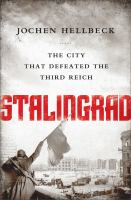
Stalingrad: the city that defeated the Third Reich / Jochen Hellbeck, 2015. Book.
This book was originally published in the German language in 2012. Historian Jochen Hellbeck interviewed both German and Russian/Soviet veterans from the Battle of Stalingrad. Unlike some other books on the subject, Hellbeck has presented the Soviet defenders in human terms. Portraits of and interviews with some of these Soviet and German veterans can be found on the author's website facingstalingrad.com .
Also available in eBook format (Access Online).

Stalingrad: the fateful siege: 1942-1943 [1st American ed.] / Antony Beevor, 1998. Book.
Military historian Beevor used primary sources in German and Russian as well as more newly-available Soviet archival material to offer the reader arguably the best account of this most important turning point battle of the Second World War on the Eastern Front. The context is set: soldiers on both sides of the battle fought under the watchful eye of Nazi and Soviet totalitarian regimes (or else) while dealing with both the horrible and the boring. But do not forget the civilian population of Stalingrad (many of whom were not allowed to leave the city) who also suffered deprivation and death among with the military combatants.
Also available in eBook format (Access Online).
Also available in Hungarian and Polish book formats.
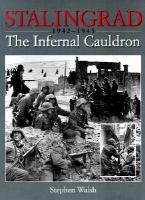
Stalingrad: the infernal cauldron, 1942-1943 / Stephen A. Walsh, 2000. Book.
Military historian Walsh provided a detailed account of the Stalingrad battle that lasted over 140 days and resulted in a crushing defeat for the German 6th Army. The reader is introduced to many black and white photographs that had not been published previously as well as detailed appendices offering information on the orders of battle, losses, and equipment.
Documentaries:
BBC History of World War II. War of the century, when Hitler fought Stalin / Laurence Rees and Samuel West; BBC Video, 2005. DVD. 190 Minutes.
This four-part documentary series built upon interviews with surviving Soviet and German participants from the war as well as drawing upon eastern film archives and expertise from historians. Episodes: 1. High hopes — 2. Spiral of terror — 3. Learning to win — 4. Vengeance.
Secrets of the dead. Deadliest battle (1 videodisc) / Liev Schreiber; PBS Distribution, 2010. DVD. 60 Minutes.
Join actor Liev Schreiber as narrator of this episode of Secrets of the Dead that looks back at the full impact of the destructive Battle of Stalingrad.
Stalingrad (1 videodisc) / History Television, 2012. DVD. 47 minutes.
Watch History Television’s Lost Evidence television program to learn about the Battle of Stalingrad.
The unknown war. WWII and the epic battles of the Russian front (5 videodiscs) / Harrison E. Salisbury, 2011. DVD. 990 Minutes.
Watch this collaborative Soviet-American 20-part documentary series from 1978 with journalist Harrison Salisbury. Contents include: Episode 5: The Defense of Stalingrad; and, Episode 6: Survival at Stalingrad.
Also available in eVideo (Access Online) format.
The world at war. Volume 3 (1 videodisc) / Laurence Olivier et al., 2004. DVD. 210 Minutes.
Join actor Laurence Olivier as narrator of this landmark documentary series from the 1970s. Contents include: The desert, North Africa 1940-1943 — Stalingrad, June 1942-February 1943 — Wolf pack, U-boats in the Atlantic 1939-1944 — Red star, the Soviet Union 1941-1943.
Feature Films:
Stalingrad (1 videodisc) / Fedor Bondarchuk, Peter Fedorov, Thomas Kretschmann et al., 2013. DVD. 125 minutes. Russian language. English, Russian, and Ukrainian subtitles available.
A small group of Soviet soldiers and sailors attempt to hold a strategic building during the battle of Stalingrad, while looking out for the welfare of a teenage girl.
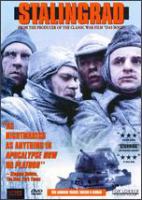
Stalingrad (1 videodisc) / Dominique Horwitz, Thomas Kretschmann et al., 1998. DVD. 138 minutes. German and English dialogue with English subtitles available.
Follow the story of four German soldiers transferred from the North Africa campaign to the Eastern Front who become trapped with the German Sixth Army at Stalingrad.
Additional copies of this feature film are also available under the following cover:
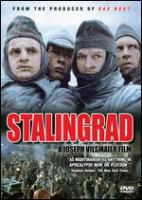
Stalingrad (1 videodisc) / 2013. DVD. German language with English subtitles.
Comments