Five Books about Alan Turing
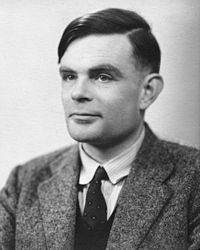 Alan Mathison Turing was born in London on June 23, 1912. He showed an early aptitude for the sciences and studied mathematics at King's College, Cambridge where he graduated with first class honours.
While he was at Cambridge, Turing proved that a machine would be capable of solving any mathematical computation as long as it could be expressed as an algorithm. Known as the Turing Machine, this theoretical device became the model for early computers.
During World War II he worked at Bletchley Park, the British cryptanalytic headquarters, where he played a critical role in deciphering German Enigma codes. He continued his association with the Government Communications Headquarters, a British intelligence agency, for much of his life.
Following the war, Turing worked at the National Physical Laboratory on the design of the Automatic Computing Engine. Although his version of the machine was not built, Turing's visionary work influenced computer scientists for years to come.
In 1952, a male lover broke into Turing's house. Turing reported the crime to the authorities and discussed his relationship with the man openly. As homosexuality was a felony in England he was charged with and later convicted of gross indecency. Turing opted for hormonal treatment rather than prison. The conviction led to the removal of his security clearance and prevented him from continuing with his intelligence work which devastated Turing.
Turing died on June 7, 1954 of cyanide poisoning in an apparen't suicide. A partially eaten apple led to speculation that he had consumed poisoned fruit in an homage to his favourite fairy tale, Snow White. The apple was not tested for poison. His mother maintained that the death was accidental. Still others believed that he had planned an ambiguous death.
If you would like to know more about Alan Turing, these are some of the books in the library system:
 |
 |
 |
 |
 |
Alan M. Turing by Sara Turing
The Annotated Turing: a Guided Tour Through Alan Turing's Historic Paper on Computability by Charles Petzold
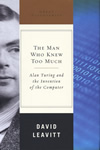
The Man Who Knew Too Much: Alan Turing and the Invention of the Computer by David Leavitt
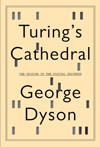
Turing's Cathedral: the Origins of the Digital Universe by George Dyson
Audiobook
eAudiobook
eBook
Other suggestions for Pride Week:
LGBTQ Teen Reads
LGBT Recommended Reading 2012
Related Posts:
Can Computers "Think" Like Humans?
Comments