Toronto Parks: the aspiration of the ‘Commons’
I live near Dufferin Grove Park. I take my wee lad there at least twice a week. I’ve met friends for coffee on its benches, enjoyed camp fires at its fire circles, seen live theatre and summer dance shows, watched bicycle polo(!) last summer, and most recently, witnessed the community’s outpouring of support for other people in Canada engaged in social struggle. It’s got me thinking about the place parks in Toronto enjoy in people’s lives and about their history as the ‘third’ place.
Sociologist Ray Oldenburg argues that societies need ‘third’ places – distinct from one’s home and one’s work. Such places provide a neutral ground where people can gather and interact, and “promote social equality by levelling the status of guests, provide a setting for grassroots politics, create habits of public association, and offer psychological support to individuals and communities.” (further details)
As a setting for recreation, public association and grassroots politics, Toronto parks have a long and colourful history. In the late 19th century, parks were for the moneyed classes to stroll through in their finery. They were certainly not for athletic endeavours or children’s play. Children were fined and put in jail for doing so! (Yesterday’s Toronto 1870-1910, p.85)
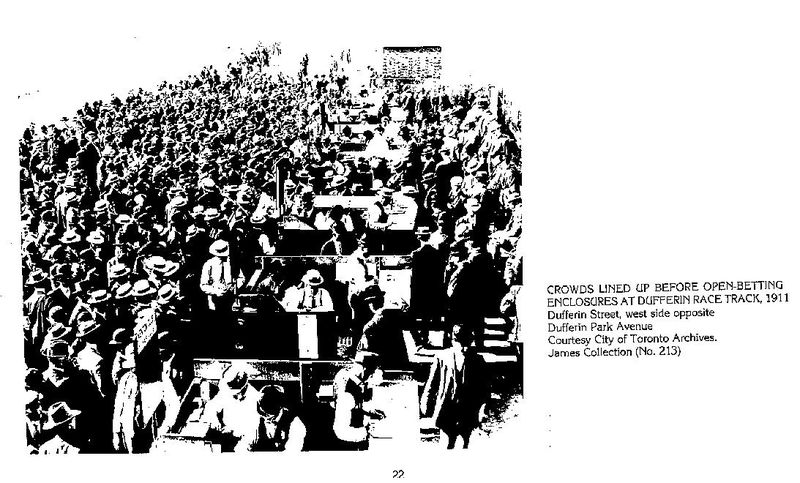
 By the early 20th century, authorities had perhaps decided that jailing ten year olds was not in the best interests of their education and sociability, and parks in Toronto had become places of sport, recreation and entertainment, including diving horses on Toronto Island (no kidding!), and horse racing at Dufferin race track across the street from my neighbourhood park. The Dufferin race track was the first track in Canada to use a starting gate, as well as the first to implement finish line cameras. The things you learn, eh?
By the 1930s, parks in Toronto would feel the weight of the world’s problems much like the rest of the city, becoming staging grounds for exactly the ‘grassroots politics’ (read: opposition) that Oldenburg envisioned decades later. The Toronto Star reports on August 16, 1933 (in this excellent database available with your library card): “Charging mounted policemen, motorcycle exhausts belching oily fumes and scores of constables on foot put a stop to speech making, but failed to disperse thousands of persons gathered in Allan Gardens last night at a meeting announced by the Worker’s ex-Service Men’s League.” The meeting – call it a demonstration – was called to “protest against treatment accorded war veterans,” and drew crowds of men, women, children, including one “young woman [who] was seen to strike a motorcycle officer across the face with a folded newspaper as she was bumped by a wheel of his machine.” Allan Gardens has since been the site of many demonstrations and political gatherings, oft focussed on problems of urban poverty and homelessness.
The date of that action is significant. I was perusing the Toronto Star’s Pages of the Past to find reportage of the famous ‘Riot of Christie Pits’, another (much larger) political action that is inextricably bound up in another Toronto park.
The Riot was unplanned, unorganized, but in no ways un-political. It was also the largest such action in Toronto’s history before or since. Reflecting the tensions of the depression and the xenophobic prejudice that was dominating European politics, the riot brought the politics of the old world to the new, and in so doing, galvanized the immigrant communities in the city and paved the way for the multi-culturalism we take for granted today.
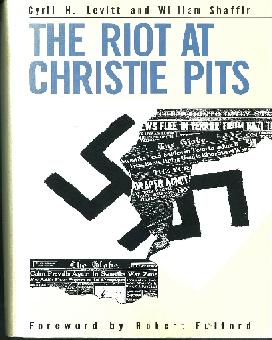 A baseball game between teams that were primarily Anglo-Protestant on one side and Jewish on the other spilled into a punch-up when young Anglo-Saxon fans unfurled a large white banner of a Swastika in the stands. The fight ranged across the park for possession of the banner, and left at least one Jewish youth with substantial injuries. Boys on bicycles then zipped to the immigrant neighbourhoods south of Bloor with the story that a Jew had been killed. Thousands of young men (mostly) responded and a post-game dust-up morphed into a full-scale street fight. It was the ‘culmination of a summer of conflict, and remains a disturbing, even legendary, part of the city’s history.’ You can read all the details in Levitt and Shaffir’s The Riot at Christie Pits. Or, for the Youtube generation, watch this:
You will note the showcasing of a Toronto library. 😉
With so much of any city’s space occupied by private property – whether for residence, commerce, finance, education, or governance, public space becomes more and more important to the vibrancy (even the existence) of civic life. Toronto parks have a long and proud tradition of stepping into that role; a tradition built on circumstance and perhaps chance, but also on people’s willingness to fight for it. Dufferin Grove comes by its community feistiness honestly.

Sources
The Great Good Place: cafés, coffee shops, community centers, beauty parlors, general stores, bars, hangouts, and how they get you through the day. (Oldenburg, Ray, 1989)
307.0973 O47 - Humanities and Social Sciences, 2nd Fl., Toronto Reference Library
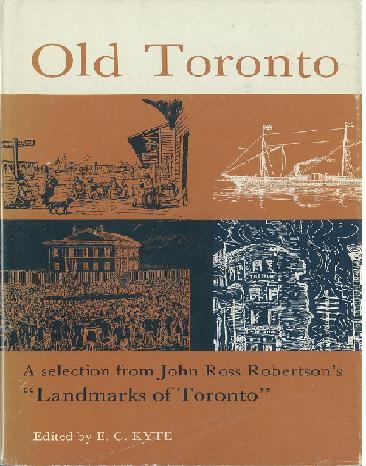
Old Toronto: a selection of excerpts from Landmarks of Toronto, by John Ross Robertson (Robertson, J. Ross, 1954)
971.3541 R – Canadiana, 6th Fl., North York Central Library
Riot at Christie Pits. (Levitt, Cyril et. al., 1987)
971.3541 L – Canadiana, 6th Fl., North York Central Library
Toronto Star's Pages of the Past – online archive includes over 30,000 complete issues. The digitized full-image version of the complete contents of the Toronto Star newspaper since 1894. Available at any Toronto Public Library branch (with valid library card)
Yesterday's Toronto 1870 – 1910. (Shapiro, Linda, 1997)
971.3541 SHA – Canadiana, 6th Fl., North York Central Library
5 thoughts on “Toronto Parks: the aspiration of the ‘Commons’”
Great post, links, and references.
Thank you for your fine post, especially the clip about the Riot at Christie Pitts.
You mentioned Dufferin Grove Park – a really lovely park across the street from the Dufferin Mall [formerly the Dufferin Park Race Track]. The Toronto Reference Library has pictures of the Dufferin Park Race Track. Type “Dufferin Park” in the search box.
Very interesting post, Jonathon. Thanks.
Such interesting and important history that we don’t learn in school.
Thanks
Wow Jonathon! That is one dynamic blog. And great clip by Giles! Thanks for all of the detailed and interesting information.