Readings on the Internet and Its Influences
Like it or not, the Internet has an influential role in disseminating information and shaping societies, both negatively and positively. Some people harken back to a taste of a pre-Internet world, while others use social media and other means to have a citizen’s opportunity to express oneself on the Internet. However, personal expression can sometimes take on a negative form in extreme cases such as cyberbullying. Does this opportunity to express oneself on the Internet constitute a shift in societal power for both democratic and autocratic governmental systems? To consider these issues, consider the following titles for loan from Toronto Public Library collections:
Do you think constant connection can actually be harmful to our lives? If so, in what ways do you think it can harm us? posted by Michael Harris on Vidoyen.
(Credit: Michael Harris – Vidoyen – Do you think constant connection can actually be harmful to our lives? If so, in what ways do you think it can harm us? - Posted on June 25, 2014 – URL: http://www.vidoyen.com/questions/do-you-think-constant-connection-can-actually-be-harmful-to-our-lives-if-so-in-what-ways-do-you-think-it-can-harm-us/answers/michael-harris )
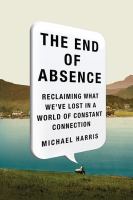
The end of absence: reclaiming what we've lost in a world of constant connection / Michael Harris, 2014. Book. Adult Non-Fiction. 303.4833 HAR
Canadian journalist Michael Harris looks at society through the “Straddle Generation”, the final generation (born before the year 1985) that remembers adult life before the Internet. Harris compares society’s exposure to the Internet to the advent of the Gutenberg printing press in the 1400s and the subsequent wider availability of the printed word. Ongoing connectedness to the Internet has deprived many people of the ability to daydream and experience solitude. The author describes his self-imposed “analog August” without a cellphone, email access, or the Internet.
Also available in eBook (Access Online) format.
Read the review in Kirkus Reviews. Read the review in Quill and Quire. Read the review in the Wall Street Journal. Read the web exclusive review and an edited interview with Michael Harris on ScientificAmerican.com.
(Credit: Herb Moyer – YouTube – Nicco Mele shares insights from his new book, The End of Big in a PEA (Philips Exeter Academy) presentation – Published on December 30, 2013 – 1:28:05)
(Credit: PBS Newshour – YouTube – Author Nicco Mele on "The End of Big" – Published on April 8, 2013 – 5:36)
(Credit: Vimeo.com – Nicco Mele – The End of Big – Published on February 5, 2012 – 14:33)

The end of big: how the internet makes David the new Goliath / Nicco Mele, 2013. Book. Adult Non-Fiction. 303.4833 MEL
The author also looks at the negative and positive influences of the Internet and technology on large institutions in the government and the private sector. For those interested in the anecdotal approach, the author draws on his time in the political sphere when he worked on Howard Dean’s American presidential campaign in 2004.
Also available in Audiobook CD, eAudiobook (Access Online), eBook (Access Online), and Talking Book (Restricted to Print Disabled patrons) formats.
Read the review in Kirkus Reviews. Read the review in Publishers Weekly.
(Credit: Random House of Canada- YouTube – Paula Todd on Extreme Mean – Published on July 3, 2014 – 1:55)
(Credit: Global News Morning Show – YouTube – Paula Todd – Published on June 10, 2014 – 6:34)

Extreme mean: trolls, bullies and predators online / Paula Todd, 2014. Book. Adult Non-Fiction. 302.34302 TOD
This book deals with the serious topics of cyberbullying, online predation and trolling. Journalist and lawyer Todd explores these issues in graphic detail by examining example cases in detail. Warning: This book may offend or upset those not prepared to explore these issues in depth.
Also available in eBook (Access Online) format.
Read the interview with Paula Todd in Maclean’s magazine. Read the interview with Paula Todd in the Vancouver Sun. Read the review in Quill and Quire.
(Credit: National Endowment for Democracy – YouTube – "Now I Know Who My Comrades Are: Voices From the Internet Underground" featuring Emily Parker – Published on April 1, 2014 – 1:20:00)
(Credit: New America Foundation – YouTube – Now I Know Who My Comrades Are: Voices from the Internet Underground – Published on March 4, 2014 – 53:36)
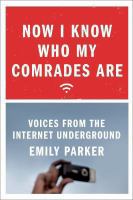
Now I know who my comrades are: voices from the Internet underground / Emily Parker, 2014. Book. Adult Non-Fiction. 302.231 PAR
Journalist (and former State Department adviser) Emily Parker focusses on the challenges faced by bloggers in China, Cuba, and Russia to affect change in those countries through the Internet. Meet Alexei Navalny, Zhao Jing (aka Michael Anti), and Laritza Diversent as they encounter apathy against and strong (online) support for the status quo in Russia, (self-) censorship and isolation in China, and fear of citizen-informers and the challenges faced by a predominantly offline population in Cuba.
Read the review on the Economist.com. Read Mario Vargas Llosa’s review in New Republic (translated from the original Spanish review in El País). Read the review from Publishers Weekly.
(Credit: Democracy Now – YouTube – "Utopian Potential of the Internet": Astra Taylor on How to Take Back Power & Culture in Digital Age – Published on April 25, 2014 – 4:22)
(Listen to: Canadian Broadcasting Corporation (CBC) Radio; Program: Spark; Host: Nora Young – “In her book The People's Platform: Taking Back Power and Culture in the Digital Age, Astra Taylor argues that the utopian idea of a democratic culture will not appear as a consequence of technology alone and what we have seen so far is more of a rearrangement than a revolution.” – June 15, 2014 – 10:52 – URL: http://www.cbc.ca/spark/blog/2014/06/15/the-peoples-platform/ )
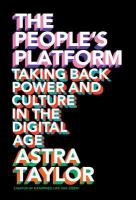
The people's platform: taking back power and culture in the digital age / Astra Taylor, 2014. Book. Adult Non-Fiction. 303.4834 TAY
Read about the intersection of cyberspace (“the Internet”) with “meatspace” (as coined by John Perry Barlow, a co-founder of the Electronic Frontier Foundation (EFF) – the “material world” or “real life”) in this book by documentary filmmaker Astra Taylor. The good intentions of democratization, empowerment and liberation on account of the Internet and information technology have given away to corporate control of said technology. The Internet has not eliminated divisions and inequities in access, influence, power, and wealth or even on a gender basis but has distributed such inequalities through other means that seek to dominate or exclude some people.
Also available in eBook (Access Online) format.
Read the review in the Boston Globe. Read the review in The Guardian. Read the review in Kirkus Reviews. Read the review in Quill and Quire.
(Credit: Canadian Broadcasting Corporation (CBC), Q with Jian Ghomeshi – YouTube – "Persona Non Grata" author Tom Flanagan – Published on May 9, 2014 – 32:43)
(Credit: Canadian Broadcasting Corporation (CBC),The National – YouTube – Interview with Tom Flanagan – Persona Non Grata – Published on May 2, 2014 – 8:38)
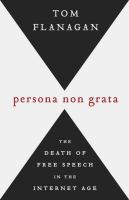
Persona non grata: the death of free speech in the Internet age / Thomas Flanagan, 2014. Book. Adult Non-Fiction. 323.44309 FLA
Conservative political scientist Thomas Flanagan accounts for his public mobbing on February 27, 2013, following an ill-timed (and arguably, ill-thought out) opinion on the basis of personal liberty that he made about child pornography (an illegal act in Canada which he did not personally endorse) during a session at the University of Lethbridge dealing with the Indian Act. Flanagan deals with the infiltration of social media and information technology into the realms of academic freedom, freedom of speech, public debate, and yes – political correctness.
Also available in eBook (Access Online) format.
For background information on the incident at the University of Lethbridge, please read Margaret Wente’s column in the Globe and Mail, and Jonathan Kay’s column in the National Post.
Read the review in the Globe and Mail. Read the review in Quill and Quire. Read the review in the Toronto Star.
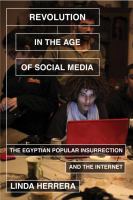
Revolution in the age of social media: the Egyptian popular insurrection and the Internet / Linda Herrera, 2014. Book. Adult Non-Fiction. 962.055 HER
Read about the subsequent Facebook social media campaign in Egypt following the beating to death of Khaled Said by several Egyptian police officers in June 2010, and the deposing of President Hosni Mubarak’s government in early 2011 as part of the “Arab Spring”.
Read the review in the Globe and Mail. Read the review in Library Journal.
Comments