Distractions at work? Learn how to stay focused
(http://www.businessinsider.com/fancy-hands-2012-8?op=1)
I read an excellent article in the Globe & Mail Why you won't finish reading this article at work
Did you know?
- That office workers are interrupted roughly every three minutes? And, once thrown off track, it can'take 23 minutes for a worker to return to the original tasks, according to Standford University Research.
- Reading and processing 100 email messages can occupy more than half a worker's day?
- Open plan offices meant to foster collaboration, subject workers to a non-stop stream of chitchat
Wall Street Journal
And then, bosses wonder why it is hard to get any work done. Maybe you feel like you have bad time management skills, or that you have problems concentrating or getting distracted. But, could it be partly the fault of your own company's modern workday set up? Modern day workers are struggling to get their real work done while they spend most of the day going through internal emails, attending meetings, interrupting themselves with social media urges, listening to co-worker's stories, working on collaborative projects, telling their own stories to coworkers etc. The "real work" which needs to be done often requires deep thinking, which is quite hard to acheive with little everyday, office distractions.
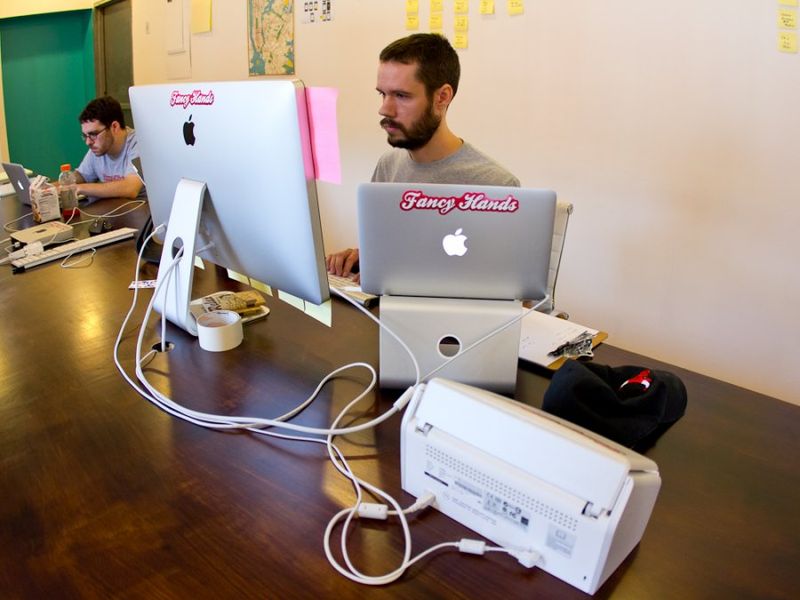
The reality is that often managers push their employees to do more with less, especially with our multiplying screens (see picture above) and increased digital demands/distractions. Maybe you work with multiple screens, or have coworkers who do – it isn't as easy to multitask as you may think, I actually heard on the radio last week that people who believe they can multitask are actually the worst at it. How does it make you feel? I know that when I'm multitasking, I feel flustered and need to write things down more often so I can remember them.
Some companies are experimenting with different ways to keep workers focused, some are trying to reduce the amount of internal emails while others try to reduce the number of projects workers do simultaneously. At Abbott Vascular , a health care company,vice president, Jamey Jacobs and productivity consultant, Daniel Markovitz realized that the majority of employees were using email to communicate the majority of their issues whether they were serious or mundane. Employees weren't really using the office telephone (I know I'm guilty of this, I think that it is faster to send an email rather than make a phone call), so they told employees to assess the importance of their messages, if it was urgent and complex – use the telephone, email was to be reserved for non-urgent messages. I know that if I did that with my work, it may make my life easier and my work more efficient. I think that emails have a tendency drag out an issue, and have a large potential for miscommunication. Whereas phone calls tend to me more direct and issues can be dealt with faster.
The company Atos, which is just outside of Paris, specializes in global IT services. After an internal study, they found that workers spent about 2 hours a day just managing their email inboxes. This company decided to completely get rid of internal emails. Now, workers can use email to communicate with external customers but they now use an internal social network to communicate with colleagues.
The reality is that there will always be distractions at work, and they will probably increase as we venture deeper into the digital age. We should also remember that distractions and working under pressure aren't all bad. A little bit of pressure and urgency can actually motivate you to accomplish tasks faster, but it does increase your stress levels.
Check out these books about productivity at work:

(also available as an ebook)
Have a happy, healthy and productive day at work!
One thought on “Distractions at work? Learn how to stay focused”
Also with email, rather than the phone, you can cc people and create a virtual paper trail to CYA. And hopefully neither you nor the other person will be also trying to listen to someone else or do something else at the same time. Email also bypasses the “hasn’t come in yet, gone to lunch, at a meeting, gone home for the day” problems. But it is time-consuming.