The best science books of 2012
As the year's end approaches, lists are everywhere – the best movies of the year, the best apps, the best songs and, of course, the best books.
Here are some of the best science books of 2012, according to a selection of lists:
 Turing's Cathedral: the origins of the digital universe by George Dyson
In 1936, a young Alan Turing published a paper in which, famously, he wrote: "It is possible to invent a single machine which can be used to compute any computable sequence".
Science and technology historian George Dyson looks at the origins of the digital universe, focusing on the efforts of John von Neumann and his associates at Princeton University to produce a universal machine. Their work in the 1940s led to the creation of ENIAC, the first random-access-memory computer.
 In Pursuit of the Unknown: 17 equations that changed the world by Ian Stewart
"Equations model deep patterns in the outside world. By learning to value equations, and to read the stories they tell, we can uncover vital features of the world around us…They have been a prime mover in human civilisation for thousands of years. Throughout history, equations have been pulling the strings of society…This is the story of the ascent of humanity, told in 17 equations".
Mathematician Ian Stewart has won awards for his books which bring complex mathematics to a broader audience. He wrote the "Mathematical Recreations" column in Scientific American for many years.
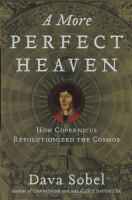
A More Perfect Heaven: how Nicolaus Copernicus revolutionized the cosmos by Dava Sobel
Popular science writer Sobel (Galileo's Daughter, 1999) examines the life and times of Polish astonomer Copernicus with a focus on the period before the publication of his great work On the Revolutions of the Heavenly Spheres. She looks at the reasons Copernicus was reluctant to publish his work and the efforts of those close to him to convince him to do so.
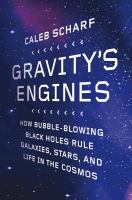 Gravity's Engines: how bubble-blowing black holes rule galaxies, stars and life in the cosmos by Caleb A. Scharf
Astrophysicist Scarf has written an accessible book about an often inaccessible subject – black holes. As new research confirms their importance, he feels they are due for an image makeover. From the preface: "Black holes are gravity's engines – the most efficient energy generators in the cosmos. And because of that, they have played a key role in sculpting the universe we see today".
Author Caleb Scharf is the director of the Columbia Astrobiology Center, as well as a science writer and blogger.
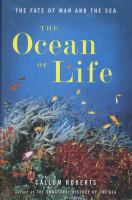 The Ocean of Life: the fate of man and the sea by Callum Roberts
Marine biologist Roberts describes the fragility of the oceans and their degradation due to climate change, acidification, pollution, over-fishing and dredging.
According to The Guardian: "It is a grim story and in another writer's hands…might have ended up as a mordent tale of ecological despair. Roberts, to his credit, gives us hope and provides a prescription for political and public action, right down to our choices of seafoods in supermarkets".
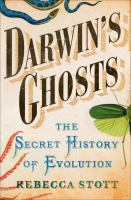 Darwin's Ghosts: the secret history of evolution by Rebecca Stott
A chronological history of the concept of evolution, from Aristotle to Darwin's contemporaries. Stott presents vivid biographical sketches of individuals over the centuries who observed and tried to explain change in the natural world. From the review in Publishers' Weekly: "She demonstrates conclusively
that evolutionary ideas were circulating among intellectuals for many
centuries and that, for most of that time, those who promoted these
ideas found themselves under attack by religious and political leaders.
Darwin's scientific breakthrough…did not occur in a vacuum,
but rather provided the most fully conceptualized theory. Stott has
produced a colorful, skillfully written, and thoughtful examination of
the evolution of one of our most important scientific theories".
 On Extinction: how we became estranged from nature by Melanie Challenger
In this beautifully written book, poet Melanie Challenger travels from England to South America and from the Arctic to the Antarctic searching for an explanation for the increasing number of extinctions. She finds that the estrangment of people in industrial societies from the natural world has made us indifferent to habitat and species loss. In an interview in Publishers' Weekly she said: "I think we need a seismic shift in how we understand human nature and how we design our lives in light of this understanding. We need to be bold and brave."
 The Spark of Life: electricity in the human body by Frances Ashcroft
"We're all familiar with the fact that machines are powered by electricity, but it's not so widely appreciated that the same is true of ourselves. Your ability to…see and hear, to think and speak, to move your arms and legs-even your sense of self-is due to the electrical events taking place in the nerve cells in your brain and the muscle cells in your limbs. And that electrical activity is initiated and regulated by your ion channels…Ion channels are truly the 'spark of life' for they govern every aspect of our behaviour".
So begins a fascinating and accessible account of the quest to understand the role of electricity in the human body. Ashcroft is a professor of physiology at Oxford University.
 Internal Time: chronotypes, social jet lag and why you're so tired by Till Roenneberg
Explores the biological basis of our chronotypes (personal biological clocks) and dispels widely-held views that our sleep habits are indicators of character traits (early risers are dynamic and energetic, while people who sleep late are lazy). Many things about modern life – the amount of time we spend indoors, the structure of the work and school day and shift work in particular – play havoc with normal sleep rhythms, which can lead to chronic health problems, weight gain and depression. The author suggests some simple steps to cope with the daily challenges to our internal clocks.
Till Roenneberg is a chronobiologist.
 Spillover: animal infections and the next human pandemic by David Quammen
Celebrated science writer Quammen turns his attention to diseases such as influenza, rabies, AIDS and Ebola which are first observed in animals but cause illness in humans. This book is part detective story, as he recounts the work of virologists who track the animal origins of these diseases, and part warning that, as the human population increases and we have more contact with disease-carrying animals, the risk of pandemics is increasing.
Happy holiday reading!
Comments