Elizabeth Posthuma Simcoe, 1762-1850
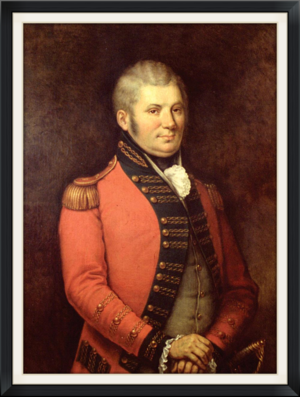
This upcoming civic holiday honours the first Lieutenant Governor, John Graves Simcoe. A detailed biography on John Simcoe is available on the Historical Narratives of Early Canada website which provides a good account of his military and historical achievements.
——
Credit in the development of Upper Canada could be shared with his adoring young wife, Elizabeth. This post will glance through Elizabeth Posthuma Simcoe's unique contributions in art, writing, and her support in shaping this new Canadian frontier.
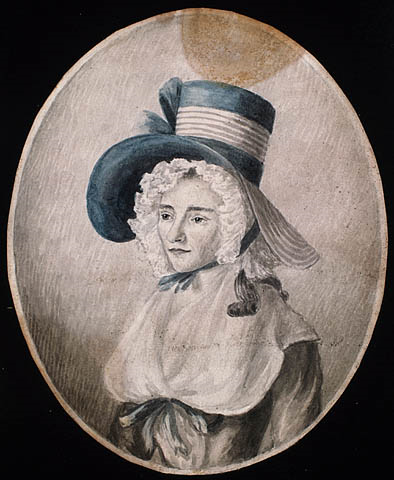
Born in Northamptonshire, England on September 22nd in 1762, Elizabeth arrived into the world filled with bittersweet anticipation. Her father, Colonel Thomas Gwillim passed away several months before Elizabeth's birth while posted to Germany on January 29, 1762. No specified cause was recorded on the manner of his death. Elizabeth's mother, Elizabeth Sophia Gwillim, died within 24 hours after childbirth. In this midst of this deep sadness, her aunt, Margaret Spinkes, took over the care of her baby niece. Both the aunt and the aunt's mother chose to name her Elizabeth Posthuma–her first name in honour of her mother and her middle name to reflect the passing of her paren'ts.
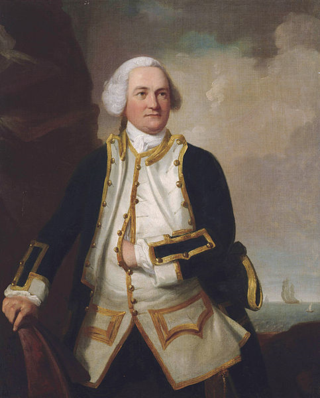
On June 14, 1769, her aunt Margaret married Admiral Samuel Graves. They met in the previous winter. The Admiral was 56 years of age and a childless widower. Margaret Spinkes was 42 years old. The Admiral saw Elizabeth as the child that he was unable to have and both aunt and uncle raised Elizabeth with the best of all intentions.
As Elizabeth was growing up, her family encouraged her to develop a positive outlook on life by providing various resources for her to explore. She developed her writing skills and wrote voraciously to family and friends far and wide; she explored the countryside on foot and on horseback and wrote copious details of her journeys; and she developed her artistic skills in sketching and painting. She also studied botany and that knowledge dovetailed nicely with her interest in painting landscapes.
In 1777 when Elizabeth turned fifteen years old, she met a handsome commanding officer twice her age. At the age of 30, the wounded Lieutenant Colonel, John Graves Simcoe, returned to England to convalesce after the British Army's defeat in Yorktown. Admiral Graves extended an invitation for John Graves Simcoe to stay at Hembury Fort House while recuperating. Since Elizabeth had a large dowry, the aunt and uncle paid careful attention to the men who showed an interest in her. In John Grave Simcoe's case, John's paren'ts were close friends. Admiral Graves was the godfather of John Simcoe and had Admiral Graves' surname for his middle name.
Over time and daily interaction in residence, both John and Elizabeth quickly fell in love to the delight of Margaret and Admiral Graves. The two remained in contact and by September 1782, John and Elizabeth became engaged. On December 30, 1782 they were married. Soon after they were married, Elizabeth purchased five thousand acres of land and built a forty-room mansion and called it Wolford Lodge.
Fast forward to nine years later, after the births of five daughters between 1783 and 1790, her first son, Francis, was born in 1791–two more daughters (one in Toronto and the other in England) and one more son was born (in England) later for a total of nine children). In the same year, her husband accepted an assignment to travel to Upper Canada as the new Lieutenant Governor. Ensuring that her children were cared for, her children either remained at Wolford Lodge and stayed with other family or they came along with her.
——
Elizabeth Simcoe began painting Canadian landscapes and waterways. She captured the Magdalene Islands in the Gulf of St. Lawrence on her journey to Quebec City.
——
When the couple arrived in Quebec on November 11th of 1791, Elizabeth sketched her first sleigh ride which she expressed as quite 'jolty' and the journey as very cold.
——
As the Simcoes settled in Quebec, on December 26th, The Constitutional Act of 1791 came into being and was the first step in amalgamating the land for this new country. On June 5, 1792, the Simcoes continued on their journey through Upper Canada in Ottawa and stayed at the Chateau de Ramezay which could be one of the oldest buildings in Canada.
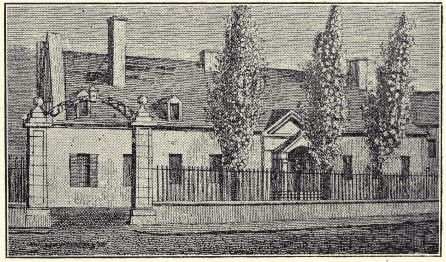
She wrote in her journal:
Sun. [June] 17th—The joy I felt in finding myself in spacious apartments was checked the next day by finding the heat more insufferable than I had ever felt. The thermometer continued at 96 for two days, and the heat was not ill-described by a sentinel who exclaimed, "There is but a sheet of brown paper between this place and hell." In the town are abundance of merchants' storehouses, the doors and windows of which are iron, and many of the houses, as well as churches, are covered with tin. By these circumstances, I believe, the heat is increased. The Government House is built on arches, under which are very large offices, which might be made very comfortable summer apartments. (The Diary of Mrs. Simcoe, 1911)
——
The Simcoes traveled to Kingston and briefly considered Kingston as the capital of Upper Canada but the location and geography did not appear to be suitable. Days later, they sailed to Niagara where Elizabeth captured the breathtaking Falls in water colour. The family stayed here in Newark (today is called Niagara-On-The-Lake) for several months. On January 16, 1793, her daughter, Katherine, was born.
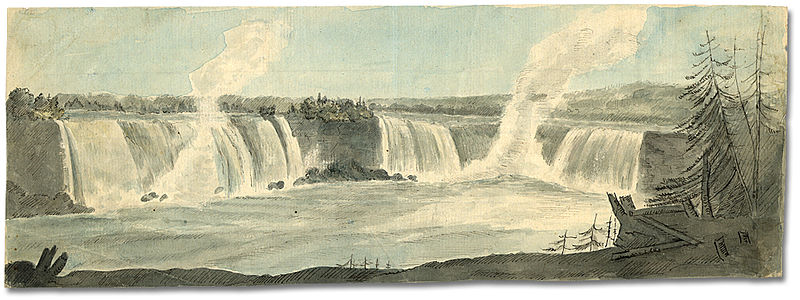
She wrote in her journal her impression of the Falls:
On the American side the river passing over a straight ledge of rock has not the beauty of the circular form or its green colour, the whole centre of the circular falls being of the brightest green, and below it frequently seen a rainbow. (The Diary of Mrs. Simcoe, 1911)
Even today, her words appear to ring true. Many current visitors can attest to the same visual beauty from its roaring depths.
——
In July, her ship, the Mississauga, entered the Toronto Harbour.
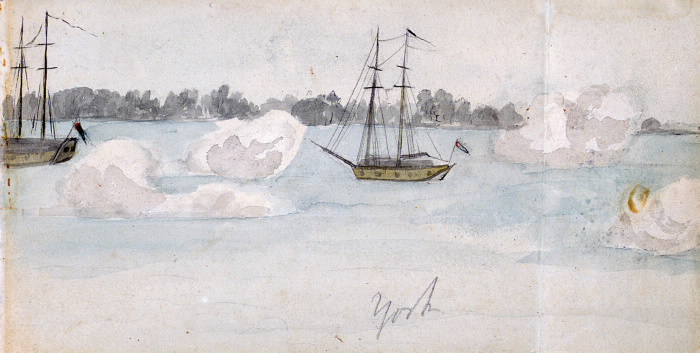
John and Elizabeth explored this region by canoe, horseback, and on foot and John noted that this harbour appears well protected by the Toronto Islands in the south and he named spit on the Island, Gibraltar Point.
Sadly, not all of Elizabeth's journey was positive. Elizabeth's daughter, Katherine perished on April 1792 at 14 months old. She was buried in the Old Garrison Burying Ground which is currently a park renamed Victoria Memorial Square near Fort York. CityNews wrote an article on this interesting plot of land.
——
On a happier note, her first son Francis Simcoe survived the Frontier. The family created a lovely castle in his honour and named it, Castle Frank.
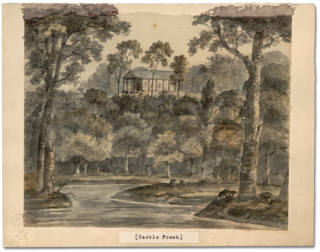
Sadly, Castle Frank is no longer standing and through time, several changes to the landscape occurred. On September 11, 1796, the family returned to England and never returned to Canada to enjoy this residence.
——
Elizabeth's diary entries are worth reading and revisiting. Consider perusing these interesting titles to appreciate her remarkable journey:
 |
 |
 |
 |
 |
 |
 |
 |
——
On this special day, consider riding to the Toronto Islands by ferry and visiting Gibraltar Point, gaze down the brilliant green Falls in Niagara, Ontario, stroll through Fort York and watch the British soldiers march in formation, and reflect on Elizabeth's journeys as you wander along the Castle Frank Brook on your travels. Much of the Canadian and Toronto traditions were inspired by John Simcoe and then brought to life in muted colours and lively written text by Elizabeth Simcoe centuries ago.
Enjoy the long weekend!
12 thoughts on “Elizabeth Posthuma Simcoe, 1762-1850”
I enjoyed your post, Ann. What an eventful, adventurous life Elizabeth Simcoe lived. It would be nice to take her diaries to read while vacationing in one of her haunts. I especially liked the quote from the sentinel: “There is but a sheet of brown paper between this place and hell.”
You are very welcome, Maureen. I am so glad you found this enjoyable. I found the research fascinating–especially discovering so much of Toronto today was shaped by the Simcoes back in the 1790s. Canadian history can be quite interesting, in fact.
Thanks for this summary of the Simcoe family. I grew up in the neighbourhood of Elizabeth Simcoe Public School in Guildwood, East Scarborough. There is much to discover about this amazing family.
Thank you Russell for your kind reply. I agree, there is so much to discover about this family. I used to play in the park (Victoria Memorial Square) as a young child and never knew that it was a cemetery. The park always felt cold and chilling and abandoned. It only occurred to me today that Katherine Simcoe was laid to rest there. Upon discovering that bit of information, this park has more significance looking back.
Hi Ann: Thank you for a detailed and interesting blog post on a topic of interest to Toronto residents and beyond. Readers of your blog post may also be interested in the following blog posts:
Snapshots in History: February 25: Remembering John Graves Simcoe – https://blogs.tpl.ca/albert-campbell/2014/02/snapshots-in-history-february-25-remembering-john-graves-simcoe.html
Snapshots in History: July 30: Remembering Fort York’s Beginnings –
https://blogs.tpl.ca/albert-campbell/2014/07/snapshots-in-history-july-30-remembering-fort-yorks-beginnings.html
Keep up the good work!
Cheers,
John P.
Hi John:
I actually thought of you and added the link to the other fabulous TPL blogs under “Elizabeth Posthuma Simoce’s” in the sentence, “This post will glance through Elizabeth Posthuma Simcoe’s unique contributions in art, writing, and her support in shaping this new Canadian frontier.”
Thank you again for highlighting these two blogs promoting this important Civil holiday and your positive feedback.
I’m sorry to say that before this I have been completely ignorant of John and Elizabeth Simcoe, and why there was a civic holiday in their honour. Thank you for this timely piece on who they were. This was a nicely written blog on their lives.
-Christine
Dear Christine:
Thank you for that wonderful comment. I agree, I learned a great deal from my brief research on this topic and while writing up this post. Elizabeth Simcoe is a new heroine of mine now–especially since I literally grew up playing in the park where her daughter was buried.
I am so glad you enjoyed reading it.
Thank you for a wonderful post about Elizabeth Posthuma Simcoe, and her adventurous life. There are many interesting stories here, including the origin of her middle name, the meaning of “Castle Frank,” and the fact that you grew up playing in the park where Katherine Simcoe was buried.
Dear Muriel:
Thank you for your positive feedback. I find writing this blog that there were so many interesting things to write about and how ‘close to home’ the past still affects Toronto today–even my own childhood. Elizabeth was amazingly brave because she endured her childbearing years knowing that her paren’ts died so prematurely.
Thank your for your informative and colourful blog post. I knew Mrs. Simcoe was an intrepid lady, since she, having had a sheltered gentlewoman’s upbringing, not only accompanied her husband to this almost completely new and unimproved place; she drew so much of it. She appreciated the wild beauty of the country and the pictures you chose show that so well.
Dear Marilyn P.:
Thank you for your wonderful comments. I am happy that the technology today provides access to her watercolours for me to create a visual biography of how her art helps to speak of the travels reflected in her travel journal. She was mature and strong beyond her years.