And the Oscar for Best Film Book of 2015 Goes to…
It's Oscar season! Academy Awards were handed out on Sunday February 28th. Meanwhile, far from the glamour of sunny Hollywood, a lowly librarian has been agonizing over her list of 2015 film books while sleet pelts her windows in chilly Toronto. This year, there were so many contenders for best film book of 2015, that narrowing them down to a short list has been a feat that involved an uncomfortable amount of mental turbulence. How do you choose between misfits, dreamers, wildflowers, comedians, Hollywood super agents, kidnappers, A-list actors, D-list actors, legends and movie loving dictators? Books were regretfully voted off the island, then, on second thought, were brought back into the fold, forcing another book to get the sadly administered boot. Depending on your interests, YOU might vote any one of these books best film book of the year. Here then, are just some of the outstanding books published in 2015 about the bigger than life world of film.
 |
 |
 |
 |
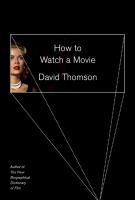
How to watch a movie by David Thomson.
Start preparing for TIFF now, film fans. Come September, you'll be able to impress your friends by speaking in knowing tones about frames, shots and cuts. "From one of the most admired critics of our time, brilliant insights into the act of watching movies and an enlightening discussion about how to derive more from any film experience." Author of many works on film, including Have you seen…? : a personal introduction to 1,000 films. From Library Journal Review: Highly readable and wickedly smart. Also available as an eBook.
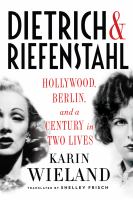
Dietrich & Riefenstahl: Hollywood, Berlin, and a century in two lives by Karin Wieland.
"Leni Riefenstahl and Marlene Dietrich both came of age in Weimar Berlin, a time of great political ferment. In the 1930s, Riefenstahl became the official filmmaker of the Third Reich, a progenitor of fascist symbolism. Dietrich's slender and androgynous beauty made her a fashion icon. Wieland brings to vivid life a time of international upheaval, chronicling radical evolutions of politics, fame, and femininity on a grand stage." From James Wolcott, Vanity Fair columnist: "…a double-decker biography about a pair of sacred monsters that motors the length of a century, through two world wars, countless affairs, still-burning controversies, and white satin streams of Hollywood lore." Also available as an eBook.
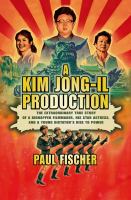
A Kim Jong-Il production: the extraordinary true story of a kidnapped filmmaker, his star actress, and a young dictator's rise to power by Paul Fischer.
"Fischer recounts the 1977-78 abductions of South Korea's leading director, Shin Sang-Ok, and his ex-wife, the movie star Choi Eun-Hee. The two were abducted on the orders of North Korea's movie-obsessed crown prince Kim Jong-Il, who wanted them to upgrade the government's wooden propaganda films with pizzazz and higher production values. The story combines harrowing hardships — Choi endured house arrest and constant Kafkaesque "reeducation" exercises; Shin was starved and tortured in prison after escape attempts — with dizzying reversals of fortune as the couple are rehabilitated to make hit films under Kim's sponsorship and later plot a nerve-racking flight to the West." (Publishers Weekly Review)
- eBook
- eAudiobook
- Audiobook CD
- Large Print Book
- CD Talking Book (Restricted to print disabled patrons)
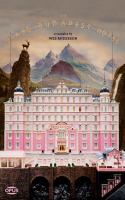
The Wes Anderson collection: the Grand Budapest Hotel by Matt Zoller Seitz
If you're a fan of auteur director Wes Anderson (and really, why wouldn't anybody be?) or were enchanted by his multi Oscar-winning movie The Grand Budapest Hotel, you'll want to have a look at this book, which explores "the wide variety of sources that inspired the screenplay and imagery — from author Stefan Zweig to filmmaker Ernst Lubitsch to photochrome landscapes of turn-of-the-century Middle Europe." Described as "eye-popping" in the New York Times Book Review, the book features photos, artwork and ephemera from the film. This book is the author's follow-up to the well reviewed The Wes Anderson collection, an overview of Anderson's work.
 |
 |
 |
 |
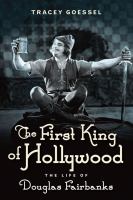
The first king of Hollywood by Tracey Goessel.
The biggest star of his generation, Douglas Fairbanks was the original swashbuckler who performed his own stunts in classic films such as The Thief of Bagdad, Robin Hood and The Mark of Zorro. He challenged the entrenched studio system, co-founding United Artists along with America's sweetheart Toronto-born Mary Pickford, Charlie Chaplin and director D. W. Griffith. The author had exclusive access to a collection of Fairbanks' love letters to Pickford (found in a box in Pickford's mansion) allowing her to illuminate their tragic love affair. The Huffington Post put this biography on their list of best film books from 2015.
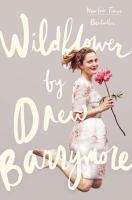
"Drew Barrymore shares funny, insightful, and profound stories from her past and present told from the place of happiness she's achieved today. Wildflower is a portrait of Drew's life in stories as she looks back on the adventures, challenges, and incredible experiences of her earlier years." "…Pure delight… If until now you merely liked Barrymore…you’ll adore her once you read this series of personal essays.” — New York Times Book Review.
- eBook
- eAudiobook
- Audiobook CD
- CD Talking Book (Restricted to print disabled patrons)
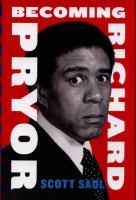
Becoming Richard Pryor by Scott Saul.
"Richard Pryor may have been the most unlikely star in Hollywood history. Raised in his family’s brothels, in Peoria, Illinois, by a grandmother who often threatened to kick him upstairs with her size-twelve shoes, he always considered himself a bottom dog. He took to the stage originally to escape the tough realities of his childhood but later discovered he could alchemize his stand-up by delving fully, even painfully, into the “off-color” life he’d known. He brought that vitality to a movie career whose best moments flowed directly out of his spirit of creative improvisation. The major studios considered him dangerous. Audiences felt plugged directly into the socket of life." "Pryor has had the good fortune to fall into the hands of a writer with the smarts to understand both his greatness and his madness…a first-rate biography." — Peter Biskind, author of Easy Riders and Raging Bulls. Also available as an eBook.
The big bad book of Bill Murray by Robert Schnakenberg.
"Bill Murray's extraordinary career is rich with fascinating anecdotes, contradictions, and mystery, from his early success on Saturday Night Live and the biggest blockbusters of the 1980s to his reinvention as a hipster icon in the early 21st century. This A-to-Z compendium is part biography, part critical appreciation, part love letter, and all fun." "Schnakenberg, a huge fan, does a great job of collecting some great snarky quotes and wacky trivia facts about one of America’s most beloved comedic actors." — The New York Post. Also available as an eBook.
 |
 |
 |
 |
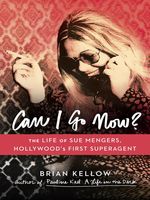
Can I go now? by Brian Kellow.
A biography of Hollywood's first superagent. "She got her start as a secretary at a powerful talent agency, where her brash, ballsy attitude got her noticed and promoted to talent agent at a small agency. At the end of the 1960s, Mengers made the leap to a larger agency in Los Angeles, where she represented such luminaries as Barbra Streisand, Ryan O'Neal, and Faye Dunaway." (Book List Review) Picture Joan Rivers with less of a filter, bulldozer-setting ramped up to 12, shpritzing venom alongside comic abuse. Imagine that, and you’ll start to get a vague idea of the lioness named Sue Mengers. . . . immensely readable and full of dish. (Scott Eyman, The Wall Street Journal) Also available as an eBook.
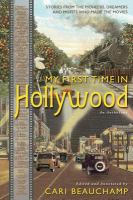
My first time in Hollywood by Cari Beauchamp.
"Over forty legends of the film business recount their first trip to Hollywood. Actors, directors, screenwriters, cinematographers, and editors — half of them women — recall the long journey, their initial impressions, their struggle to find work, and the love for making movies that kept them going. Each story is intimate and unique, but all speak to our universal need to follow our passions and be part of a community that feeds the soul." "What a priceless parade of evocative and highly entertaining memories. Once you start reading you won't want to stop." — film critic and historian Leonard Maltin
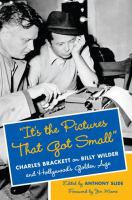
"It's the pictures that got small" by Charles Brackett, edited by Anthony Slide.
"Anthony Slide has culled from Brackett's voluminous diaries a treasure trove of scenes and wit from Golden Age Hollywood, 1932-1949. The playwright and novelist's reflections feed curiosity about his primary collaborator, Billy Wilder, and about others too. The diaries record spats, feuds, put-downs, and studio machinations. A book to be skimmed and referenced–but primarily relished." (Maurice Yacowar, University of Calgary).
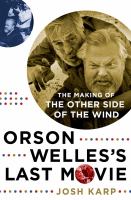
Orson Welles's last movie: the making of The other side of the wind by Josh Karp.
"In the summer of 1970 legendary but self-destructive director Orson Welles returned to Hollywood from years of self-imposed exile in Europe and decided it was time to make a comeback movie. Coincidentally it was the story of a legendary self-destructive director who returns to Hollywood from years of self-imposed exile in Europe. Welles swore it wasn't autobiographical. Welles planned to shoot it in eight weeks. It took twelve years and remains unreleased and largely unseen. A fast-paced, behind-the-scenes account of the bizarre, hilarious and remarkable making of what has been called "the greatest home movie that no one has ever seen." "Like some semi-mythic warlord, Welles lays about him, bullying, terrifying, charming, lying, cheating, cajoling, manipulating, destroying, creating in pursuit of a goal he himself barely understands…an unputdownable read." — Welles biographer Simon Callow. Diehard Welles fans may want to check out the well-reviewed 2015 book on Welles, Young Orson: the years of luck and genius on the path to Citizen Kane and the 2015 DVD Magician: the astonishing life and work of Orson Welles.
- eBook
- CD Talking Book (Restricted to print disabled patrons)
 |
 |
 |
 |
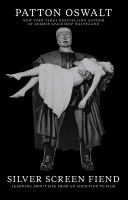
Silver screen fiend by Patton Oswalt.
"Between 1995 and 1999, Patton Oswalt lived with an unshakable addiction. It wasn't drugs, alcohol or sex: it was film. After moving to L.A., Oswalt became a huge film buff (or as he calls it, a sprocket fiend), absorbing classics, cult hits, and new releases at the New Beverly Cinema. Silver screen celluloid became Patton's life schoolbook, informing his notion of acting, writing, comedy, and relationships." "This fine book…is downright impossible to put down." — Book List Review
I lost it at the video store: a filmmakers' oral history of a vanished era. Interviewer Tom Roston.
"Tom Roston interviews the filmmakers — including John Sayles, Quentin Tarantino, Kevin Smith, Darren Aronofsky, David O. Russell and Allison Anders — who came of age during the reign of video rentals, and constructs a living, personal narrative of an era of cinema history which, though now gone, continues to shape film culture today." "Informative, hilarious, a little sad, but mostly just exuberant: This chronicle of a lost era details not just how the video-rental revolution shaped a generation of filmmakers, but how it changed the ways we watch and talk about film. It may even make you nostalgic for rewinding." — Stephanie Zacharek, Chief Film Critic, The Village Voice
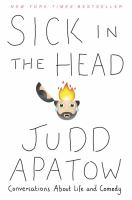
Sick in the head: conversations about life and comedy by Judd Apatow.
"Before his name became synonymous with a new style of comedy; before he had written, directed, or produced his first movie or TV show Judd Apatow was a kid in Syosett, Long Island who was utterly obsessed with comedy. That obsession has made him one of the most recognizable and influential comedic filmmakers working today. This book is a collection of 30 years worth of conversations — always funny, often poignant, and incredibly intimate. Featuring interviews with luminaries like Mel Brooks and Chris Rock and modern icons like Louis CK and Amy Schumer, this is a book for fans of comedy, from the nerdiest fan of all." Also available as an eBook.
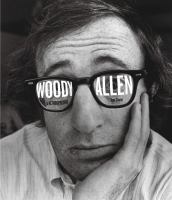
Woody Allen: a retrospective by Tom Shone.
"Woody Allen is a uniquely innovative performer, writer and director with nearly fifty movies to his credit, from cult slapstick films and romantic comedies to introspective character studies and crime thrillers. In this timely retrospective, Tom Shone reviews Woody Allen's entire career. His informed commentaries are combined with many classic quotes from Allen that define the directors self-deprecating humor and acute thinking about his life and times. A fitting tribute to one of the masters of modern cinema, published to mark Woody Allen's eightieth birthday."
For the true cinephile, here are a few more noteworthy film books from 2015:
Production design/art direction:
William Cameron Menzies: the shape of films to come by James Curtis.
About Hollywood's first production designer, he won'the first Academy Award for Art Direction.
Acting:
Maggie Smith by Michael Coveney.
Maggie Smith's incredible career in film, theatre and television spans six decades, and includes a four-season run at Ontario's Stratford Shakespeare Festival. This biography focuses on Smith's professional life.
Two more books have been published in Cahiers du cinéma's Anatomy of an actor series:
Johnny Depp: anatomy of an actor by Corinne Vuillaume.
Leonardo DiCaprio: anatomy of an actor by Florence Colombani.
Directing:
Hitchcock lost and found: the forgotten films by Alain Kerzoncuf.
A lot of ink has been spilled writing about Alfred Hitchcock's life and iconic films. This book takes a less traveled road, looking at the legendary director's forgotten, incomplete and lost productions.
Film fashion:
Creating the illusion: a fashionable history of Hollywood costume designers by Jay Jorgensen.
"Presents the history of fashion on film, showcasing not only classic moments from film favorites, but a host of untold stories about the creative talent working behind the scenes to dress the stars from the silent era to the present day."
Envisioning freedom: cinema and the building of modern black life by Cara Caddoo.
"Viewing turn-of-the-century African American history through the lens of cinema, Envisioning Freedom examines the forgotten history of early black film exhibition during the era of mass migration and Jim Crow."
Film process:
Fantasia of color in early cinema
"We normally think of early film as being black and white, but the first color cinematography appeared as early as the first decade of the twentieth century. In this book, the editors present a treasure trove of early color film images from the archives of EYE Film Institute Netherlands, bringing to life their rich hues and forgotten splendor." "I could gaze at the images in this book for hours. They are as fascinating as illuminated manuscripts or magic lantern slides." — Martin Scorsese
The dawn of technicolor, 1915-1935 by James Layton.
"Traces the first two decades of the Technicolor Corporation and the development of its two-color motion picture process." Lavishly illustrated with 428 images.
History of women in film:
Lois Weber in early Hollywood by Shelley Stamp.
"Among early Hollywood’s most renowned filmmakers, Lois Weber was considered one of the era’s "three great minds" alongside D. W. Griffith and Cecil B. DeMille. Despite her accomplishments, Weber has been marginalized in relation to her contemporaries, who have long been recognized as fathers of American cinema. Stamp demonstrates how female filmmakers who had played a part in early Hollywood’s bid for respectability were in the end written out of that industry’s history."
Related posts:
2 thoughts on “And the Oscar for Best Film Book of 2015 Goes to…”
Thank you, Maureen, for this fascinating, wide-ranging list of 2015 film books – they all look like winners!
There’s something for almost every taste here, isn’t there? I’m looking forward to seeing what’s published about the world of film in 2016. Thanks for commenting.