Nurturing Children’s Connection to Nature
When I think back to my childhood, my fondest memories are all of the outdoors, split between two very different countries. I grew up taking walks by the Padma River with my paren'ts and watching fishermen work tirelessly. In the Monsoon rain, in my school’s courtyard, I gathered fallen mangoes to share with my earliest school friends. When school was out, I visited my grandmother and spent most of my time playing in the garden, devouring scents of jasmine flowers and aromatic lime leaves.
Soon after my 8th birthday, my paren'ts received their immigration papers for Canada. Moving to Toronto in the middle of winter, unable to speak English, separated from friends and the land I knew so well, I experienced not just culture shock, but an environmental shock! Adapting to this new land was made easier by taking bike-rides and walks along Morningside Park with new friends. Then there was a trip to Lake St. George in grade 6 where I experienced my first “chickadee feeling”! Wild chickadees are trusting birds that eat seeds from hands, as long as the hand is steady and the body is still.
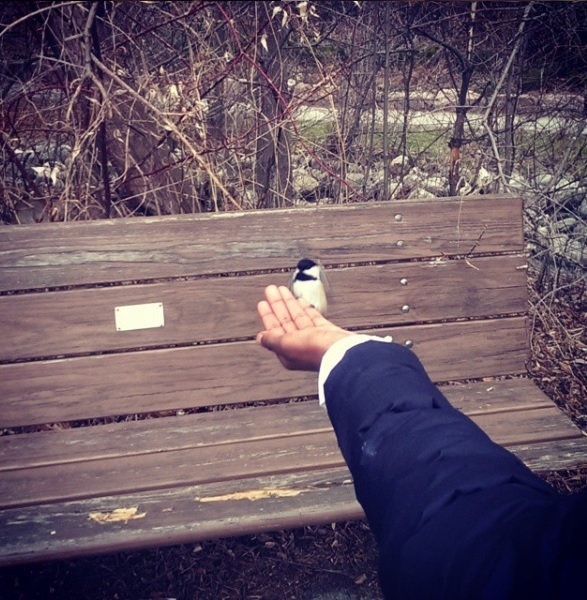
For a few years after moving here my paren'ts, like most other immigrants, worked long hours and earned barely enough to make ends meet. So, like many other immigrant children I did not attend camps or any other paid outdoor activities. Another added barrier was that my paren'ts were largely unaware of how to access available funded programs.
Now, as a Children’s Education Supervisor at the Toronto Botanical Garden (TBG), I plan and deliver programs to children from various demographics, including many coming from marginalized communities. I receive the warmest hugs and the greatest high fives from the happiest and the youngest garden visitors. I regularly witness first “chickadee feelings” and the narrowing of nature deficit gaps.

The term Nature Deficit Disorder was first coined by Richard Louv, in his 2005 book, Last Child in the Woods. Louv noticed this disconnect between people, especially children, and their natural habitat extending beyond human-built houses. In Canada, Nature Deficit Disorder is likely still very widespread based on the 2018 ParticipAction Report Card where Canadian children received a “D” grade for active play and leisure activities. Children are spending increasingly more time plugging into screens and disconnecting from nature. In doing so, they are missing out on many benefits of being in nature. According to the Children’s Nature Network, time in nature can reduce nearsightedness, stress, anger and aggression. Children that are outdoors more are more likely to be active. The PartcipAction Report and the Children's Nature Network also draws direct connection between busier bodies and improved cognitive functioning.
In the busy lives of urban paren'ts, with added burden of limitation of resources, it can be difficult to provide regular outdoor play and nature exploration time to children on a regular basis. Louv in his book describes many activities that can be done right in the backyard! However, a backyard is not available to many urban children, so here are a few of my favourite activities and tips to help nurture a child to connect with nature:
Activities

- Plant a garden anywhere! Grass, alfalfa and chia seeds are very fast-growing, easy to grow and require little space. You can also try food scrap gardening.
- Get a paper or a sketchbook and a pencil. Go out to any natural green space, find a favourite “sit spot” and draw anything that grabs the attention.
- Borrow field guides from the library and go on a walk anywhere. See if you can identify two or three unknown plants, mushrooms, birds or other animals that you come across.
- If it is difficult to let go of the screen then put technology to good use and go on a nature photography walk. Limit the number of photos that can be taken so there is still an opportunity to simply observe with naked eyes.
- Turn a simple game of tag into a predator vs. prey game. Include a designated space for a shelter and have the "prey" come out of the shelter to search for "food" during "meal time". The imaginary food can be anything that will not blow away in the wind, safe to carry and easy to spot, such brightly coloured, mid-sized beanbags. While looking for "food", they have to avoid getting tagged or becoming the "meal" for a "predator" that is lurking around!
- Go to any natural green space or even a patch of vegetation along a sidewalk and count the number of different leaves that can be found.
- On snow days, build snow shelters.

Tips for Outdoor Play and Exploration
- Stay on designated paths to help protect different species and also for your own safety. For example, in recent years, blacklegged ticks that can carry the bacteria that causes Lyme disease have spread across Toronto. These ticks like to hang out in grasses and leaf piles, so going off path may greatly increase your chance of exposure to them. You can also keep away from poison ivy and other poisonous plants just by staying on the path.
- Do not feed wild animals. Feeding wild animals can be unsafe for both humans and the animals. If you would like to feed chickadees, I recommend going to a nature centre where they offer programming that includes feeding chickadees. Nature centres in Toronto include the High Park Nature Centre, Downsview Park Discovery Centre, Toronto Botanical Garden, Humber Arboretum, Evergreen Brickworks and the Rouge Valley Conservation Centre.
- Dress appropriately. Avoid shorts when going outdoors on nature walks because that can mean a lot more bug bites on the legs/feet.
- Sign-up for e-newsletters from nature centres and attend their free events and also to stay updated about their camps.
- Go to nature-based library programs. Look under the “Our Fragile Planet” banner for programs at branches around the City.
Broti Kar is the Environmentalist in Residence for Spring 2019.
10 thoughts on “Nurturing Children’s Connection to Nature”
Thanks for sharing your experience, Broti! I too have enjoyed many a walk around Morningside Park, even spotting deer and coyote there in the early morning hours. I like your suggestions for nature-based activities–much needed for those of us lacking nature in our urban environments. We could all use a little more forest bathing! https://time.com/5259602/japanese-forest-bathing/
Absolutely! I recently saw that the University of Guleph is offering a guided forest bathing walk in September. Until then, I am going to continue “garden bathing” at the Toronto Botanical Garden!
I truly enjoyed reminiscing about my childhood. I am so glad that you liked the activities.
These suggestions are great for adults too!
Interesting article Broti.
Tips for outdoor exploration are useful for all ages.
Hope you get a chance to practice a few at your favourite outdoor green space!
Thank you!
Broti, thanks for sharing some experiences with your blog post.
After reading your #1 tip for play and exploration I was really irked. You reference Richard Louv’s excellent book and then espouse a tip that is totally antithetical to all his advice. You’ve been spending too much time near the groundkeepers at Edwards Gardens it seems 🙁
In your list of nature centres located in Toronto, please consider adding The Downsview Park Discovery Centre.
None of your embedded images are loading for me. Seeing things like: The image “https://blogs.tpl.ca/.a/6a00e5509ea6a188340240a467cb77200c-800wi” cannot be displayed because it contains errors.
Typo in activities #5
And to Suzanne’s comment — there is plenty of nature all around us in our urban environments, one just needs to take a chance and look for it.
Kids: get out there and get dirty! To take participactions slogan: the most dangerous thing is staying indoors!
Better a broken bone than a broken spirit.
After reloading the page twice to try and fix the time-zone issue with the comment time the images have appeared. Guess it was a temporary Typepad error.
Hi Chris,
Thank you for your response.
Downsview Park is a great space. I have taken my campers there. Thanks for recommending it!
Chris, going off path can have some serious consequences for individuals and the ecosystem especially when there is a lack of environmental knowledge. Soil compaction, erosion and dispersal of invasive species are just a few examples of issues related to people going off path and into natural areas. Broti references Richard Louv’s book but I think it is great that she is concerned about the safety of her readers also. You seem to have this idea that safety takes away fun which does not have to be the case at all. I would rather that my child learns how to properly interact with nature and to respect it before going off into areas where they can do some severe damage. Also, I would rather not have my child come home with a broken bone, severe rashes or ticks if there is any way to prevent it. That does not mean that I don’t want them going out and exploring. I think this article offers safe and fun ways to build connections with nature for children living in urbanized areas, at least to start. These do not have to be the only ways. The nature centres she listed are also places where a lot of free play can happen. Not everyone is ready to go off path!