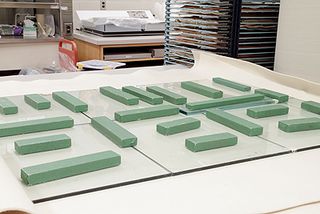
Preservation is both a science and an art

October 20, 2011 | Katherine | Comments (3)

Ever since it opened in the 1880s, the Toronto Public Library has been commited to maintaining and preserving our cultural heritage. TPL’s Special Collections Centre holds many valuable historic items about our city, our province, and our country.

Preserving old documents, books, paintings and photographs is both a science and an art. TPL’s professional Conservators specialize in the care and preservation of paper. They decided to pull back the cover and give the public a behind-the-scenes glimpse of how a particular item is prepared, a process that can'take several weeks of detailed work to complete. (Watch the video.)

Preservation of an early 18th century map of North America
TRL2011_Bain-Map_Treatments_mg_6888 

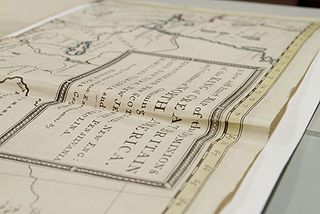
A New and Exact Map of the Dominions of the King of Great Britain on ye Continent of North America, Containing Newfoundland, New Scotland, New England, New York, New Jersey, Pensilvania, Maryland, Virginia and Carolina.  According to the newest and most exact observations, by Herman Moll, Geographer, Printed and Sold by Tho. Bowles. 1715.

Map in its original condition with folds and tears.

Moll’s map is one of the earliest illustrations to show the dispute between Great Britain and France over boundaries separating their colonies in North America. Known as the “Beaver Map” after a vignette of beavers working against the backdrop of Niagara Falls, the map symbolizes the hard work and perseverance required of new settlers. Also called “the first American postal map” as it is the first map to show American postal routes. One of the most accurate maps of the period, it is rich with historical and geographical information and elaborate design.

Herman Moll, 1654-1732, was one of the most prominent cartographers in England, emigrating to London from the Netherlands about 1678. He worked as an engraver until he opened his own business about 1688. By the turn of the century, Moll became a respected map publisher whose distinctive maps were copied by other publishers.
TRL2011_Bain-Map_Treatments_mg_6868 
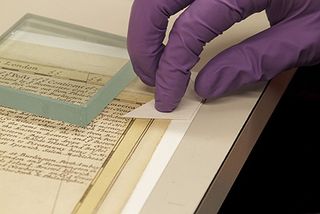
Inks on the map are spot tested
The paper is tested to see if the map can be cleaned with water. In this case, the coloured inks dissolved in water, so an alternative method will be needed to clean the map.

TRL2011_Bain-Map_Treatments_mg_6877 
Spot cleaning
A dry sponge is used to clean centuries of grime off the surface of the map.
TRL2011_Bain-Map_Treatments_mg_6990 
Humidifying the map
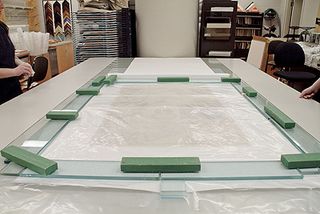
Because the ink will dissolve, the map cannot be submerged under water for cleaning. However, some humidity is required to relax the map, and allow it to lay flat again. The map is instead placed on a damp paper blotter to create a moist platform to allow for humidity.
The map is covered in another layer of special fabric, then covered in plastic sheeting.
Glass and weights are placed around the edges to keep the humidity inside the map.
TRL2011_Bain-Map_Treatments_mg_6998 
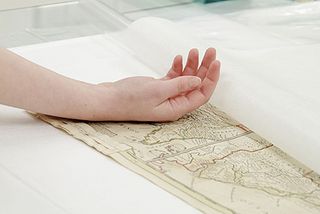
Checking the moisture level of the map
TRL2011_Bain-Map_Treatments_mg_6994 
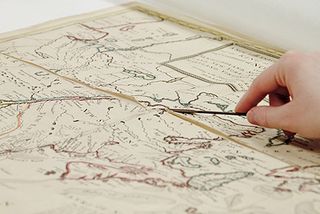
The creases and folds of the humidified map are then unfolded to allow the paper to relax
Map 
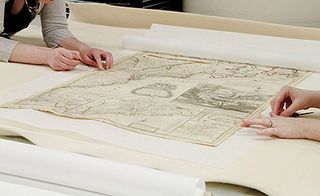
Making sure the tears line up

TRL2011_Bain-Map_Treatments_mg_7006 
Drying and flattening
The map is covered again with a special fabric and felt.
Glass sheets and weights are added to further flatten the folds.
TRL2011_Bain_Map_Treatment_mg_9829 
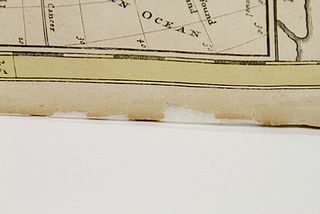
Edges and tears are repaired
Acid-free Japanese paper is affixed to the broken edges and tears of the map using wheat starch as a binding agent.
Japanese paper provides additional support, to help preserve the original map paper without causing further deterioration.
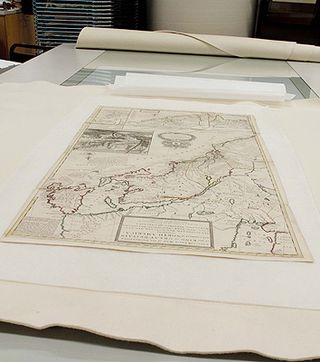
TRL2011_Bain_Map_Treatment_mg_7447 
The preserved map

You can see this map in person in the TD Gallery exhibit A Passion for History: The Legacy of James Bain, which runs from June 16th-September 1st, 2012 in the newly renovated first floor of the Toronto Reference Library. See you there! 


Comments

3 thoughts on “Preservation is both a science and an art

  1. Preserving records from the past is a very serious work. I think every historical document deserves to be displayed as they have become part of the humanity’s great history. This article just shows how a historical map was restored to its prime condition. I was entertained upon looking at the photos, and I definitely learned a lot.
    Jeleryl Comisky

    Reply

Leave a Reply to Donna-Marie Cancel Reply

Your email address will not be published. Required fields are marked *

Preservation is both a science and an art

October 20, 2011 | Geerthana | Comments (3)

Ever since it opened in the 1880s, the Toronto Public Library has been commited to maintaining and preserving our cultural heritage. TPL’s Special Collections Centre holds many valuable historic items about our city, our province, and our country.

Preserving old documents, books, paintings and photographs is both a science and an art. TPL’s professional Conservators specialize in the care and preservation of paper. They decided to pull back the cover and give the public a behind-the-scenes glimpse of how a particular item is prepared, a process that can'take several weeks of detailed work to complete. (Watch the video.)

Preservation of an early 18th century map of North America
TRL2011_Bain-Map_Treatments_mg_6888 

A New and Exact Map of the Dominions of the King of Great Britain on ye Continent of North America, Containing Newfoundland, New Scotland, New England, New York, New Jersey, Pensilvania, Maryland, Virginia and Carolina.  According to the newest and most exact observations, by Herman Moll, Geographer, Printed and Sold by Tho. Bowles. 1715.

Map in its original condition with folds and tears.

Moll’s map is one of the earliest illustrations to show the dispute between Great Britain and France over boundaries separating their colonies in North America. Known as the “Beaver Map” after a vignette of beavers working against the backdrop of Niagara Falls, the map symbolizes the hard work and perseverance required of new settlers. Also called “the first American postal map” as it is the first map to show American postal routes. One of the most accurate maps of the period, it is rich with historical and geographical information and elaborate design.

Herman Moll, 1654-1732, was one of the most prominent cartographers in England, emigrating to London from the Netherlands about 1678. He worked as an engraver until he opened his own business about 1688. By the turn of the century, Moll became a respected map publisher whose distinctive maps were copied by other publishers.

TRL2011_Bain-Map_Treatments_mg_6868 
Inks on the map are spot tested
The paper is tested to see if the map can be cleaned with water. In this case, the coloured inks dissolved in water, so an alternative method will be needed to clean the map.

TRL2011_Bain-Map_Treatments_mg_6877 
Spot cleaning
A dry sponge is used to clean centuries of grime off the surface of the map.

TRL2011_Bain-Map_Treatments_mg_6990 
Humidifying the map
Because the ink will dissolve, the map cannot be submerged under water for cleaning. However, some humidity is required to relax the map, and allow it to lay flat again. The map is instead placed on a damp paper blotter to create a moist platform to allow for humidity.
The map is covered in another layer of special fabric, then covered in plastic sheeting.
Glass and weights are placed around the edges to keep the humidity inside the map.

TRL2011_Bain-Map_Treatments_mg_6998 
Checking the moisture level of the map
TRL2011_Bain-Map_Treatments_mg_6994 
The creases and folds of the humidified map are then unfolded to allow the paper to relax
Map 
Making sure the tears line up

TRL2011_Bain-Map_Treatments_mg_7006 
Drying and flattening
The map is covered again with a special fabric and felt.
Glass sheets and weights are added to further flatten the folds.
TRL2011_Bain_Map_Treatment_mg_9829 
Edges and tears are repaired
Acid-free Japanese paper is affixed to the broken edges and tears of the map using wheat starch as a binding agent.
Japanese paper provides additional support, to help preserve the original map paper without causing further deterioration.
TRL2011_Bain_Map_Treatment_mg_7447 
The preserved map

You can see this map in person in the TD Gallery exhibit A Passion for History: The Legacy of James Bain, which runs from June 16th-September 1st, 2012 in the newly renovated first floor of the Toronto Reference Library. See you there! 


Comments

3 thoughts on “Preservation is both a science and an art

  1. Preserving records from the past is a very serious work. I think every historical document deserves to be displayed as they have become part of the humanity’s great history. This article just shows how a historical map was restored to its prime condition. I was entertained upon looking at the photos, and I definitely learned a lot.
    Jeleryl Comisky

    Reply

Leave a Comment

Your email address will not be published. Required fields are marked *