Maple Leaf Forever
On the evening of July 19, 2013, a tree was brought down in a storm. But this wasn't just any tree…
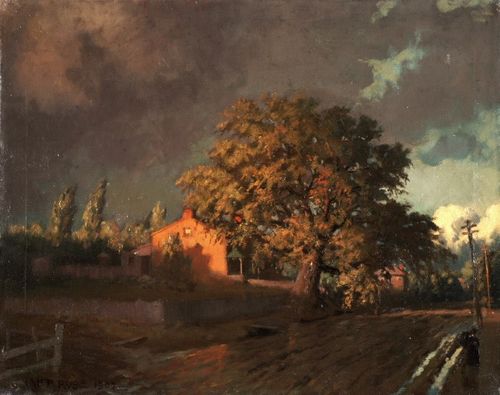
John McPherson, The House of A. Muir after a Shower in Toronto, 1907. [T 31990]
… it was the tree that inspired Alexander Muir, in 1867, to write the song “The Maple Leaf Forever.” (You can listen to "Maple Leaf Forever" here.)

Through the efforts of LEAF, a Toronto non-profit dedicated to the protection of urban forests, a number of commemorative artifacts were made from the reclaimed wood from the famous tree. On October 19, several artifacts, including easels and holders for supporting rare books, were presented to the Library in the Marilyn & Charles Baillie Special Collections Centre on the 5th floor of the Toronto Reference Library. Now we can'truly say that the Maple Leaf will last forever at the Library.

But why the maple leaf? And how has it become such a strong symbol associated with national identity?
At a public meeting in August, 1860, a group of Toronto citizens decided that those born in Canada would don a maple leaf to distinguish themselves from those born in the British Isles during the first ever Royal Visit.
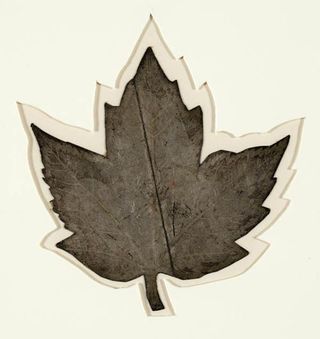
Leather Maple Leaf badge, 1860. [S 204]
This leather maple leaf, held in the Library’s Special Collections, comes from the first time the symbol was adopted and worn as a national badge.
The Maple Leaf was quickly adopted as the symbol of Canada and featured prominently in World War I posters and propaganda.
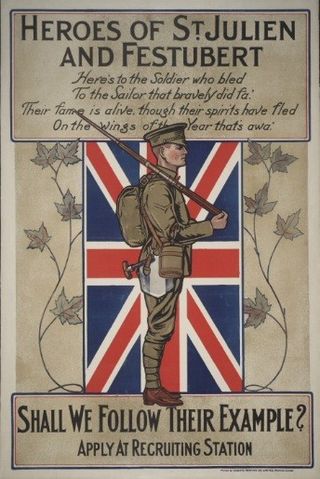
In 1965, the Maple Leaf was chosen as the motif on Canada’s new National Flag. It was stylized in Canada’s Centennial emblem in 1967.

Be sure to visit the Marilyn & Charles Baillie Special Collections Centre to see the documents of our past, and bring these stories to life.
3 thoughts on “Maple Leaf Forever”
The origin story you have presented here as fact is generally understood to be apocryphal. You are dodging an important issue by avoiding a discussion of Muir‘s anti-Irish feelings, which were quite overtly expressed.
To the previous commenter – there are so many issues tied up with this song; I don’t blame her for not delving into every single one. Apocryphal or not, the tree has played a role in the history of Canada, and I for one am fascinated to hear about its fate. I dodged many of the same issues when I wrote my very short children’s book about the song, The Maple Leaf (Forever).
Our nation’s history is at times… a little complicated, at best. We trampled and killed the First Nations and yes, each group hated the others for many irrational reasons. This song captured one era and its attitudes; for better or for worse, it is an inextricable part of our history.
(Despite the attempts of many to extricate it from that history for not being the most politically correct song we’ve ever sung as a nation.)
Jennifer – Thank you for your very thoughtful response. Certainly, as you have said, the histories of our nation and its symbols are often quite complicated. Much more could and has be said about Muir, his attitudes, and the reasons why this song waned in popularity (and was eventually re-written to be more inclusive in 1997).
Our intention here was to highlight efforts to commemorate and preserve this symbolic tree – including the donation of objects now held in the library’s Special Collections. Hopefully you have a chance to visit and see these artifacts one day!