Curator’s Choice: George Cruikshank at the Osborne Collection
Curator's Choice
Interested in learning more about the fascinating stories and unique materials found in the library's Special Collections? Join us for free, weekly talks offered by collection librarians.
Every Saturday at 11 am, the Osborne Collection of Early Children’s Books (located in the Lillian H. Smith branch) offers Curator's Choice talks, fascinating show-and-tells showcasing favourite treasures from the collection.
The Merril Collection of Science Fiction, Speculation, and Fantasy also offers Curator's Choice talks Saturdays at 11:30 am. Upcoming topics include hidden treasures and humour in science fiction and fantasy.
At Toronto Reference Library, you can get a glimpse into the Baldwin Collection of Canadiana, Special Collections in the Arts, or the Arthur Conan Doyle Collection through themed Discover Special Collections talks, held in the Marilyn & Charles Baillie Special Collections Centre, either Wednesdays or Thursdays each week at 3 pm.
Martha Scott, librarian at the Osborne Collection, has written a fascinating summary of a recent Curator's Choice talk on George Cruikshank. Take it away Martha.
George Cruikshank at the Osborne Collection
Osborne librarian Lori McLeod presented a short talk on renowned British book illustrator, George Cruikshank, as part of the “Curator’s Choice” series of Saturday morning programs at the Osborne Collection of Early Children’s Books. What follows is a brief summary of Lori’s talk, highlighting just a few of Osborne’s Cruikshank holdings.
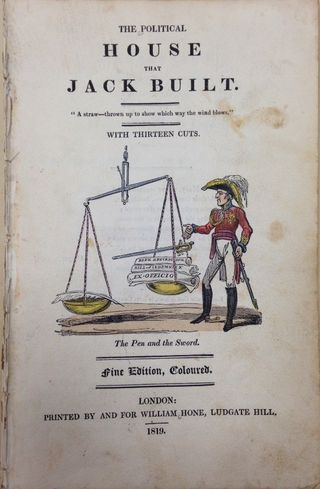
George Cruikshank was one of 19th-century England’s most popular and prolific illustrators. He was born in London in 1792. As a boy he had little formal education, but worked alongside his father, artist and caricaturist Isaac Cruikshank. As a young man, he began to specialize in topical cartoons. Among the earliest Cruikshank holdings at the Osborne Collection is The Political House that Jack Built (1819), a satirical pamphlet written by William Hone that parodies the traditional nursery rhyme.
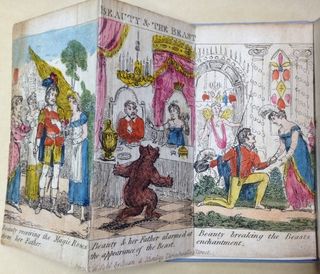
In 1822, Cruikshank, in collaboration with his brother Robert, provided illustrated frontispieces for a series of fairy tales published by Dean & Munday. Shown here is the frontispiece to The History of Beauty and the Beast, or, The Magic Rose (1822).
Cruikshank is well known as Charles Dickens’ first illustrator. His etchings appeared in Dickens’ Sketches by Boz (1836) and in serialized installments of Oliver Twist (Bentley’s Miscellany, 1837-1838).
 Title page for an 1894 edition of Sketches by Boz
Cruikshank experienced resounding success in 1823 with his illustrations for the influential first English translation of Grimms’ fairy tales by Edgar Taylor German Popular Stories: Translated from the Kinder Und Haus Märchen. A second volume was published in 1826.
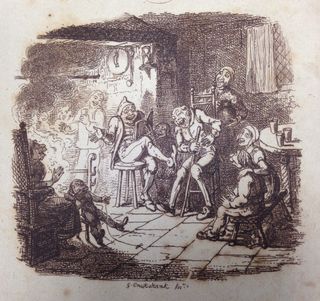
The title page to Volume I presents a merry fireside storytelling scene.
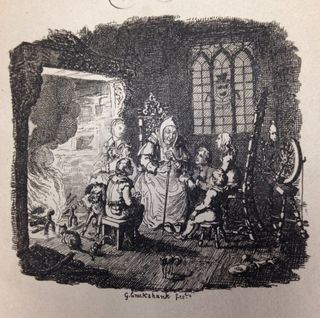
On the title page to volume II, an elderly storyteller captivates her listeners.
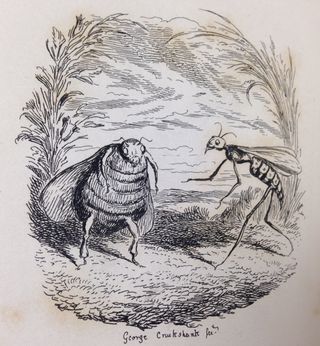
In The Bee and the Wasp: A Fable in Verse (1832) by Richard Frankum, a humble bee is led astray by a rogue of a wasp. The Osborne Collection holds a second edition of this work, published in 1861.
Among many classic novels illustrated by Cruikshank is The Life and Surprising Adventures of Robinson Crusoe, of York, Mariner (1831).
Crusoe discovers the “footprint in the sand”.
In 1848, Cruikshank illustrated an English translation of the Pentamerone, a collection of Neapolitan fairy tales written by Giambattista Basile published between 1634 and 1636. The collection contains prototypes of many celebrated tales, such as “Cinderella”, “The Sleeping Beauty”, “Puss in Boots” and “Rapunzel”.
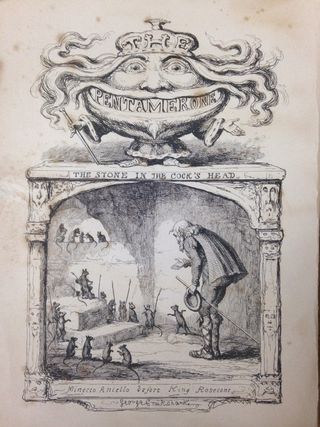
Frontispiece to The Pentamerone, or, The Story of Stories: Fun for the Little Ones (1848).
In the late 1840s, Cruikshank took up the cause of temperance and began to campaign actively against the evils of drink. He was well-acquainted with the disastrous effects of alcohol abuse: his father had died of alcohol poisoning at the age of 48, his brother suffered from alcoholism, and Cruikshank himself was known to be a heavy drinker.
His two series of prints, The Bottle (1847) and The Drunkard’s Children (1848), pictured the tragic downfall of a family due to alcohol abuse. Both works were enormously successful, but Cruikshank realized little profit, having under-priced them so as to make them affordable to working class readers.
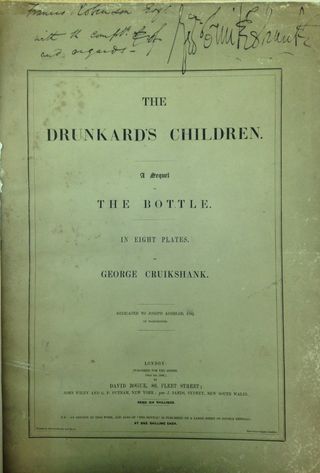
Front cover of Osborne’s copy of The Drunkard’s Children (1848), inscribed by Cruikshank.
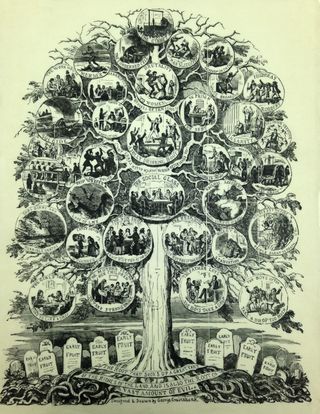
[Fruits of Intemperance] (ca. 1854). Print taken from an engraved woodblock held at the Osborne Collection. The block measures 39 x 31 cm. Thirty-six images across the branches of the tree depict the escalating risks and consequences of alcohol abuse, from “The Father Lets the Boys take a Drop” to “House Breaking” and ultimately “The Gibbet”. The text at the base reads “The Root that Sucks up a Great Part of the Riches of the Land, and is also the Root of a Vast Amount of Evil.”
Faced with a decrease in popularity in the 1850s, Cruikshank sought to rekindle his career with a return to fairy tales, issuing four titles in the George Cruikshank’s Fairy Library series from 1853 to 1864. In rewriting the tales, he altered them to reinforce principles of behaviour and inserted his own teetotal morals.

In Hop-O’-My-Thumb and the Seven-League Boots, the father of the young hero is a former count turned woodcutter who spends the greater part of his income on alcohol. The Ogre also drinks. In the final scene, the King abolishes the use of “all intoxicating liquors,” which leads to a dramatic reduction in crime and poverty throughout the kingdom.
In Cinderella and the Glass Slipper, the King plans to celebrate the marriage of Cinderella and the Prince with “fountains of wine,” but the Fairy Godmother objects. The King then orders all the “wine, beer, and spirits” in the land to be burned in a giant bonfire on the night of the wedding.
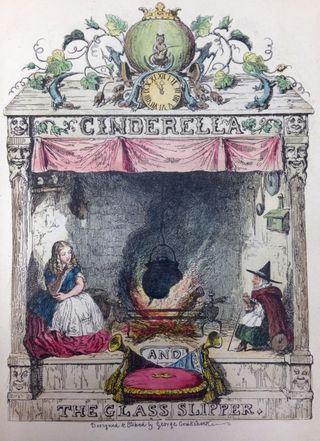
In altering traditional fairy tales, Cruikshank raised the ire of Charles Dickens, who published an article in Household Words (1859) entitled “Frauds on the Fairies”. Dickens argued that the old tales should not be manipulated: “In an utilitarian age, of all other times, it is a matter of grave importance that Fairy tales should be respected…”
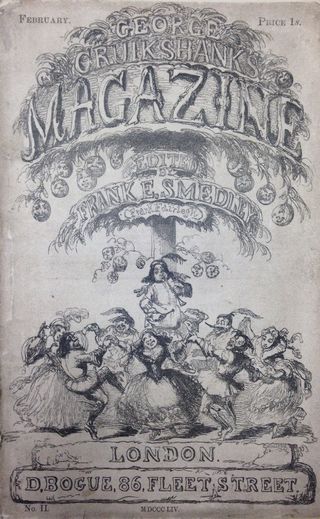
Cruikshank defended himself in “A Letter from Hop-O’-My-Thumb to Charles Dickens, Esq.”, published in his short-lived George Cruikshank’s Magazine (1854).
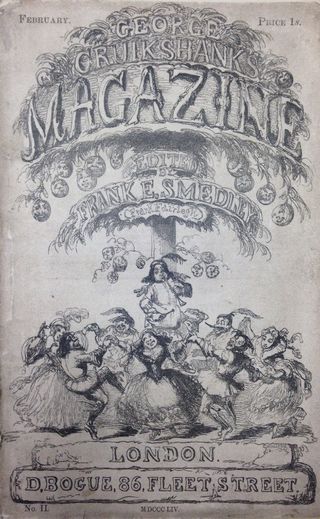
Second (and final) issue of George Cruikshank’s Magazine containing Cruikshank’s response to Dickens’ “Frauds on the Fairies.”
Cruikshank died on February 1, 1878. It is estimated that he created more than 12,000 printed images during his lifetime (Robert L. Patten. George Cruikshank’s Life, Times, and Art, 1992). Among his final illustration commissions were Juliana Horatia Ewing’s The Brownies and Other Tales (1870) and Lob Lie-by-the-Fire, or, The Luck of Lingborough and Other Tales (1874).
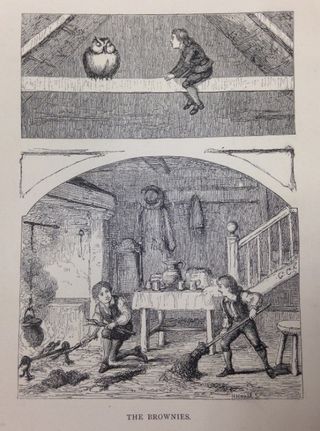
Frontispiece to The Brownies, and Other Tales by Juliana Horatia Ewing (1870). Two idle and mischievous boys, Tommie and Johnnie Trout, learn to help their widowed father by pretending they are house-sprites known as “Brownies”.
Comments