A decent read — THE INVENTOR’S SECRET reviewed
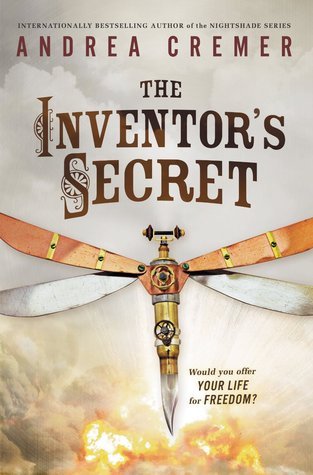 The Inventor's Secret by Andrea Cremer
Reviewed by Lexin, age 14
The Inventor’s Secret by Andrea Cremer was a historical, fantastical, steampunk fiction; an interesting mix. The bits of fantasy sprinkled amid the historical and steampunk vibe balanced out and allowed the book to not confine to a specific genre. Despite the historical aspect of the story it contained a dystopian vibe to it.
Cremer turned back the hands of time and made the setting seem to be the future yet very much grounded in the past. America is a free country in reality; Cremer's world suggests what would’ve been if America had gone down a different road. The world in which Britain became victorious in the American Revolution and held power over their struggle for independence.
The protagonist/heroine, Charlotte, lives in hiding in the undergrounds, titled the Catacombs. She is part of the Resistance, the group of patriots against the Empire. The Empire are the British that rule over the people of America. The Empire has more or less enslaved the now lower class Americans into generations of labor punishment. Charlotte is with the children of the Resistance; it’s where they stay to safely grow up; isolated from the laborious punishments of the Empire. Her brother, Ash, is the leader of the children and keeps them all safe.
When Charlotte discovers a peculiar boy on one of her errands outside the Catacombs she saves him from Rotpot, also known as an Imperial Labor Gatherer, and returns with him to a furious Ash. The boy claimes to have no recollection of who he was or a majority of his memories.
They proceed to make a trip with their band of companions to the Floating City, the heart of the Empire, to meet with the Resistance and figure out where the boy came from. They act as if Charlotte is a maiden and looking for a husband in the city and is going through traditional courting. There they discover secrets hidden within each other and the potential threatening disasters of the Empire.
Andrea Cremer creates a nicely fleshed out world. However, the way she introduces her world building is difficult to comprehend at times. There are parts with info dumps that contain a lot of historical facts that I found challenging to catch and then it moves on with a flip of a page. This made some of the world hard to grasp.
The characters were likeable and interesting. I instantly would get excited at parts when the story delved deeper into the characters and their interactions with each other. I wasn’t sure about how I felt about Charlotte’s transitions from a rebellious, speaks-her-mind sort to her confined, proper female role. At times it seemed like she had comfortably adjusted to the confined female behavior of the Empire when it wasn’t necessary. The character interaction lacked at times where I felt there should have been better or more tradeoffs between them.
I expected to have Ash be a big role in the book and it turned out that he wasn’t as focused on as I had anticipated. Similarly, Jack, Ash’s companion and Charlotte’s interest had a different personality than my initial impression might have suggested. All the characters; including Jack, Meg, Grave, and Coe were well defined as their own persons and they were executed well. Their character arcs, each in their own right, were clear and defined.
When it came to the plot, unfortunately I felt it to be slightly weak. The motive in general was weak. I felt as if the story moved on because of the events that were happening and because it had to. The characters were blindly trekking forward to an indecisive goal. When their plans or ambitions were clear I didn’t find them to be dire. Half the time I didn’t really understand where and why they wanted to go to places; just that they had to go. The stakes felt too low. They were in no terrible danger during the whole time in enemy territory. You’d think that the officials would be after them; their cover wasn’t even glanced at twice.
Contrarily, the climax was satisfying and was a good pivot point for all of the characters. It became more intriguing, pieces fell together and the pace picked up. The title of the book finally made sense. I also loved how Cremer pulled from Greek mythology and intertwined the rise of industrialization with Hephaestus and the art/wisdom/war that accompanied it with Athene (Athena) and the dynamic between them. They represented the tension and cohesiveness amongst the two. All in all The Inventor’s Secret was a decent read. I thought the writing, characters and concepts were brilliant and I was satisfied with the story.
2 thoughts on “A decent read — THE INVENTOR’S SECRET reviewed”
I’ve been seeing this book go around lately and it seemed interesting enough. I know absolutely nothing about American history though so I don’t know if I’ll be able to keep up with it. I’m still willing to give it a try but I’m probably going to be lost more than once 😛
I guess I’ll give this book a try if I see it in library, since it does seem interesting.