Canada finishes 4th on the first Web Index
The
World Wide Web Foundation,
spearheaded by its Founding Director Tim Berners-Lee
(also the inventor of the World Wide Web), issued its first Web Index report
for 2012 in which 61
countries were evaluated on their effectiveness of using the Internet to
improve people’s lives through the measurement of the Internet’s economic,
political, and social impact. The Web Index employed 85
indicators to measure the web’s impact as well as the state of a country’s accessibility
and infrastructure; these indicators were sub-divided into 3 groupings,
including: communications and institutional infrastructure scores; web content
and web use scores; and, social, economic, and political scores. Unfortunately,
the
Internet’s impact is still limited as only 1 in 3 people around the world use
the Internet, while less than 1 in 6 people in Africa use the Internet. Not
surprisingly, the Web Index rankings showed a dichotomy between
developed and developing countries with 7 of the 10 bottom finishing countries
based in Africa.
The
Web Index concluded that high
broadband prices and censorship trends are impediments to the World Wide Web’s
usefulness. About 30% of countries included on the Web Index demonstrated
moderate to major restrictions on accessing websites; almost 50% of the
countries showed augmented threats to freedom of the press. Across the 61
countries surveyed, internet broadband connections cost almost 50% of monthly
income per capita.
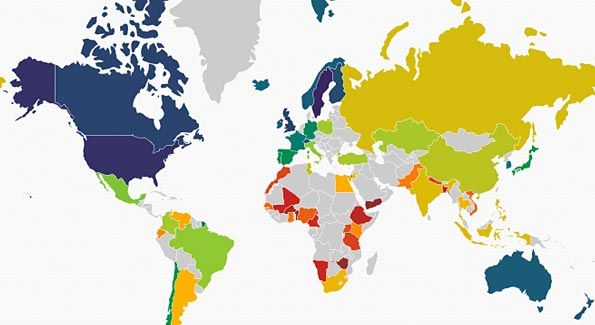
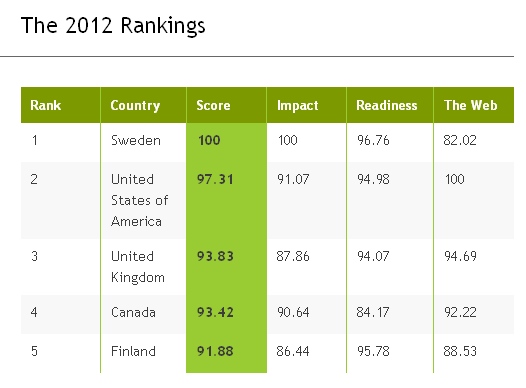
Amongst the top ten countries, Canada placed fourth (93.42)
behind Sweden (100), the United States (97.31), and the United Kingdom (93.83),
but ahead of Finland (91.88), Switzerland (90.49), New Zealand (89.15),
Australia (88.44), Norway (87.76), and Ireland (87.42). (Please access the full
Web Index rankings here.)
Canada achieved the highest web score on social
impact (including the use of social networks and the use of the web to
distribute public health information) but rated lower on economic and political
impact, and placed poorly on infrastructure with slow internet speeds and low
cell phone subscriptions on a per capita basis.
Google provided initial seed funding to get the
Web Index initiative going but time and resource limits and questionable
results in several instances lacking consistent, comparative data led to the
inaugural Web Index comprising only 61 countries. Economist Hania
Farhan, given the task of creating the Web Index, added that she hoped to
include more countries in the Web Index in the future by working with other
organizations with quantifiable data.
Comments