2.3 Billion Internet Users and 6 Billion Cellphone Subscriptions
The International Telecommunication
Union (ITU), an agency of the United Nations, issued the report Measuring
the Information Society 2012 that reported increasing mobile phone use in
developing countries increased global cellular phone subscriptions to 6 billion
in total, while 2.3 billion people out of a global total of 7 billion (about
one-third) were found to use the Internet. Canada
reported 26 million mobile phone subscriptions with 78% of households
reporting that they had at least one mobile phone. China reported 1 billion
mobile phone subscriptions with India close behind. Click here
to access the executive summary of the ITU report.
The annual ITU report ranked 155 countries on
accessibility to, usage of and skills relating to information and communication
technology (ICT). The
Republic of Korea continued to place first in ICT rankings, followed by
Sweden, Denmark, Iceland, and Finland rounding out the top 5 countries once
again. The Netherlands, Luxembourg, Japan, the United Kingdom, and Switzerland
comprised the remainder of the top ten ranked ICT nations. Canada finished in
22nd position just behind Australia while the United States placed
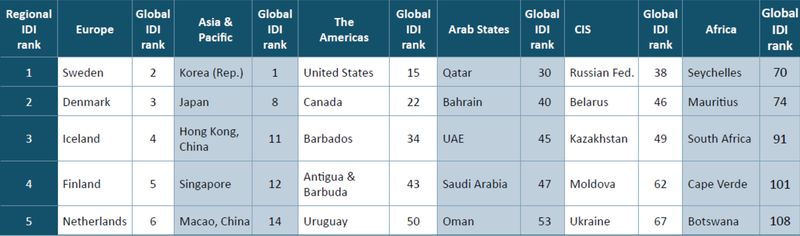
15th. The following table showed the top 5 countries in each of
Europe, Asia/Pacific, Americas, Arab States, CIS, and Africa:
Table
1: Top five IDI economies in each region and ranking in the global IDI, 2011
Source:
ITU
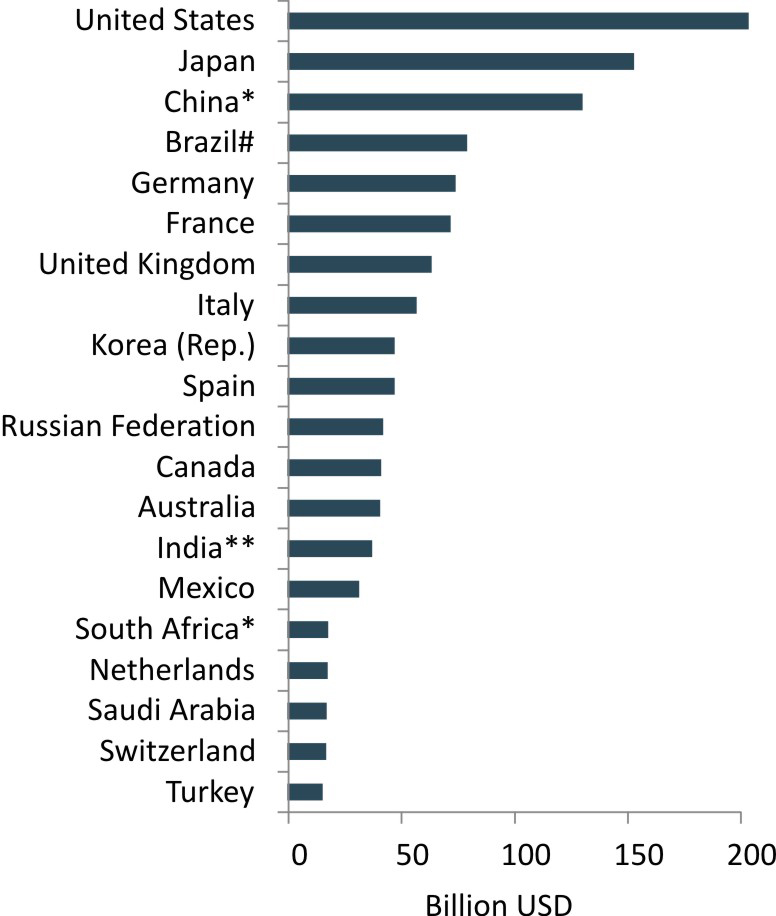
Consider the following chart that showed Canada in
12th position amongst the top 20 telecommunication markets in terms
of revenue from telecommunication services in 2010:
Chart 4: Top 20 telecommunication markets in
terms of revenue from telecommunication services, 2010
Source:
ITU
The
ITU also reported an increase in mobile broadband services by 40% worldwide and
78% in developing countries alone. However, fixed
broadband access remained too expensive in developing countries at over 40% of
monthly gross national income (GNI) per person, while globally, average
prices in fixed broadband have declined by 75% between 2008 and 2011.
Consequently, there are ongoing concerns about the “digital
divide” in the world between developed
(“rich”) and developing (“poor”) countries.
Comments