Recent Trends in eBooks and e-Reading Devices
The
Pew Research Center through the Pew Internet & American Life Project reported on December 27, 2012 that eBook
readership amongst Americans aged 16 and older increased from 16% in 2011 to
23% in 2012, while print book readership declined from 72% of Americans
aged 16 and older in 2011 to 67% in 2012. Increased eBook reading has led to
increased ownership of electronic book reading devices; ownership in eBook
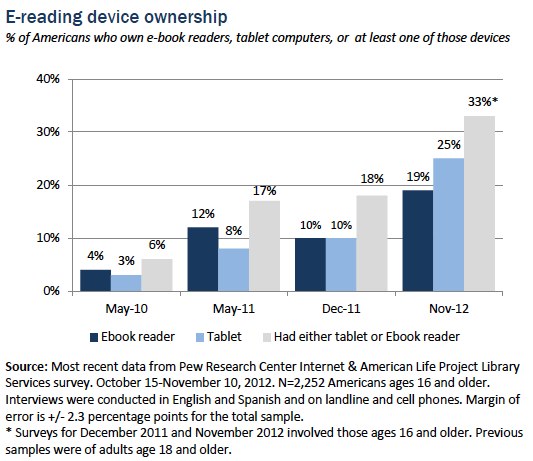
reading devices or tablet computers increased from 18% in late 2011 (December)
to 33% in late 2012 (November). Tablet computer ownership increased from 10% in
late 2011 to 25% in late 2012, while eBook reading device ownership went up
from 10% in late 2011 to 19% in late 2012. (See also the graph below depicting
e-reading device ownership.)
The rate of borrowed eBooks by American library
users increased
from 3% in 2011 to 5% in 2012, while the awareness of libraries offering
eBooks for loan increased from
24% of the overall population in 2011 to 31% in 2012.
Booknet
Canada conducted a survey with over 1,000 Canadians that
indicated a decline in eBook purchases from 17.55% of total book purchases
in the first quarter of 2012 to 14.16% in the third quarter of 2012. The fourth
quarter data for 2012 has not yet been reported and with the likely impact of
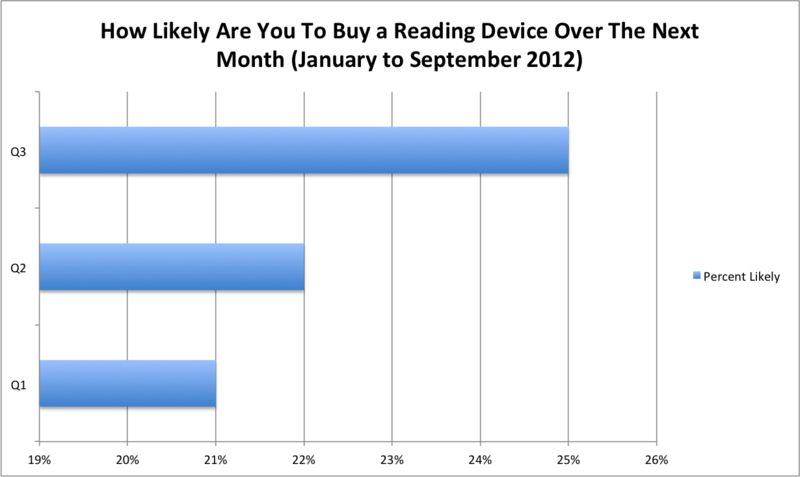
eBook readers and similar devices as gifts. However, the likelihood of buying
an electronic reading device increased over the year from the first to the
third quarters as indicated by the following graph:
Source Credit: Booknet Canada
The survey data further indicated an upward trend
for the likely purchase of a tablet computer and, conversely, the downward
trend for the likely purchase of an eReader as indicated by the following
graph:

Source Credit: Booknet Canada
Popular devices for viewing eBooks included
Kobo at 27.1%, Kindle at 19.1%, and Apple’s iPad at 14.3%, according to
Booknet Canada. While most book buying is still directed toward print-based
books bought in physical bookstores, the
declining purchase prices of tablet computers and eReaders has contributed to
changing behaviour regarding buying and reading. So has the availability of
popular books in eBook and related formats such as the Fifty Shades trilogy by E.L. James that captured the top three
spots of Digital Book World’s list of best-selling
eBooks of 2012; Suzanne Collins’ Hunger
Games trilogy captured
the next three spots on that list. A Kobo survey conducted in July 2012
found that 70%
of respondents who read Fifty Shades of Grey read it as an eBook.
Users
of eBook also have the option of borrowing eBooks through their local public
library system, where applicable. The Greater Victoria Public Library in
British Columbia reported a
184% increase in eBook borrowing between January and November 2012 with
some 33,500 patrons out of a total of about 195,000 having borrowed an eBook.
In its Annual
Report for 2011 (page 4), Toronto Public Library reported a 103% increase
in usage of the library’s eBook and eAudiobook collections in 2011 over 2010,
and celebrated the surpassing of “the 500,000 circulation mark for e-book
downloads” that represented only 1.5% of Toronto Public Library’s total
circulation of borrowed materials.
Arguably,
there are certain types of books that are unlikely to be dislodged by eBook
equivalents. One possible example is that of cookbooks
for several reasons: Physical cookbooks lend themselves better to cooking
situations; Improved technology such digital photography has enhanced the
publication of cookbooks; the lack of authentication for many online recipes on
the Internet may encourage people to continue trusting printed sources; many
foodies who use blogs and other social media options have also turned to publishing
hard copies of their recipes. Nathan Maharaj, Kobo’s merchandising director,
acknowledged that cookbooks
are one of the few categories in which hard or soft cover books are more
popular than a digital eBook equivalent. In fact, chef Jamie Oliver’s new
cookbook 15-Minute Meals was
the top selling book in the United Kingdom over the Christmas week with 140,155
copies sold as of December 22, 2012, contributing to the best weekly
performance (since Christmas 2009) of printed book sales in the UK at over £75
million. This was despite the fact that printed book sales in the UK were down
3.5% year on year by volume and 5.5% in terms of value in the first ten months
of 2012. On the other hand, some celebrity cookbooks are due to be published as
both books and eBooks, including
that of actress Gwyneth Paltrow which is due to be published in April 2013.
(See also: New
tablet or eBook reader? Borrow free eBooks and eAudiobooks )
Comments