Does the Facebook “Likes’” Study Add Up?
Facebook users have had an ample opportunity to acknowledge
their preferences on their Facebook pages since the inception of its
“Like “ button on February 9, 2009. A report
was published in the March 12, 2013 (Vol. 110 No.11) issue of Proceedings of the National Academy of Sciences
entitled “Private
traits and attributes are predictable from digital records of human behavior”.
The research and ensuing article was conducted by two academics at the
Psychometrics Centre of the University of Cambridge and one researcher from
Microsoft Research based in Cambridge, England. John C. Dvorak, writing on pcmag.com, reminded readers that Microsoft
Corporation is a part-owner of Facebook, thereby calling the study’s
results into question. The study involved more
than 58,000 Facebook users in the United States participating through a
Facebook app called myPersonality, owned by David Stillwell, one of the
study’s authors from the University of Cambridge’s Psychometrics Centre. The 58,000-plus users in the test population
volunteered information on their “likes”, personalities, and demographic
profiles. Researchers
used an algorithm for data analysis which was said to accurately predict American
males’ sexual orientation 88% of the time, Americans’ political affiliations
between Democrats and Republicans 85% of the time, and differentiate the
backgrounds of African-Americans and Caucasian-Americans 95% of the time.
John C. Dvorak also noted that the 58,000-plus
Facebook users were
not randomly selected but volunteered for the study. Dvorak felt that the
study’s intent was to reinforce the idea to marketers that Facebook advertising
can be targeted in an exact fashion and recommended to users not to click on
anything to divulge personal information, preferences and the like. On the
positive side, the study’s authors contended that the
results could be used to ameliorate products and services such as online stores
that could adjust themselves to fit users’ profiles.
Marina Ziegler, writing on the Secure.me blog, expressed being startled
by the fact that the predictions from the University of Cambridge study could
be generated without
Facebook users giving away too much obvious information. Ziegler also expressed
concern at how many users share their data without wondering how the data could
be used. Many Facebook users make their “Likes” lists open to their friends and
often to the public. In addition, Facebook users often share their “Likes” with
the apps that they use with their Facebook accounts. Secure.me provided a list of the top 10 apps
in the United States that seek permission to access one’s “Likes” if one wishes
to connect these apps with a Facebook account:
“
- Yahoo* more
than 10 Mio. users/month - Pinterest more
than 10 Mio. users/month - TripAdvisor* more
than 10 Mio. users/month - Causes* more
than 5 Mio. users/month - Zoosk more
than 5 Mio. users/month - Pandora more
than 5 Mio. users/month - Etsy* more
than 1 Mio. users/month - Groupon* more
than 1 Mio. users/month - Hulu more
than 1 Mio. users/month - Amazon* more
than 1 Mio. users/month
*These apps don’t only access your own, but also your friend’s “Likes”.”
(Source Credit: https://www.secure.me/en/2013/03/12/show-me-what-you-like-on-facebook/
)
Secure.me also offers
users the ability to check out which apps seek permission for accessing one’s
“Likes” and personal information by visiting their App Security Network . Facebook users can
also take measures to protect their own privacy by improving privacy settings,
cleaning up apps’ lists, ensuring that friends’ apps cannot collect one’s
personal data, and hiding one’s “Likes”.
Facebook users interested in privacy options should read the article “A
Guide to Facebook Privacy Options” in the Wall Street
Journal by Lorrie Faith Cranor, a security expert and academic from
Carnegie Mellon University. Dr. Cranor emphasized that Facebook offers tools
that help users control who can view one’s posts, use account settings to
prevent account takeover, prevent one’s name and image from appearing in
advertisements for products for which one expressed a “Like”, and prevent apps
from showing up in one’s timeline. Better yet, Dr. Cranor developed a graphic
that illustrates various Facebook privacy settings and how to use them. Facebook will be rolling out a home page
change that will affect the placement of icons denoting privacy and security
BUT the settings are not supposed to change.
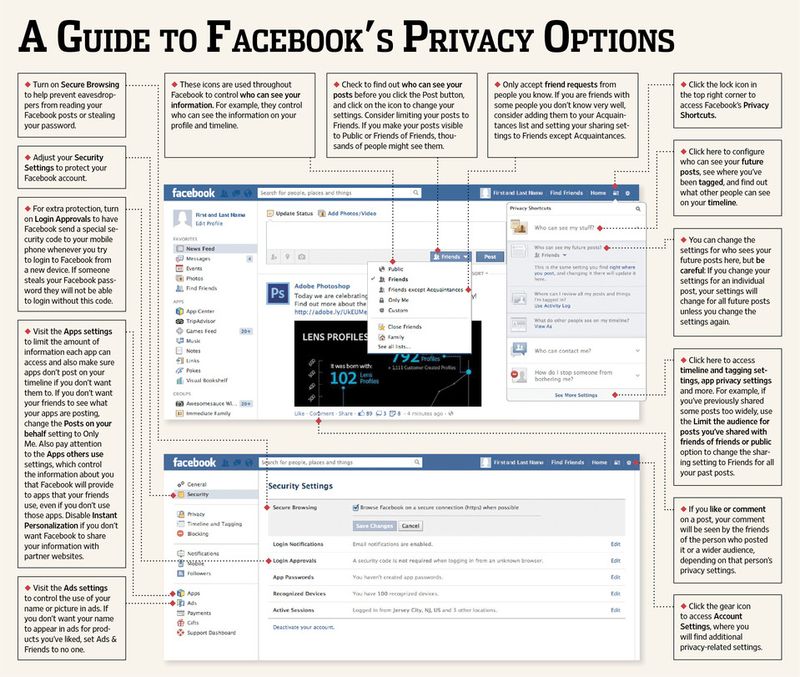
(Source
Credit: Wall Street Journal and Lorrie Faith Cranor, Carnegie Mellon University
– http://online.wsj.com/article/SB10001424127887324880504578300312528424302.html#project%3DFBPRIVACY0308%26articleTabs%3Dinteractive
)
What
do you think about Facebook privacy settings? Do you use them? Tell us about
your experiences on the Computer
and Library Learning blog.
2 thoughts on “Does the Facebook “Likes’” Study Add Up?”
This was very interesting and helpful — as usual for this blog! Thank you. You’ve given me a lot of food for thought, and you have in the past, as well.
Really interesting stuff. I forwarded it to some friends. Thanks.