Google Reader to Shut Down: Why? What are the Alternatives?
On
March 13, 2013, Urs Hölzle, Google’s Senior
Vice-President of Technical Infrastructure and Google Fellow, announced on the Official Google Blog that
more Google products were being dropped
over the course of the year 2013, including Google
Reader. Mr. Hölzle acknowledged that Google Reader has had “a loyal
following” but usage of the service has dropped. Consequently, the decision was
made to retire Google Reader on July 1, 2013. Google Reader users interested in
pursuing RSS (Rich Site Summary or Really Simple Syndication)
alternatives (to continue receiving regularly updated content from one’s
favourite websites) are able to export their Google Reader data, including
their RSS website subscriptions, using Google Takeover (Google’s
data liberation service) over the next several months to Google Reader’s expiration
on July 1, 2013.
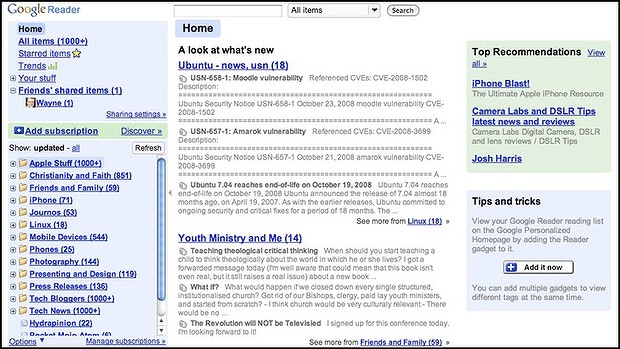
(Source Credit: Sydney Morning Herald, March 15, 2013 –URL: http://www.smh.com.au/digital-life/digital-life-news/outrage-at-googles-decision-to-axe-reader-20130315-2g4ci.html )
The
downside of the Google Reader shutdown is that dedicated users must now find an
alternative before the July 1, 2013 deadline. The good news is that the
migration of Google Reader users to other RSS reader services has already
begun. Further good news is that many writers in the technology field have
written many articles recommending viable alternatives to Google Reader. Let’s
take a quick look at some of them:
Feedly
reported on March 15, 2013 that over
500,000 Google Reader users had joined Feedly since Google’s announcement
on March 13, 2013. “Seamless migration” is available for iOS, Android, Google
Chrome, Mozilla Firefox, and Safari users. Ellis Hamburger, writing on The Verge, argued that Feedly is the “only
real Google Reader alternative” because it is the only RSS application that
comes with free companion mobile apps of excellent quality, ensuring the
ability to continue without difficulty. Feedly also gives the user the option
of dividing one’s RSS feeds into folders and choosing a preferred view (i.e.
headlines, timeline etc.). Similarly, Mellisa Tolentino, writing on Silicon Angle, reported that Feedly
developed a clone application
programming interface (API) to Google Reader’s API (operating on Google App
Engine) called
Normandy; Normandy will be in place for the transition when Google Reader
shuts down. Paul Chaney, writing on Practical
Ecommerce, noted that one could log into Feedly by using one’s Google
account with
the result that one’s feeds will be automatically synchronized. Chaney
further praised Feedly’s “more visual interface” but users should be aware of a
condensed version of subscribed feeds that shows up when one has selected the
“ALL” link.
Newsblur is
arguably the best RSS service for news junkies with
a refreshed screen of one’s news feeds every minute and offers the ability to
organize news feeds with folders inside other folders. Tejas Morey noted
that Newsblur
has better add-ons than Google Reader with the free service supporting 64
feeds showing 10 stories. Unfortunately, access
to the free service has been temporarily frozen but interested users can
sign up for the paid service with additional flexibility. Newsblur has apps for
iOS and Android users that synchronize “saved stories”.
Pulse is an
alternative best suited to those who are visually oriented, and is available for web,
iOS, and Android users. Pulse posted a notice on its blog for Google Reader
users to
instruct them on how to add their Google Reader feeds to Pulse on a mobile
device after which one can log into Pulse on a desktop or laptop computer and
see their feeds back in their web browser.
Netvibes
is a dashboard service intended for business but there is a free version
available for individuals to use. Alan Henry, writing on Lifehacker.com, described Netvibes as “a
free and functional replacement for Google Reader” with an attractive
dashboard from which users have access to widgets for topics such as news and
weather information.
For those seeking a Canadian-based alternative, Terry Brodie of The Globe and Mail highlighted the
content-curation start-up firm Spundge based in Montreal in a March 19,
2013 article. Spundge announced in a March
15, 2013 blog post that Google Reader users had imported over 10,000 RSS
feeds since Google announced its intention to terminate Google Reader. Users
with a free Spundge account can consult the quick start guide “5
keys for getting started on Spundge” as well as “Importing
RSS Feeds from Google Reader” for help.
Not forgetting Mac users, one should consider NetNewsWire (which has been in business
since 2002, somewhat dated and slow as it relies on one’s computer but a Google
Reader account is not needed to use it. Combined with reliable refreshing of
feeds and keyword searching, Ellis Hamburger contended that NetNewsWire is the “most
well-rounded local RSS client for Mac.”), Reeder, Vienna (an open-source alternative), and Leaf (which
presents RSS feeds in a Twitter-like format.).
My colleague Blog Prince, in addition to writing
about Feedly, also listed Bloglines
(with both
desktop and mobile apps) and The Old
Reader (based on an older version of the Google Reader but web-based
only at this time) as alternatives to Google Reader in his recent blog post
“Will
you miss Google Reader?”.
Google Reader users are welcome to share their
migration experiences from Google Reader to other RSS alternatives with us here
on the Computer
and Library Learning blog by making a comment.
Comments