Snapshots in History: April 30: Remembering the World’s First Website on the WWW
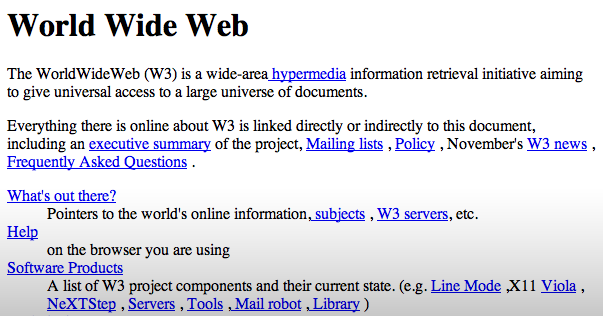
(Source
Credit: CERN – URL: http://info.cern.ch/hypertext/WWW/TheProject.html
)
Those of us who use the World Wide Web to view
webpages might want to take a brief moment to celebrate the twentieth (20th)
anniversary of the world’s first website. On April 30, 1993, in a desire for an
“open web”, the European
Organization for Nuclear Research (known by its French acronym CERN) released
royalty-free the software and technology needed to run a web server to put
websites on the Internet, accessible through a basic web browser. In
celebration of the 20th anniversary, CERN launched a working version
of the world’s
first original webpage.
Many people are aware of the role of British
computer scientist Tim
Berners-Lee in creating the World Wide Web (or W3)
while he was working at CERN in 1989. Following the launch of the CERN webpage
which was hosted on Berners-Lee’s NeXt computer at the time, there were over 500 web servers by the end of 1993 with the
World Wide Web making up only 1% of Internet traffic while other activities
involved remote access to computer networks, email activity, and file transfers
from one computer to another workstation. In 2013, there are approximately 630
million websites.
In the early days of the World Wide Web, there were
no search engines to help find information. However, on the first website,
there were 17
subject areas from which to look for information:
Aeronautics; Astronomy and Astrophysics; Bio
Sciences; Computing; Geography; Law; Libraries; Literature; Humanities;
Mathematics; Meteorology; Music; Physics; Politics and Economics; Reference;
Religion; and, Social Sciences.
What about the “open web”? Stephen Shankland, writing on
cnet.com, noted that proprietary technology
has found a place on the World Wide Web. The World
Wide Web Consortium (or W3C) has developed recommendations with the goal of royalty-free
implementation and the avoidance of patented technology. For example, when
Unisys wanted patent royalties for developing GIF (Graphics Interchange Format)
files, W3C
helped to develop an alternative called Portable Network Graphics (PNG). Patents
also exist in video compression codec with an industry standard called H.264 (or AVC – advanced
video coding) for which individuals using the standard in hardware, software,
streaming etc. must pay royalties to patent holders through Motion Picture Experts
Group LA (licensing authority). Shankland also discussed digital rights
management (DRM) which can place limitations on the copying of television
programs, music sharing, or watching a rented movie after the expiration of 24
hours. The Free Software Foundation, Creative Commons, Electronic Frontier Foundation and other bodies
have
urged W3C to keep its standards free of DRM. However, controversy is
swirling around Tim Berners-Lee’s support of a proposal being debated within
W3C to add digital rights management to the new version of hypertext markup language (HTML)
called HTML 5.
Canadian-British science fiction author and blogger Cory Doctorow,
writing about HTML 5 on The Guardian’s
Technology blog, argued
that the addition of digital rights management to the HTML 5 standard will have
major impacts “that
are incompatible with the W3C's most important policies, and with Berners-Lee's
deeply held principles”. Doctorow is well-acquainted with W3C’s patent-free
approach and argued that when W3C members hold title to a patent that becomes
part of a W3C standard, licensing should be offered without stringent
conditions. However, this desire is in direct conflict with the intent of
digital rights management to impose strict conditions on browsers, such as “robustness”
against end-user changes, thereby preventing the use of free, open source
software. Consequently, popular browser technologies such as WebKit (used in Chrome and
Safari web browsers) and Gecko (used
in Firefox browsers) would be legally restricted from implementing the emerging
W3C standard. Doctorow also questioned the effectiveness of DRM in preventing
copying. The desire of an “open
and neutral Internet” which Berners-Lee developed without permission is in
direct conflict with digital rights management which necessitates permission
for the right to create and innovate.
Undoubtedly, the World Wide Web and its place on the
Internet will continue to evolve, influenced by participants with differing viewpoints
on the patent debate and digital rights management. What do you think? Have
your say here on the Computer
and Library Learning Blog.
Comments