Recommended Websites at Toronto Public Library and the Hidden Web

(URL: http://www.torontopubliclibrary.ca/books-video-music/recommended-websites/ )
 Many Toronto Public Library customers with limited or no knowledge of computers before have gone through the spectrum of free computing training workshops offered at Toronto Public Library
branches, including the series of Web Basics 1, Web Basics 2, and Web Basics 3 workshops that emphasize three different ways of accessing information on the Internet:
1) When you know where you are going (i.e. the URL or the website’s address);
2) When you want to explore (and don’t have a specific website in mind) (i.e. use a search engine such as Bing, Google, or Yahoo! etc.); and.
3) When you want the exploring done for you (i.e. go to a special website or subject directory that links to other websites on the basis of category or topic – e.g. Internet Public Library and yes, Toronto Public Library’s Recommended Websites ).
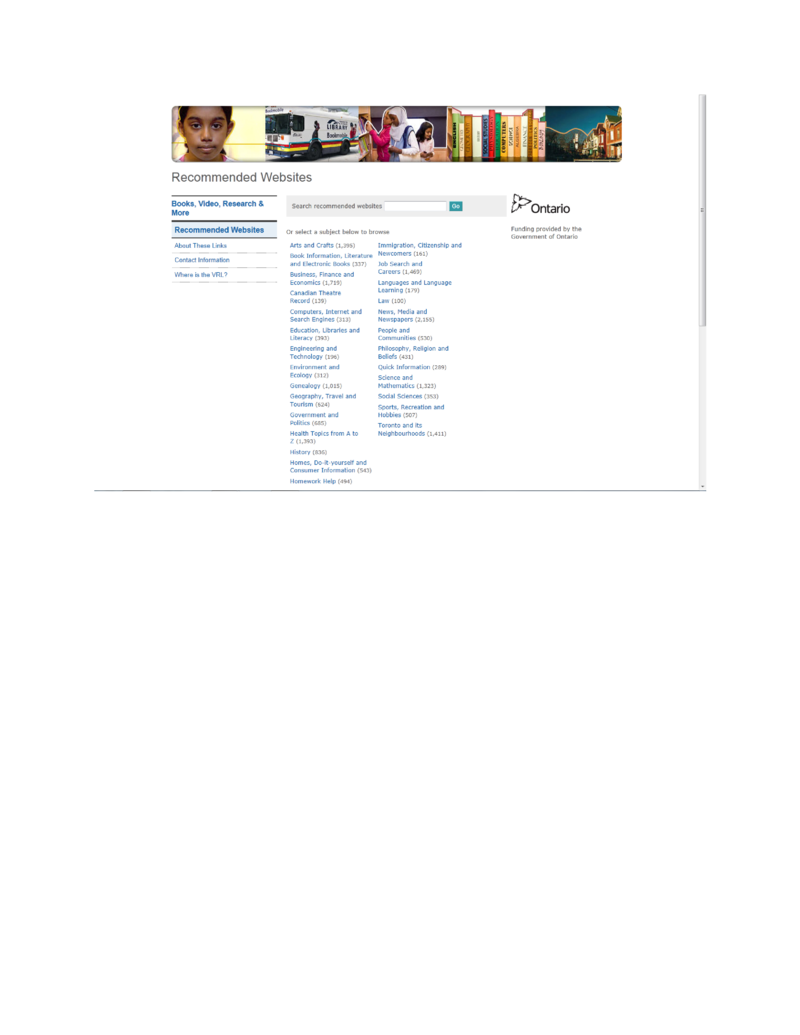
It is method #3 that will be the focus here as we look at the “Recommended Websites” section of the Toronto Public Library website. “Recommended” means that Toronto Public Library librarians
have selected said websites for inclusion in a designated website category, evaluating the quality of the information presented, and monitoring those websites for potential changes. Customers using “Recommended Websites” have the option of searching by keyword(s) or can browse by subject categories to move from the general subjects to the more specific ones. Here are the general
subject categories as listed on Toronto Public Library’s Recommended Websites (with the number of listed websites in paren'theses as of May 18, 2013):
Arts and Crafts (1,395)
Book Information, Literature and Electronic Books (337)
Business, Finance and Economics (1,719)
Canadian Theatre Record (139)
Computers, Internet and Search Engines (313)
Education, Libraries and Literacy (393)
Engineering and Technology (196)
Environment and Ecology (312)
Genealogy (1,015)
Geography, Travel and Tourism (622)
Government and Politics (685)
Health Topics from A to Z (1,393)
History (836)
Homes, Do-it-yourself and Consumer Information (541)
Homework Help (494)
Immigration, Citizenship and Newcomers (161)
Job Search and Careers (1,469)
Languages and Language Learning (179)
Law (100)
News, Media and Newspapers (2,155)
People and Communities (530)
Philosophy, Religion and Beliefs (431)
Quick Information (275)
Science and Mathematics (1,323)
Social Sciences (353)
Sports, Recreation and Hobbies (507)
Toronto and its Neighbourhoods (1,411)
As an example, let us focus on the Computers, Internet and Search Engines category. When entering this category, one now finds more specific subject categories (with the number of selected websites listed in paren'theses as of May 18, 2013):
Communications and Networking (7)
Dictionaries (6)
Email (6)
Free-Nets (3)
Hardware (14)
Newsletters, Magazines and Journals (11)
Operating Systems (11)
Organizations and Associations (14)
Programming (9)
Search Engines and Directories (72)
Security (13)
Software (28)
Word Processing Tutorials (10)
World Wide Web (94)
Now let us focus on the Search Engines and Directories category which breaks down further as follows (with the number of websites per category in paren'theses as of May 18, 2013):
French Language Search Engines and Directories (9)
Regional Search Engines and Directories (7)
Search Engines (8)
Subject Directories (14)
Subject Directories – Canadian Focus (5)
Subject directories (or recommended websites by category) websites are not always fully searchable or visible on the Internet through the use of a search engine that indexes the “Surface Web” or the “Visible Web”. Along with subscription databases and websites requiring membership to access
additional content, such sources constitute part of what is referred to alternatively as the “Deep Web”, the “Hidden Web”, or the “Invisible Web”. For those interested in learning more about the “Hidden Web”, consider the following titles available from Toronto Public Library collections:
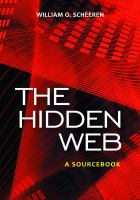
The hidden web: a sourcebook / William O. Scheeren, 2012.
The author contended that many researchers, students, and even some librarians possess superficial searching skills of the Internet. Scheeren argued that the ability to use the Hidden Web in school and public libraries is essential as the most current and qualitative information is often found there. This book evaluated and subdivided various sources based on subject category, accompanied by resource
descriptions.
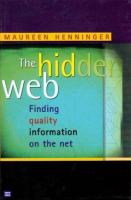
The hidden web: finding quality information on the net / Maureen Henninger, 2003.
Henninger took the reader beyond surfing the Internet to seek information. In addition to discussing search syntax and Boolean language strategies, the author addressed the presence of the “Invisible
Web” comprised of databases and some search engines that could be used by web users for free or for cost, depending on the source in question. Henninger provided search examples.
Comments