January 28 is Data Privacy Day

(Credit: Web Banner – 740 pixels x 127 pixels – Office of the Privacy Commissioner of Canada)

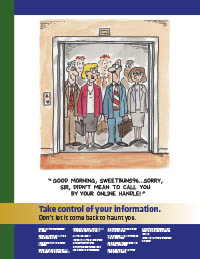
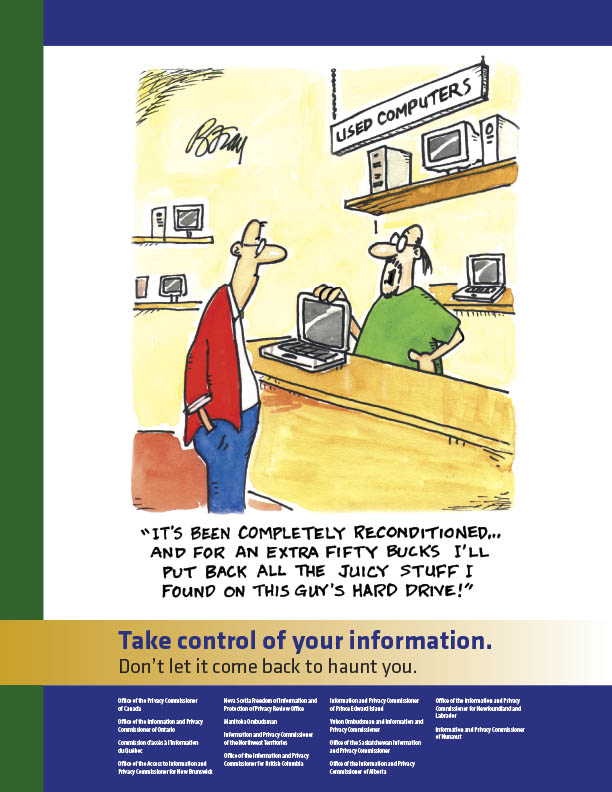
(Credit: Posters – Office of the Privacy Commissioner of Canada)
(Source: Global TV BC – Mon, Jan 27, 2014 – The provincial government has proclaimed Tuesday “Data Privacy Day” in B.C.)
Once again, we are barely into another year when (International) Data Privacy Day comes around again on another January 28. Data Privacy Day began in January 2008 in Canada and the United States as an extension of the Data Protection Day in Europe, dating back to Convention 108 signed on January 28, 1981 as the first legally-binding international treaty dealing with data protection and privacy issues. Data Privacy Day is now a global event.
The Internet has facilitated the free flow of information in today’s world. Both individuals and organizations need to be protective of personal information entrusted to them by practicing good data stewardship, and encouraging and educating people to protect their privacy and manage their digital footprint. The National Cyber Security Alliance, a non-profit public-private partnership, operates the website StaySafeOnline.org as a source for those wanting to stay safe online, teach online safety, keep their business safe online, and get involved. Earlier on January 28, 2014, Ryerson University’s Privacy and Cyber Crime Institute hosted an International Data Privacy Day event to raise awareness. In January 2013, the Office of the Privacy Commissioner of Canada released a final report – Survey of Canadians on Privacy-Related Issues (based on a telephone survey of 1,513 Canadians (aged 16 and over) conducted between October 25, 2012 and November 12, 2012) – that found Canadians’ knowledge of their rights under Canada’s privacy laws is inadequate but improving; that showed two-thirds of Canadians to be concerned about the protection of their privacy (with 25% expressing extreme concern on this point); that found 70% of Canadians felt that their personal information had less protection than 10 years previously; that demonstrated 71% of Canadians felt that protecting their personal information would be one of the more important issues faced by the country and its governments over the next 10 years; that showed most Canadians were aware that their online browsing, searching, purchasing, and service interactions could be tracked by the visited websites but also demonstrated that 54% of Canadians had not taken any steps on their own initiative to reduce this type of tracking; and, that revealed that 92% of Canadians surveyed thought that Internet companies should have to seek their consent to track what they do on the Internet, while 81% of Canadians believed that it was important for websites to actively inform users about what personal information is collected and how it will be used. Nonetheless, many Canadians don’t tend to read privacy policies of websites, continue to use bad passwords, and do not change the privacy settings of mobile devices and corresponding apps.
There is some degree of debate as to how much responsibility for managing online privacy should rest with the individual. Some such as Avner Levin of Ryerson University’s Privacy and Cyber Crime Institute have called for increased powers in the role of Canada’s federal privacy commissioner, echoing the recommendations made by former federal privacy commissioner Jennifer Stoddart herself in 2011, that would allow the privacy commissioner to examine how companies handle personal data without the need of an initial complaint.
So what can individuals do to protect themselves online? Technology journalist Dan Misener of the CBC Radio program Spark suggested reviewing the privacy settings of social networks used, removing unused apps, and seeking information from the Canadian Access to Social Media Information Project (CATSMI), using himself and his accounts as examples. Media professor Sidneyeve Matrix of Queen’s University offered some suggestions for protecting one’s digital footprint gleaned from a variety of sources, including:
- Combat identity theft by avoiding the use of personal information on social network sites such as one’s birthday, current location, home address, and telephone number since personal information is often used for password retrieval;
- Choose not to participate in data tracking (for advertisement and search history purposes) by opting out on popular websites such as Facebook, Google, Bing, Yahoo, Twitter and from third-party cookie tracking on the Google Chrome and Mozilla Firefox web browsers;
- Avoid or minimize use of open, unsecured wi-fi access in public places as communications can be intercepted and read. If one must use such wi-fi access, limit Internet access to website addresses beginning with HTTP Secure (aka https://) or consider using a VPN (virtual private network). At Toronto Public Library branches, customers are reminded that: “The Library's wireless access points are unsecured connections to the Internet. The Library is not responsible for data transmitted or loss of information over the wireless network. Users should be aware that third parties may be able to obtain information about users' activities when using the wireless service to connect to the Internet. The Library assumes no responsibility for the security and privacy of on-line transactions…”;
- Employ better data security with stronger passwords; mobile phone users should also consider two-step verification as additional protection for their email and other web-based accounts (as hackers would also need to possess the actual mobile device to attempt hacking into those web-based accounts);
- Paren'ts should configure permissions and privacy settings for Android-based and Apple iOS-based devices to which their children have access.
(Source: United States. Federal Trade Commission. Consumer Information. – What Are You Doing On Data Privacy Day?)
Consider the following titles for borrowing from Toronto Public Library collections:
Unauthorized access the crisis in online privacy and security / Robert H. Sloan and Richard Warner, 2014. eBook format (Access Online – Requires Login)
Thinking about cybersecurity from cyber crime to cyber warfare [3 videodiscs] / Paul Rosenzweig, 2013. DVD. Documentary. Adult Non-Fiction. 364.168 THI DISC 1-3
Take control of your online privacy / Joe Kissell, 2013. eBook format (Access Online – Requires Login)

Interop the promise and perils of highly interconnected systems / John G. Palfrey and Urs Gasser, 2012. eBook format (Access Online – Requires Login)
(Access an additional eBook format copy online requiring login by clicking here.)
Talking back to Facebook: the common sense guide to raising kids in the digital age [1st pbk. ed.] / James P. Steyer; with a forward by Chelsea Clinton, 2012. Book. Adult Non-Fiction. 004.67808 STE

Popular mechanics who's spying on you?: the looming threat to your privacy, identity, and family in the digital age / Eric Sofge and Davin Coburn, 2012. Book. Adult Non-Fiction. 613.6 SOF
Internet and surveillance: the challenges of Web 2.0 and social media / Christian Fuchs [et. al.], 2012. Book. Adult Non-Fiction. 005.8 INT
Also available in eBook format (Access Online – Requires Login).

Cyber warfare: techniques, tactics and tools for security practitioners / Jason Andress [et. al.], 2011. Book. Adult Non-Fiction. 355.343 AND
Privacy and big data / Terence Craig and Mary E. Ludloff, 2011. eBook format (Access Online – Requires Login)
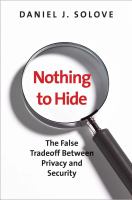
Nothing to hide: the false tradeoff between privacy and security / Daniel J. Solove, 2011. Book. Adult Non-Fiction. 342.73085 SOL

Data data everywhere: access and accountability? / Colleen M. Flood, 2011. Book. Adult Non-Fiction. 651.50426 DAT
Media divides: communication rights and the right to communicate in Canada / Marc Raboy [et. al.], 2010. Book. Adult Non-Fiction. 302.2309 RAB
The Canadian privacy and data security toolkit for small and medium enterprises / Claudiu Popa and Nicholas F. Cheung; Canadian Institute of Chartered Accountants, 2009. Book + 1 CD-ROM. Adult Non-Fiction. 342.71085 POP
Comments