Find the history (and cool historical images) of your neighbourhood!
Toronto has been dubbed a “city of neighbourhoods” and neighbourhoods are of great importance to local residents and organizations, as well as to city planners and service providers.
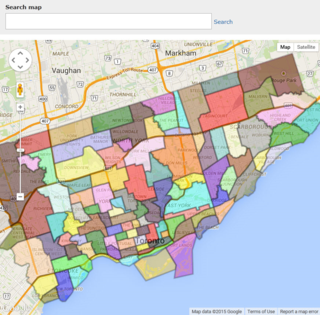 But finding local information is often difficult, so Toronto Public Library staff has created an interactive neighbourhood map to assist users in discovering resources in the Library’s collections.
The city has been divided into 107 neighbourhoods, and relevant materials are indexed using the area's assigned name within specific geographic boundaries. No other library or archive provides this level of indexing.
We include historical pictures, maps and atlases, ephemera (posters, flyers, etc.) and e-books in the Library’s Digital Archive as well as catalogue records for print books and other formats in our collections.
Links to external sites that library staff recommends are also provided from the map. Let us know about additional websites for your neighbourhood that you would like us to review. They should have some historical information and preferably be non-commercial.
Find your neighbourhood from a list (see below), or zoom in on the map, or, if you aren’t sure what neighbourhood you are looking for, type in a specific address, intersection or place name in the dialogue box above the map.
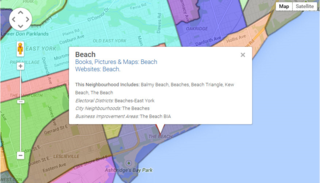 When you click within a neighbourhood on the map, a bubble shows alternative names – one person’s “The Beach” is another’s “Beaches”, for example. Other names are provided including smaller neighbourhoods within the larger unit – Balmy Beach, Beach Triangle and Kew Beach are all part of our “Beach”. Let us know if we’ve missed a name, and we’ll consider adding it.
How neighbourhood names and boundaries were determined
Common usage was the most important criteria for choosing the neighbourhood names but library staff also checked out historic names, and usages by the City of Toronto, resident and ratepayer associations, local institutions such as schools, parks and libraries, and real estate advertisements.
City of Toronto studies such as neighbourhood profiles and heritage conservation districts helped the Library determine neighbourhood boundaries, but we were also guided by our own collections. The map shows more neighbourhoods in the older areas of the city where the Library has more historical materials, and fewer neighbourhoods in the more recently-developed areas.
Additions and revisions to the map
The Toronto neighbourhoods map is a work in progress, and we are always adding new digital resources and supplementing or refining the indexing terms to help our users. A few years ago, we added some new names to the interactive map that the Toronto Star and Toronto Life used for their neighbourhood maps. Recently, our cataloguers made sure that the designated heading “Beach (Toronto, Ont.)” was used consistently so that more of the Library’s records could be found.
 Often, we focus on digitizing historical materials from our collections to support community celebrations such as the centennial of the incorporation of the town of Leaside in 2013 and the 100th anniversary of the present library in Weston in 2014.
Right: Thumbnails of some results for Weston
This year, we will start adding hundreds of photographs of North York neighbourhoods from a collection that was donated by the North York Historical Society. We will also be digitizing the 1912 fire Insurance plan of Toronto whose plates include detailed maps of some of the city’s newly-established suburbs. We will continue to add catalogue and holdings records for community newspapers in our branch local history collections.
Of course, each picture, map and newspaper title will be indexed by neighbourhood names!
3 thoughts on “Find the history (and cool historical images) of your neighbourhood!”
Dear Ms. Myrvold:
I was extremely interested in your two publications St. Clair West in Pictures, history of the communities of Carlton, Davenport, Earlscourt and Oakwood. 1999& 2008 (also Nancy Byers). My name is June Oliver (Salmon) and I am the eldest daughter of James Victor Salmon (J V Salmon Collection. I came across your books while I was trying to find more information on Dad’s book, Rails from the Junction. As you know, his amazing and extensive collection of prints, glass negatives and books etc. are in the Baldwin Room in your Toronto library. While looking through your two books online which I found very informative, I noticed that a number of photos belonging to his collection were only referenced by his name and no mention of the “J V Salmon Collection” which these photos came from and was a disappointed that it was not noted in any of your end notes in either books and in fact one of the write-ups quoted a passage from Rails from the Junction. I am considering reprinting his book in an up-to-date format as it was done in the sixties. I know this is not a big concern to anyone else but just thought it should be mentioned. If you wish to reply to my comments, I can be reached via email at oliwatsca@yahoo.ca or my home number 1-705-645-4947. !sincerely June Oliver.
Ms. Myrvold:
I am trying to contact you. I am a volunteer with the group Friends of Glen Stewart Ravine. I would like to see if you might be interested in writing some pieces for a blog for us or being involved as a speaker or in any other capacity.
Cherie Daly (dalycherie@gmail.com) or 416 693-2734
Hello Mrs. Oliver
Thank you for your email. We are very careful to provide detailed sources for the images and quotations that we use in our local history books, and so I was surprised to read that you felt that James V. Salmon’s collections and work were not adequately credited in St. Clair West in Pictures.
I searched for “Salmon” in the online copy of the second and enlarged edition of St. Clair West in Pictures, and found ten references, including six credits to images from his picture collections at the Toronto Reference Library (pp. 22, 32, 51, 91, 102) and the City of Toronto Archives (p. 42); a quotation from Rails from the Junction (p. 37) that is credited with endnote 37 (p. 144) and an entry in the bibliography (p. 148).
To save space, all pictures in the image credits are simply given the name of the creator; an abbreviation of the institution where the picture is located (the key to abbreviations used in picture credits is on the verso of the title page); and the identification number that the institution uses for the image, which can be used to identify the specific collection name.
We acknowledge your father’s invaluable contribution to Toronto history in the caption for the image on p. 102: “Salmon, an amateur photographer and a railway buff, documented many historic Toronto buildings in the 1950s, as well as street railways, railroads and buses. The James V. Salmon Collection is now part of the Canadian Historical Picture Collection, Toronto Reference Library.” This is referenced in the index (p. 154).
It is good to hear that you plan to reprint Rails from the Junction, which your father wrote in the 1960s. This book has has long been out of print and a new edition will be welcomed by local and railway historians.