Google and “Me on the Web”
Google introduced its new reputation tool called “Me on the Web” on June 15, 2011 on the Google Public Policy Blog. Online identities are influenced not only by what someone posts about oneself but also what others post about that individual, or mention in a photo tag or an update. Using a search engine like Google would bring up this mixture of information.
The intention of “Me on the Web” is to facilitate identity monitoring on the internet and offer access to resources describing ways to “control” the information appearing on the internet. “Me on the Web” is a subset of the Google Dashboard underneath the Account details section. Google account holders can also use Google Alerts to set up a notification system when their names and/or email addresses are mentioned in the media and/or on websites. Google had previously addressed its supported identity options of unidentified, pseudonymous, and identified in a previous Google Public Policy Blog post.
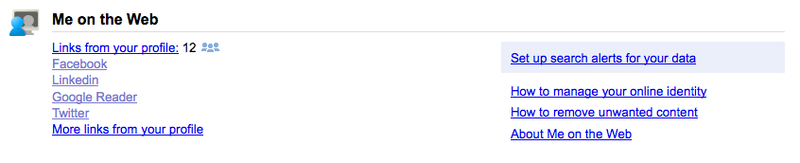
Google offers tips such as keeping personal information off Google, re-think before placing personal information online, attempt to get questionable content removed from the offending website, and use positive information to balance out negative information. Let Google know if websites containing personal details such as credit card numbers and social insurance numbers show up in a Google search; Google will contact the website’s hosting company to request that the page with confidential, personal information be removed from the internet.
Individuals seeking to remove questionable material from a website that they own can request Google to remove the web page from a web search by using the URL removal tool in Google Webmaster Tools. Otherwise, if the content is on a website owned and controlled by someone else, Google recommends contacting the webmaster to remove content. If it becomes difficult to find an email address, Google suggests doing a “Whois” search including the URL or website address. Google users can use Google Webmaster Tools to request a webpage removal from Google search results. Some sources note the limitedness where this can happen and suggest employing a fee-for-service alternative to pursue webpage removal.
Some commentators see “Me on the Web” as Google’s response to the Facebook phenomenon by creating Google Profiles. Arguably, Google Profiles do not help Google users with the management of their online reputation but rather helps Google to learn more about their users by offering search results that are more relevant to Google account holders. Having a Google Profile is necessary for a Google user to show their internet likes (represented by +1) publicly. (Please refer to post: Google’s +1 Button: Social + Identity = ? )
For those who don’t like their web searching tracked, one option is not to have a Google account or even a Google Profile (if one chooses to have a Google account). Another option is to use a search engine that does not track one’s searching interests for those who value privacy. One example is DuckDuckGo which does not track one’s searches and send them to other websites or store them. One can access DuckDuckGo’s privacy statement that states DuckDuckGo “does not collect or share personal information.” One commentator noted DuckDuckGo’s attempt to circumvent the “filter bubble” (dubbed by Eli Pariser) where websites such as Facebook, Google and Yahoo attempt to guess one’s information preferences by examining the past search history. (Please refer to post: The Filter Bubble: What the Internet is Hiding from You )
Comments