The Shallows: What the Internet is doing to Our Brains
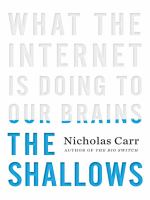
The Internet has become a large part of daily living for many people. Some have begun to question how the Internet might be changing the thought processes of human beings. Technology, culture, and economics writer Nicholas Carr (author of The Big Switch: rewiring the world, from Edison to Google (2008)) tackles the effect of the Internet on human thought processes in The Shallows: What the Internet is doing to Our Brains (2010), an expansion of his July/August 2008 article in The Atlantic, “Is Google Making Us Stupid? What the Internet is doing to our brains”. In that article, Nicholas Carr wrote of the feeling of his brain being affected by something reprogramming his memory and remapping his neural circuitry and noticed that he had a shorter concentration span.
One can acknowledge the influence of communications and information technology in changing society. However, there is less certainty about and agreement on whether this technology could change human brains and beings. Carr used neuroscience and its “plasticity” of the human brain to postulate that habitual activities can alter neurons and influence the brain. Not everyone buys this argument. Harvard psychology professor Steven Pinker argued that the Internet and communications and information technology are essential to keeping humankind smart. University of London Education Professor Andrew Burn opined that relating Internet usage to being distracted or shallow-thinking is fallacious and does not consider detail-oriented activities such as online role playing games. Author Donald Morrison, writing in the Smithsonian, relayed his experience in following up on research that a friend told him about and learned some interesting facts about the hummingbird along the way, leading him to conclude that human brains may be able to evolve in different ways but that the Internet might be helping to make humankind smarter. An August 15, 2010 Guardian article by John Naughton discussed Carr’s book but also collected a variety of opinions on the issue of the internet influencing human thinking.
Author and journalist John Harris reviewed Carr’s book in the Guardian on August 20, 2010 and cited the 2008 research of UCLA psychiatrists led by Dr. Gary Small, the co-author of iBrain: surviving the technological alteration of the modern mind (2008). Small and his colleagues published “Your brain on Google: patterns of cerebral activation during internet searching” that described the results of 24 test subjects aged from 55 to 76 years, 12 of whom had minimal Internet searching experience while the other 12 individuals had more substantial Internet searching experience. The preliminary findings suggested a greater usage of neural circuitry not previously activated while reading pages of text but only in those individuals with previous computer and internet searching experience. Small expressed concern that too much online time can affect human contact skills and human creativity can be hampered by a plethora of text messaging because people are not developing ideas on their own but constantly with others.
The Shallows: What the Internet is doing to Our Brains is available for loan through Toronto Public Library in book format, as an audiobook CD, and in talking book format (restricted to print disabled patrons). (My colleague Ian first brought attention to this book on this blog with his Focused Reading with Instapaper blog post.)
Comments