Norton Cybercrime Report 2012: Where Does Canada Fit In?
Symantec, the makers of Norton security products,
released its third annual 2012
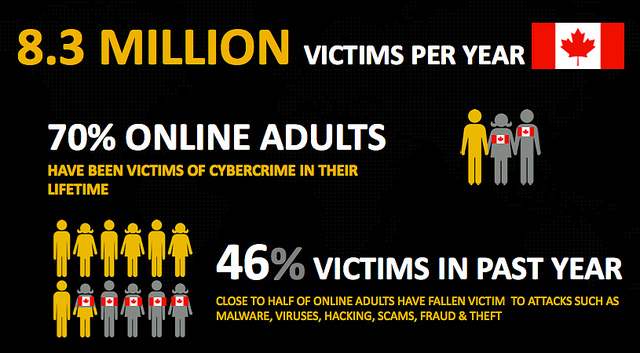
Norton Cybercrime Report that showed that cybercrime
is increasing in Canada to a cost of $1.4 billion with more than 46% of
Canadians having fallen victim to cybercrime in the past year at a per capita
cost of $169. The report was based on interviews with 13,018 online adults aged
18-64 based in 24 countries, including Canada.
Globally, the scale of consumer cybercrime is
large at the rate of 556 million victims annually with a cost of US$110 billion,
over 1.5 million victims daily, or 18 victims per second. Here is a fact sheet
that summarizes the situation both in Canada and on a worldwide basis:
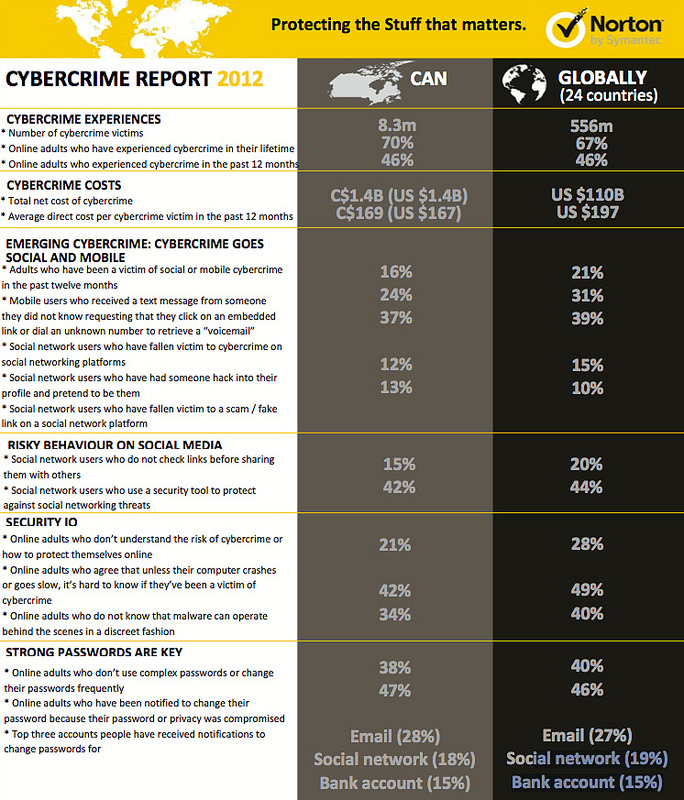
Canadians fared better on cybersecurity knowledge
than the worldwide average on the following factors: understanding cybercrime’s
risk and the need to protect oneself (21% to 28%), on not knowing that malware
can operate behind the scenes on one’s computer (34% to 40%), and on
the difficulty of knowing that a computer has been affected by malware unless
it crashes or operates slowly (42% to 49%). Canadians were only marginally
better than the worldwide average (38% to 40%) on not using complex passwords
and changing their passwords on a regular basis. 15%
of Canadian social network users admitted to not checking links before sharing
them with others, compared to 20% on a worldwide basis.
Norton’s report also showed a pattern shift in
cybercrime targeted towards mobile devices and use of social media. The report
noted that 2 in 3 adults used mobile devices to access the internet and that
mobile vulnerabilities doubled in 2011 from 2010. 31% of mobile users surveyed
admitted that they received a text message from someone not known to them
requesting them to click on an embedded link or dial an unknown number to
obtain a voicemail. Additionally, 35% of adults surveyed said that they had
lost their mobile device or had it stolen. In a further telling blow,
two-thirds of mobile device users do not avail themselves of security options
for their mobile device, while 44% were not even aware that security options
for mobile devices existed.
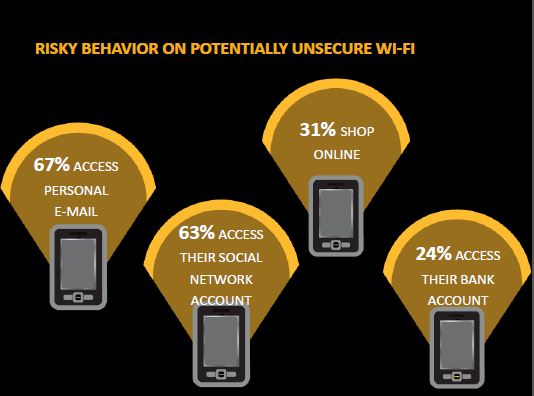
The
report also expressed concern over “risky behavior on potentially unsecure
wi-fi” networks. On a worldwide basis, two-thirds of adults online used free
public or unsecured wi-fi networks for internet access. 44% of online adults
accessed personal email accounts through free or unsecured wi-fi connections. The
report included other indicators of risky behavior, including the following:
The upside of this situation was that more than half
(53%) of online adults expressed concern over the security of their internet
connection.
Next time, we will take a look at what
Symantec’s rival McAfee had to say in its “Threats Report” for the second
quarter of 2012…
(See
also: McAfee
Threats Report for Second Quarter 2012)
Comments