Search Engines and Research: Where Do Students and Teachers Draw the Line?
On November 1, 2012, the Pew Research Center issued a report entitled How Teens Do Research in the Digital World in conjunction with the National Writing Project and the College Board in the United States. While the report focuses on middle and secondary school education and research in the United States, the report’s findings will be of interest to some readers elsewhere. The summary of findings noted that 75% of Advanced Placement and National Writing Project teachers participating in the study believed that the Internet and digital search tools had a mainly positive impact on the research habits of their students. However, 87% of those teachers also noted that these technologies are leading to a generation that is easily distracted with short attention spans. Furthermore, 64% believed that digital technologies are doing more to distract students than to assist them academically. The reports’ authors acknowledge that the dichotomy in beliefs may have resulted due to the methods of data collection, namely: an online survey of more than 2,000 middle and secondary school teachers; and, a series of offline and online focus groups with middle and secondary school teachers and some of their students.
Teachers in the focus groups were especially concerned that students were becoming too dependent on the Internet at the expense of other worthwhile information sources; in some instances, the Internet might be the only information source used along with the assumption that information can always be found online in an easy and fast manner. (See Report, pp.27-28) Many teachers acknowledged that online search engines can be a good beginning point for student research. However, students need to effectively consult other resources such as books, journals/magazines, and library databases. Some teachers were worried that students were losing the ability and desire to use sources other than search engines, even if those sources are a better match for researching a given question or subject. When the Internet is not available, some of the focus group teachers noted that some students are not sure what to do next; conversely, when the Internet is available, a research scan might be limited to the first page of a search engine’s results pages (SERPs).
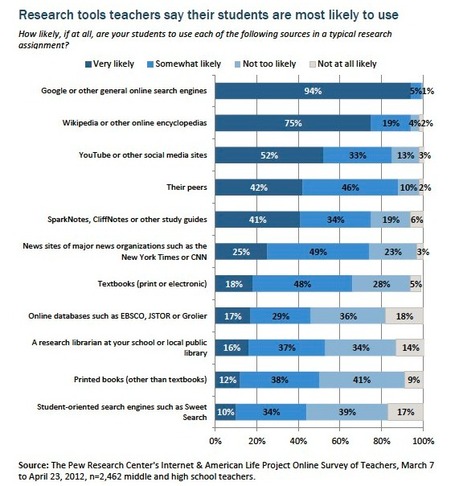
Teachers also expressed their views on various research tools that they were very likely, somewhat likely, not too likely, or not at all likely to use. Here is a list of research tools in descending order ranked on the basis of very likely usage:
(See Report, p.34)
It is interesting to see that Google and other general online search engines ranked first with 94% very likely and 5% somewhat likely to use with Wikipedia and other online encyclopedias (75% very likely, 19% somewhat likely) and YouTube or other social media sites (52% very likely, 33% somewhat likely) in second and third place respectively. Textbooks (print or electronic) ranked seventh (18% very likely, 48% somewhat likely) although their usage would vary greatly by subject (more so for the sciences and less so for English). Somewhat, disappointingly for information professionals, online databases (e.g. Ebsco, Grolier and JSTOR) ranked eighth (17% very likely, 29% somewhat likely) while librarians at a school or local public library placed ninth (16% very likely, 37% somewhat likely). Rounding out the field were printed books (not including textbooks) (12% very likely, 38% somewhat likely) and student-oriented search engines such as Sweet Search (10% very likely, 34% somewhat likely).
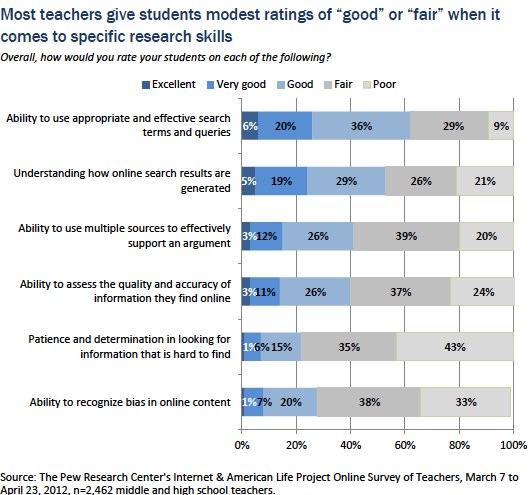
Consider also the teachers’ ratings of students’ research skills:
(See Report, p.44)
Students faired positively on the following skills, namely: the ability to use appropriate and effective search terms and queries (6% excellent, 20% very good, 36% good); and, understanding how online search results are generated (5% excellent, 19% very good, 29% good). Students ranked negatively in the following skills: the ability to use multiple sources to effectively support an argument (39% fair, 20% poor); ability to assess the quality and accuracy of information they find online (37% fair, 24% poor); patience and determination in looking for information that is hard to find (35% fair, 43% poor); and, ability to recognize bias in online content (38% fair, 33% poor).
Further to the context of research skills, it is interesting to point out that in the research survey, more of the teachers of the lowest income students evaluated their students as “poor” than did their counterparts who taught higher income students. One exception was that teachers ranked students equally (regardless of socioeconomic background) on “patience and determination in looking for information that is hard to find”.
Here are some hyperlinks to various media reports on the Pew Research Center’s report:
http://searchenginewatch.com/article/2222455/Googling-Research-for-94-of-Teen-Students-Study
http://www.sfgate.com/technology/article/Teachers-call-online-search-mixed-bag-3998816.php
http://finchannel.com/Main_News/Tech/118607_How_Teens_Do_Research_in_the_Digital_World_/
http://www.decodedscience.com/digital-information-overload-overwhelms-and-distracts-students/19798
Toronto Public Library staff members are available during branch open hours to assist customers of all ages in accessing information through a variety of sources, including research-oriented electronic databases. Customers interested in learning more about electronic resources should contact their local library branch. For further information, please consider reviewing the following Computer and Library Learning blog posts that discuss a variety of databases:
What is a database? 2011-01-27 | Beatriz | Computer and Library Learning
Online Magazines & Journals – Keyword Search 2011-03-29 | Beatriz | Computer and Library Learning
Database: Canadian Points of View Reference Centre 2011-11-18 | John P. | Computer and Library Learning
Database: Credo Reference 2012-01-17 | John P. | Computer and Library Learning
Online Tutorials for Gale Databases 2012-02-13 | Michael | Computer and Library Learning
JSTOR 2012-02-15 | John P. | Computer and Library Learning
I've taken all the classes. Now what? 2012-04-30 | Kelli | Computer and Library Learning
Here are a couple of databases that may be useful to secondary school students needing to do research who have valid Toronto Public Library cards:
Opposing Viewpoints in Context
Social issues, opinions from many sides of current debates.
Available anywhere | Sign in with library card
Help with diseases, drugs and alcohol, nutrition and fitness, mental and emotional health and more.
Available anywhere | Sign in with library card
Next time, let us explore a search engine that teachers do not mind students using for research purposes…
Comments