Global Internet Connectivity Report: Where Does Canada Place?
The International
Telecommunication Union (ITU), an agency of the
United Nations, issued its Measuring
the Information Society 2013 report that tracked
the 2012 results by country of the benchmarking tools used to measure the
“information society”, namely the ICT (= information and communication
technologies) Development Index (IDI) and the ICT Price Basket (IPB). The IDI
was subdivided into indices tracking access, use, and skills and is useful in
tracking the “digital divide” between developed and developing countries (See Report,
pages 39-40). The Executive
Summary (ES) of the report offered some interesting
highlights:
– By the end of
2012, about one-half of the world’s population lived within access to a 3G
network. (ES, Page 1);
– Developed
countries are seeing slower growth in fixed or wired broadband. (ES, Page 2);
– The recent
financial crisis had less effect on telecommunication revenues in developing
countries. Consequently, the peak telecommunication investment levels reached
in 2008 have not yet been restored. (ES, Pages 2-3);
– Up to 1.1
billion global households are not yet connected to the Internet. (ES, Page 3);
– 80% of global
households had a television, compared to 41% of households with a computer, and
37% of households with Internet access. The gap between households in
developing countries having a TV as opposed to a computer and Internet access
is almost 3 to 1, compared to 1.3 times in developed countries. (ES, Pages 4-5);
– The 2015 target
of the Broadband Commission for Digital Development to have 60% of the world
online as well as 50% in developing countries, and 15% in the least developed
countries (LDCs) is not likely to be achieved. The ITU estimated that by the
end of 2013, almost 40% of the global population, including 31% of the
population in developing countries and less than 10% of the population in the
least developed countries, will be online. (ES, Page 5);
- The top ten
ranking countries on the IDI Index for 2012 were Republic of Korea, Sweden,
Iceland (up 1 spot from 2011), Denmark (down 1 spot from 2011), Finland,
Norway, Netherlands, United Kingdom (up 3 spots from 2011), Luxembourg, and
Hong Kong-China. The next ten ranked countries on the 2012 IDI Index were
Australia (up 4 spots from 2011), Japan (down 4 spots from 2011), Switzerland
(down 1 spot from 2011), Macao-China (down 1 spot from 2011), Singapore (down 1
spot from 2011), New Zealand (up 2 spots from 2011), United States (down one
spot from 2011), France (up 1 spot from 2011), Germany (down 2 spots from
2011), and Canada (unchanged in 20th position). (ES, page 7);
– Approximately
2.4 billion people or one-third of the world’s population live in the least
connected countries where ICT levels are low. (ES, Pages 9-10).

(Source: International Telecommunication Union
(ITU): http://www.itu.int/en/ITU-D/Statistics/Pages/publications/mis2013/infographic-1-idi.aspx
)
So now we know that Canada has maintained its
respectable 20th place on the IDI Index in 2012. In the context of
the Americas, the Report
(Page 72) noted that Canada and the United States had the highest rates of
fixed (wired) broadband penetration in the Americas region (North, Central, and
South) at 33% and 28% respectively as well as the highest proportion of
regional use of the Internet at 87% of Canadians and 81% of Americans
respectively. In terms of fixed (wired) broadband prices, Canada finished in 23rd
position at 1.1% GNI per capita. (Report, Page 82). In the case of
mobile-broadband prepaid handset-based prices (500 MB), Canada was less
affordable at 1.3% GNI per capita in 31st place (Report, page 100); for
mobile-broadband postpaid handset-based prices (500 MB), Canada finished in 28th
spot at 1% GNI per capita (Report, page 101). In terms of mobile-broadband
prepaid computer-based prices (1 GB), Canada was even more expensive in 55th
position at 2.7% GNI per capita (Report, page 102); in the case of
mobile-broadband postpaid computer-based prices (1 GB), Canada finished in 42nd
position at 1.4% GNI per capita (Report, page 103).

(Source: International Telecommunication Union
(ITU): http://www.itu.int/en/ITU-D/Statistics/Pages/publications/mis2013/infographic-2-price.aspx
)
The results
on “digital natives” also proved to be interesting. The Report
(page 139) defined a “digital native” “as a youth, aged 15-24 inclusive, with
five or more years experience using the Internet.” Canada finished in 17th spot in
the digital natives ranking with digital natives comprising 11.9% of the total
population and 90.1% of the total youth population. (See Report,
Table 4.1, page 143). The top
ten digital native countries by percentage of total
population were Iceland (13.9%), New Zealand (13.6%), Republic of Korea
(13.5%), Malaysia (13.4%), Lithuania (13.2%), United States (13.1%), Barbados
(13.1%), Slovakia (12.7%), Latvia (12.3%), and Denmark (12.3%).
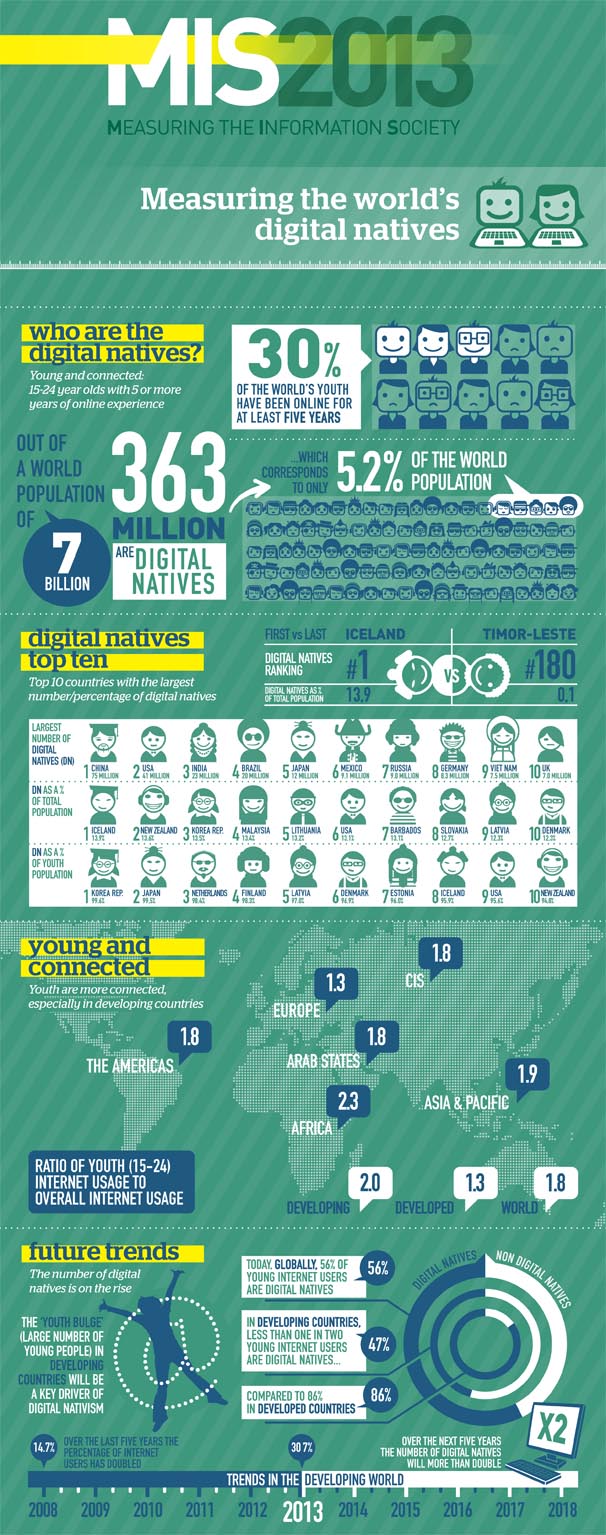
(Source: International Telecommunication Union
(ITU): http://www.itu.int/en/ITU-D/Statistics/Pages/publications/mis2013/infographic-3-dn.aspx )
Finally, on the pay TV (primarily digital) front, Canada finished in 10th
position with 84% of its households with some form of pay television, behind
the Netherlands (100%), Norway (97%), Belgium and Hong Kong-China (both 94%),
Denmark (92%), Malta (86%), and Sweden and the United States (both 85%). (See Report,
page 187).

(Source: International Telecommunication Union
(ITU): http://www.itu.int/en/ITU-D/Statistics/Pages/publications/mis2013/infographic-4-broadcast.aspx
)
Comments