Week One
Welcome to Three Things, a blog about developing a nose
for narrative. This week's offerings: “Smokes on a Plane,” “The Flock” and “A
Dog and his Girl.”
Smokes on a Plane
This week a headline on the CBC news site caught my eye:
"Flight to Caribbean Diverted Due to Smoking Family." Even before I
read the article I was curious. A whole family? Were there children involved, and
if so, how young was the youngest smoker? What happened exactly – was there a
fire? A fight?
As I read on, the following phrase caught my
fiction-writer's eye:
"They were smoking in the plane's washroom . .
."
Really? Two paren'ts in their fifties and a son in his
twenties (let’s call them the Wilsons) – all three of them packed in there
together? Now here was a scene that begged to be written. What did they talk
about? Did Papa Wilson sit on the toilet with his wife on his knee? Maybe Mama sat on her son's knee (or vice versa) and Papa stood awkwardly with his
back to the door . . .
And then there was this:
". . . there was a lot of screaming and swearing. .
. . [but] they were co-operative when they were removed from the plane by
police."
Okay, so what happened between the fight and the
decision to "go quietly"? Sure, maybe the Wilsons just came to their
senses and calmed down, but wouldn't it be more interesting if something
"broke" during all that the screaming and swearing – something that
had been building all day (or indeed, for their entire lives)? And what about
those lives? Where had this family come from – a reunion, a visit to a
grave? Or were they on their way
to pick up the body of the elder Wilson son who had died on vacation? Or to
attend his wedding on a Bermuda beach? Come to that, maybe this elder son gave his little brother his first drag on a cigarette; maybe a flashback to that experience would make for an
illuminating scene.
I could go on, but you get the idea. The family in my
mind was becoming fictional, the characters beginning to take on a life of
their own. How? Through a process of posing questions (ideally the kind that no
news article will answer) – through gravitating toward those "holes" in
the story that invite an imaginative response.
Of course, in order to pose those questions, I had to be
open to the material in the first place. Smoking is harmful to the health – we
all know that – but a fiction writer must think beyond the “what” of human
behaviour to the “why.” Consider the metaphorical implications of cigarette
smoke: the intangible presence, the smokescreen, the poisonous atmosphere.
(Check out Colm Toibin's short story, "A Journey" from the
collection, Mothers and Sons for a masterful evocation of an emotionally
stifling car ride with a chain-smoker.) Give some thought to the
"time-out" effect of a smoke break, the future-focused state
engendered by any addiction, and, perhaps most importantly, the bonding ritual
of lighting up together, especially in a world wherein fewer and fewer people
smoke. It doesn't matter whether you're a smoker, an ex-smoker, or an avid
non-smoker – the practice of writing fiction requires that we see beyond our
own experience.
We're like actors in this way; imagine a doyenne of the stage who claimed she
couldn't do a death scene because she'd never died . . .
The Flock
Not far from where I live, a steeply-sloped roof catches
the sun between a condo building and the bell tower of a church. Pigeons roost
here by the dozen. Often, and for no apparen't reason, they rise together and
circle over the street – once, twice, even a dozen times before settling on
the roof again. Standing below on the sidewalk the other day, I began to
imagine a character who lived in one of those condos – a young (or old, or
middle-aged) man who lies on his couch and watches those pigeons leave and
return for hours at a time. I asked myself, how might the mesmeric effect of their flight shape his thoughts
(and therefore, the structure of a story about him)? Why does he lie there,
unwilling or unable to rise? How long has he been doing so, and with what
consequences? Does anyone come to visit him? Does anything change?
This would be a challenging story to write; "man
sits in a room and thinks" narratives often suffer from a lack of forward
momentum. That said, something about the way those birds repeatedly lift and
land puts me in mind of the rhythms of human memory, human thought. It's a
subtler "lead" than the smoking Wilsons, but a lead all the same.
A Dog and His Girl
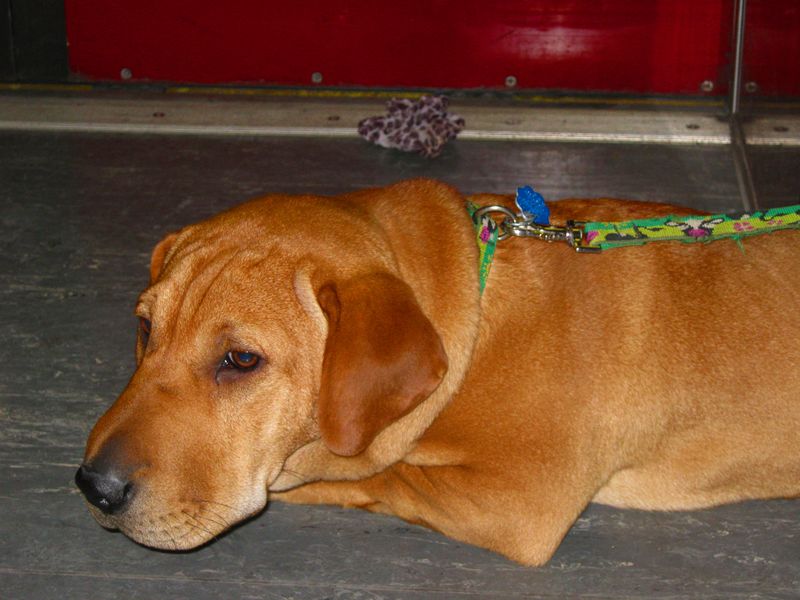
While waiting on the subway platform recently, I happened
to notice a girl standing down the far end with her dog. The dog wasn’t on a
leash, and while he appeared to be well-trained, I found myself wondering how
he would react if he caught sight of a rat running along the tracks. This is
the kind of “what if” thinking that serves a fiction writer well. What if the
girl (say her name was Annie) failed to notice the predatory thrill that
suddenly animated her beloved pet? What if he (Peaches, maybe, or Rex) leapt onto the tracks and took off down the tunnel in keen pursuit of his
quarry? Would Annie follow, or would she stay put and call? The latter might be
the smarter choice, but the former would certainly make for a more gripping
tale. Of course, in order for an attempted rescue to be credible, Peaches/Rex would
have to mean a lot to Annie. In which case, how did he come to be in her life? Did she save him from somebody
brutal? Had she shared him with someone she’d loved and lost? And what happens
in that tunnel, anyway? Do one or both of them meet their maker? Or does
Peaches/Rex lead Annie to a handsome young maintenance worker who's clearing garbage off the tracks . . . ?
Again, you get the idea. My fellow fiction writers, the world around us is rife with
material. Observe and be curious. Let your imagination run.
Comments