Week Three
Welcome to the third round of Three Things. This week's
offerings: "Guilty?" "Three Times Three" and
"Thirst."
Guilty?
This week the trial of Richard Kachkar has been in the
news. It's a tragic story: A desperate man goes on a rampage in a stolen snowplough,
killing the police officer who tries to stop him.
If I were to mine the case
for fictional material, I would tend to shy away from the biographical details
out of respect for the families involved. In any case it’s not those details
that speak to me, it’s a single quote from a piece on the CBC
news site:
“As Kachkar was arrested, he made reference to his sister,
[arresting officer Sgt.] Payne said. ‘It's my sister's fault, my sister made me
do this.’”
I began to think about the act of accusation, the power
of holding someone responsible whether or not s/he is in any way to blame. Say
a man loses control of his life and ends up taking the life of another, then
insists the fault lies with his sister (or brother, or father, or mother . . .).
Consider the effect of writing such a story from the point of view of the
killer alone. Or the guilty(?) family member. Or both. What if both characters
had accusations and/or confessions to make?
Three Times Three
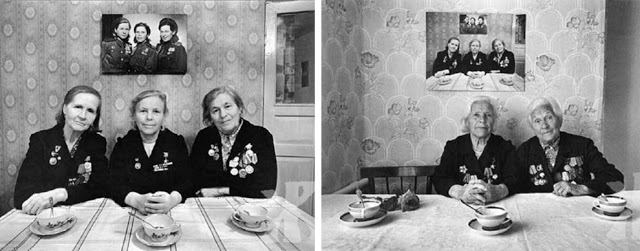
This week's other offerings both originated with a
collection of images called "40 of the Most Powerful Pictures Ever
Taken" (posted on the website imgur.com). Every one of these photographs
contains a story (many contain a novel!); it was a challenge selecting only
two.
The first picture in the collection features three group portraits
of the same three sisters, taken over a period of many years. The structure of
the image immediately suggested a narrative structure: a story in three
sections, each of which presents three first-person accounts of a particular
point in time. Each sister gets three chances to tell it like it is; the first
sister, missing from the last photo in the series, could even get the last
word, delivered from the grave.
Add to this narrative stream the host of allusions these
images call to mind: Chekhov’s Three Sisters; King Lear’s unhappy daughters;
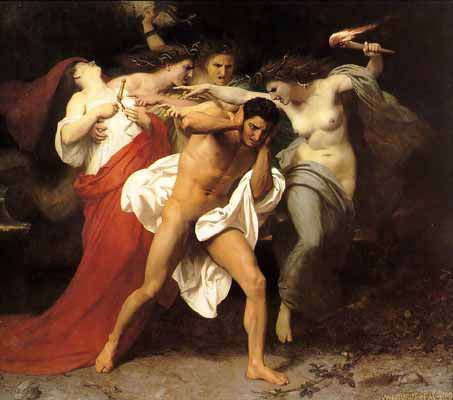
the trio of prophetic witches in Macbeth; the avenging Erinyes of Greek
Mythology (a.k.a. the Furies) . . .
Any one of these literary or classical references has the
potential to add dimension to a story, but the Erinyes fire my imagination
most. Following up on the theme of guilt/blame, what if a man close to our trio
was directly (or even indirectly)
responsible for the death of the first sister? What if this man – a divisive
father? a lover to all three? – finally goes too far, prompting the remaining
two sisters to join forces after a lifetime of competition and avenge their sister’s death?
(A word of warning regarding allusions, be they
classical, literary, biblical, musical or otherwise: the best of them support
rather than overwhelm the central narrative; used wisely, they serve to enrich
a work for those who “get the reference” and those who don’t.)
Thirst
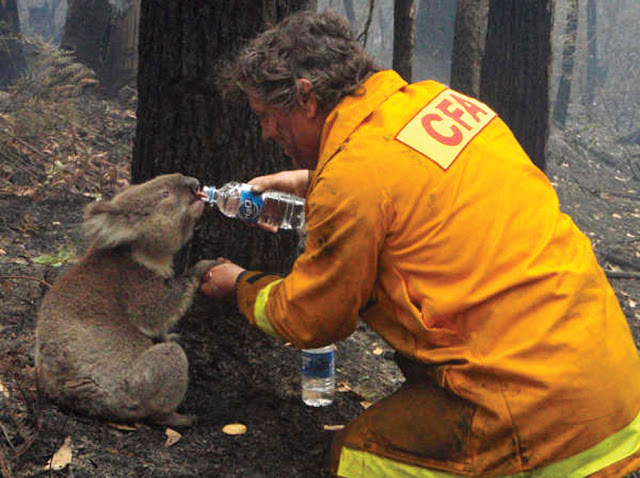
The caption for picture number 22 reads as follows: “A
firefighter gives water to a koala during the devastating Black Saturday
bushfires that burned across Victoria, Australia, in 2009.”
It’s a deeply affecting image; there’s something so
hopeful about the tenderness with which the firefighter provides succour to a
single surviving creature in the midst of a scene of devastation – not to
mention the trusting surrender with which that “wild” creature responds. Still,
it wasn’t quite enough to breathe life into a fictional character.
The missing element of the narrative arrived later in the week, when my husband and
I attended the funeral of a friend’s brother. We’d never met the deceased – we
were there to support our friend – but we came to know him through a series of
moving stories told by his siblings and his friends. A troubled man who never
had a family of his own, he nonetheless contributed greatly to the lives of
others through his roles of older brother, uncle, and generous, charismatic
friend.
And so my fictional firefighter became an older brother and beloved uncle – the one who never married, perhaps because the girl he
loved married his younger brother. It came to me that the scene depicted in the
photo could take place late in the day, when many lives and homes in the region had already
been lost. What kind of a story would it be if the firefighter’s brother,
sister-in-law and their two children were among those lost? What if only the
brother died? Does our hero suffer a complete and
devastating loss, or face fraternal heartbreak laced with guilty hope?
Comments