Week Nine
Welcome back, fellow fans of the written word. This week's
triple threat: "Monkey Mind," "Disruptive
Presence," and
"Fatima."
Monkey Mind
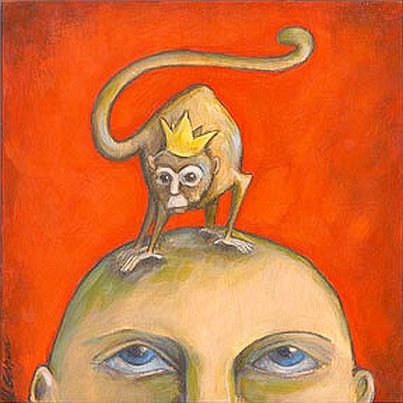
This week the headline from one news story
"cross-pollinated" with the image from another to get me thinking
creatively about our fur-clad cousins. The resulting equation:
One angry response to the idiocy of subjecting any pet to
a punishing tour schedule
+
one eerily "human" gaze
=
one narrative lead about a selfish human and his
long-suffering simian companion!
At some point the Buddhist notion of the "monkey
mind" entered the mix. For those who don't know, the phrase has nothing
to do with how monkeys think. Picture instead the whirl of busy, often anxious, thoughts that
crowd the human mind like a troop of chattering macaques in the absence of any
meditative practice.
My story, however, would concern itself with both. I'd
give the monkey's "owner" a voice, certainly – it's always stimulating to
inhabit a mind unlike your own – but I'd also give the creature itself a say. Human
"monkey mind" meets (as near as we might imagine) the real thing . . .
A side note: Remember the recent internet sensation
caused by the "IKEA Monkey"? For an insightful response to the
phenomenon, look no further than Canadian author, Andrew Westoll's essay, "Does Darwin the IKEA Monkey Need a Human Mother?"
Disruptive Presence
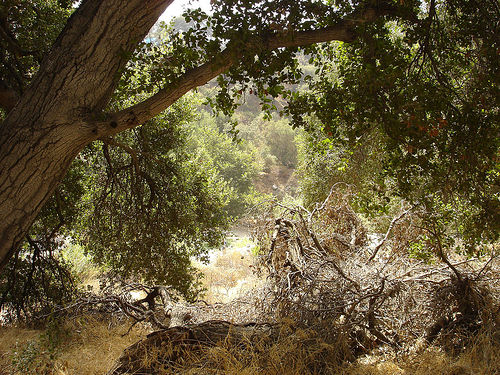
This week I was struck by the evocative beauty of a (rather long) sentence in the short story, "The Valley of Lagoons" by David
Malouf (from the collection, Every Move You Make):
"And as I moved deeper into the solitude of the
land, its expansive stillness – which was not stillness in fact but an
interweaving of close but distant voices so dense that they became one, and
then mere background, then scarcely there at all – I began to forget my own
disruptive presence, receding as naturally into what hummed and shimmered all
around me as into a dimension of my own being that it had taken my coming out
here, alone, in the slumbrous hour after midday, to uncover."
Angus, the teenage protagonist/narrator of the story, is
confident he has enough "bush sense" not to get lost – until he does.
He finds his way soon enough, however; an ominous single gunshot leads him back to the
hunting companion he'd prefer to leave behind. In any case, it wasn't the notion
of losing one's way that captured my imagination; it was the idea of losing
one's self – of shedding the sense of one's own "disruptive presence"
in nature.
I began to think about the human preoccupation with the (permeable?) lines between our own lives and those of our fellow
creatures. Creation stories from around the world chart the transformation of
humans into animals and vice versa. So how about a creation/destruction story
that follows a lost hiker through the last days of her life?
Consider the effects of fasting (deliberate or otherwise)
on the human mind; liberated from its mundane task of transmuting food into fuel,
the human organism is free to inhabit the world of the imagination – of story, in fact. And what about the
psychological and spiritual effects of removing oneself from the constructed
context of "daily life."
What elements of "self" does our hiker lose track of along the way?
What does she inevitably become?
Fatima

I'd heard the lovely song, "Fatima," by K'naan on
the radio before, but this week marked the first time I paid attention to the
lyrics:
. . . I fell
in love with my neighbour's daughter
I wanted to protect and support her
Never mind I'm just twelve and a quarter
I had dreams beyond our border.
The narrative had me. I stopped chopping onions and stood
listening, spellbound:
. . .
Fatima, Fatima, I'm in America
I make rhymes and I make them delicate
You would have liked the parks in Connecticut
You would have said I'm working too hard again.
Damn you shooter, damn you the building
Whose walls hid the blood she was spilling
Damn you country, so good at killing
Damn you feeling, for persevering.
Fatima, what did the gunman say
Before he took you away
On that fateful day?
Fatima, did he know your name
Or the plans we made
To go to New York City?
Later, I looked up a live performance on YouTube and
found out about the true story behind the song. As a human being I responded
strongly to all of it – the story, the song, the performance. As a writer, I
was struck by three elements in particular:
1) "Fatima, Fatima, I'm in America/ . . . You would
have liked the parks in Connecticut"
2) "Damn you feeling, for persevering"
3) K'naan's body language in the video, particularly the emotion
evident in his hands.
I began to imagine a story about a young man making his
way in the "New World," accompanied by absence/presence of his lost
first love. A story in two voices, perhaps – the survivor and the ghost? Or the
survivor and the new girl who steps unwittingly into the dead one's shoes?
I wouldn't make our hero a musician, but I would bless
him with ability; the greater one's gifts, the greater one's potential guilt,
no? Can he find a way to love the
"parks in Connecticut," even though his "Fatima" will never
never see them? What about the girl he meets by the duck pond – can he let
himself love her too?
Comments