Week Five
Hello again, and welcome to Three Things. This week's
offerings: "Poison," "Your Affectionate Son" and
"Practice Rooms."
Poison
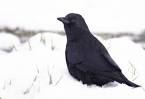
This week an unusual sight caught my eye: alongside the
driveway a dead crow lay face down in a snow bank, tail feathers pointing
skyward, wings tucked in at its sides. It looked as though it had simply tipped
forward on its branch and let go.
The next morning I saw another one, not far from the
first. And then another.
Three dead crows in the snow, each one looking as though
it had taken a sudden nose dive from its roost. When I mentioned these
sightings to my friend and fellow writer, Tanis MacDonald, she shook her head
and said, "Someone must be poisoning them." (She also
recommended a related poem by Winnipeg poet Alison Calder entitled "We
Hate the Animals.")
The image of those three dark bodies – backs smooth as
stones, tails like glossy black fans – remains vivid in my mind. As does the
idea of the poisoner. What would drive a person – a character, perhaps even a
narrator – to such measures? Is she gripped by an irrational phobia, unable to
leave her home for fear of being mobbed by a murder of crows? Or is
he perhaps a stymied writer, increasingly fixated on the
chorus of caws outside his window? (Such a narrative might even include
abortive attempts at writing that devolve into anti-corvid invective . . .) Or
what if our poisoner has nothing against crows? What if she's a devoted bird lover who sets out to rid her
neighbourhood of the feral cats that threaten her feathered friends, only to
have her misguided plan backfire?
The possibilities are endless. Just do the math:
1 stark and disturbing image (metaphor? symbol?)
+ 1
unbalanced character driven to action
= narrative gold!
Your Affectionate Son
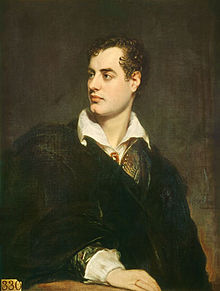
A few days ago while reading up on famed Romantic poet,
Lord Byron (as one does), I came upon an intriguing line regarding the poet and his
mother: "Mrs Byron was an ill-educated and almost pathologically irascible
woman who nonetheless had an abiding love for her son; they fought violently
when together, but corresponded affectionately enough when apart, until her
death . . ."
Potent material for fiction? You bet.
I could go any number of ways with a story inspired by
such a quote. A couple of approaches spring to mind:
1) a heavily-researched,
fictionalized rendering of the real-life relationship, complete with excerpts
from their actual letters (if available) and fictional scenes depicting those violent times they spent
together
2) a wholly imagined relationship between a modern-day mother and son
with the same love-hate, home-and-away dynamic at its core
The second option appeals to me more – perhaps because it
allows for the greatest imaginative latitude – but the first might easily light a
fire under another writer (especially if s/he had a special interest in the
Romantics). Either way, the quote itself suggests a compelling narrative
structure: affectionate letters (or emails, or phone messages, or all three)
interspersed with explosive in-person encounters.
Ask yourself, how might such a story develop? Put another
way, how might the writer of such a work continually up the emotional stakes?
(Remember, with literary fiction it's not just about what happens next, but
how and especially why complications occur.) What form might the crisis or
climax of such a see-sawing narrative take? Might it have something to do with that compelling
phrase at the close of the quote that began it all, "until her death"?
Practice Rooms

On Friday I found myself with half an hour to wait for a
bus. It was an icy cold day, but I was able to take refuge in a nearby campus
building. As luck would have it, the first floor where I found a cozy corner was home to twenty or more practice rooms for music students.
Every room seemed to be in use; I could hear various instruments, including
the plaintive, rising note of a young woman's voice. It was like sitting in the
midst of a orchestra while the members tuned up for the show. It might have driven me mad if I'd had to
sit there all day, but as it turned out, thirty minutes of muffled cacophony
was strangely soothing. More importantly, it was evocative. All those closed
doors leaking seemingly random notes acted as a stimulant for my writer's mind.
Before long I zeroed in on that lone female voice.
"Eee-eee-eee-eee-ee," the unseen woman sang, as though she was keeping her vocal cords
primed for future cries of terror or delight. Then came a a haunting refrain of
"ooo-oo-oo-oo-ooo" – practice for when and if she became a ghost?
The singer sparked my imaginative process, but in terms
of narrative potential she wasn't quite enough on her own. I began to conceive
of a second presence – someone who, like myself, was listening to those eerie vowels rise
and fall. Perhaps a lonely trumpet player on the other side of the wall? (Or a
flutist, or a bassoonist – consider the effect of changing the instrument . .
.)
In any case, what if a conversation of sorts were to
arise between those two adjacent practice rooms – a wordless exchange more
intense, more sympathetic than either participant had ever known?
2 thoughts on “Week Five”
I’ve really enjoyed all of your posts for the Toronto Public Library. Once I used to think ideas for fiction were as hard to find as needles in hay stacks. Now I believe they are as numerous as grains of sand on the beach, if one just pays attention! Thanks for confirming my change in opinion…
Great to hear, Maureen!